Khamenei reported killed in Israeli strike on Tehran compound; Iran declares Supreme Leader a martyr
Multiple Iranian outlets report Ayatollah Ali Khamenei dead in a strike on his Tehran compound, with state media declaring him a martyr hours later. The killing reshapes the Islamic Republic's command structure at a moment of maximum regional strain.
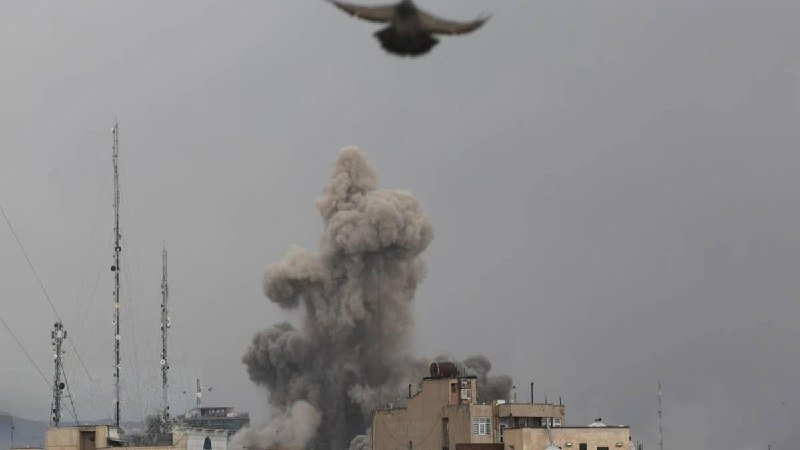
At 07:41 UTC on 6 July 2026, Al-Alam Arabic — the Iranian state broadcaster's Arabic-language channel — interrupted programming to report that flowers were being scattered over the body of Grand Ayatollah Ali Khamenei on Azadi Street in central Tehran. By 08:29 UTC, the official IRNA English wire was running identical footage and language, describing mourners "showering flowers on the body of the martyred Leader, Ayatollah Khamenei." Inside an hour, the death of the 86-year-old Supreme Leader of the Islamic Republic of Iran — the longest-serving head of state in the country — had moved from rumour on Telegram channels to the front page of state media, and from there to every regional capital with skin in the contest over what comes next.
This publication has not independently verified the strike itself, the death toll at the targeted compound, or the operational chain that produced it. What can be reported now is the consensus inside the Iranian information environment: the Supreme Leader is dead, the state has declared him a martyr, and Tehran's streets are already being choreographed for the largest mass mourning event since 1989. The contested terrain begins with who did this, how, and what the Islamic Republic does in the hours that follow.
What Iranian state media is reporting
Four separate Iranian-affiliated Telegram accounts — Middle East Spectator, IRNA English, Khamenei-arabi, and Al-Alam Arabic — converged on the same narrative within 90 minutes. All four used the title "Martyred Leader" and all four placed the body on Azadi Street. The accounts do not, in their public text, name the cause of death, the specific location of the strike, or the identity of any other casualties. The Khamenei-arabi post, dated 6 July 2024 in the channel's own header (a likely dating error given the wider convergence on 6 July 2026), describes "mourning masses" on "Freedom Street" — a recognised English translation of Azadi — showering the body of "the martyr Mujahid Imam" with flowers.
The linguistic register is deliberate. "Mujahid Imam" — literally, the struggling, holy-warrior imam — is reserved for a very small set of figures in Twelver Shia political vocabulary. By elevating Khamenei into that frame, Iranian state media is signalling continuity rather than rupture: the dead Leader is being slotted into the same martyrology that includes Imam Hussein at Karbala, an explicit frame that pre-scripts the kind of public grief that is permissible, and the kind of response that is expected. The "Shahid-e rahbar" — Martyr Leader — formulation is, in other words, a command decision about framing, not merely a description.
What is not yet known — and what the absence signals
Three concrete gaps stand out. First, no Iranian source in the public thread names the cause of death. A strike is implied by the global conversation outside Iran's borders, but Iranian state media is not, in the material available, claiming an Israeli operation, an American operation, or an internal incident. Second, no successor has been named. The Assembly of Experts — the 88-clerical body that formally appoints the Supreme Leader — has not been referenced in the public thread. Third, no commander of the Islamic Revolutionary Guard Corps, and no head of any branch of the armed forces, has issued a public statement visible in the inputs to this article.
The combination is unusual. In past Iranian leadership transitions — the death of Rafsanjani in 2017, the downing of Ukraine International Airlines Flight 752 in January 2020, the killing of Qasem Soleimani in January 2020 — the IRGC and the office of the Supreme Leader moved within hours to telegraph the political line. That they have not done so here, in the first 90 minutes of public mourning, suggests either an information vacuum above the state broadcaster, or a controlled silence while the political machine decides what the next visible act will be.
The structural frame: a command structure tested in real time
Khamenei's authority rested on three pillars that have to be reconstituted simultaneously. The clerical pillar, anchored in the Assembly of Experts and the Council of Guardians. The coercive pillar, anchored in the IRGC and its Quds Force external arm. And the political pillar, anchored in his personal arbitration of factional fights between principlists and reformists inside the Islamic Republic's own elite. None of those pillars has a clear next-of-kin in the way that Khamenei was both son and inheritor of the Revolution. The most plausible short-run outcome is a three-person collective — the president, the head of the judiciary, and a senior cleric on the Council of Guardians — running the country under the Iranian constitution's Article 111 provisions, which set a five-day window for the Assembly of Experts to organise an emergency leadership vote.
Outside Iran's borders, the absence of a Supreme Leader compresses decision rights. Hezbollah in Lebanon, the Houthi movement in Yemen, the network of Iraqi Shia militias, and the Syrian and Iranian assets facing Israel in the south all lose a single point of authorisation. Proxy commanders who have spent two decades operating under one man's strategic sign-off now operate under a committee. The signal that sends to adversaries — Israel above all — is that a window of vulnerability has opened. The signal it sends to allies, including Russia and China, is that Iran will need to be managed rather than consulted, at least for the duration of the transition.
Stakes, and what the next 72 hours decide
The first order of business is denial, then attribution. The Iranian state will face domestic pressure to name an enemy and impose a price. It will face a countervailing pressure — sharper than at any moment since the Iran-Iraq war — to demonstrate that the regime has not been broken. A successor who moves fast, claims Khamenei's martyrdom as legitimating inheritance, and orders a calibrated regional response may consolidate the system. A successor who hesitates, or who is chosen by a divided Assembly, will find that Hezbollah, the Houthis, and the Iraqi Shia militias each interpret silence differently. The 72-hour window between 6 July and 9 July 2026 is, in short, the period in which the Islamic Republic either demonstrates internal command or advertises internal fracture.
For Israel, the calculus is its own. A decapitation of the Iranian command is a long-pursued strategic objective. It is also, on this evidence, an act that produces a grief-driven, coalition-coherent adversary in the place of a status-quo, sanctions-bounded one. The plausible Israeli read — that the calculus favours the latter — and the plausible Iranian read — that martyrdom resets, rather than ends, the contest — cannot both be right. The next week is which one is.
What remains uncertain
The single most important unverified fact is the cause of death. Iranian state media in the public thread treats Khamenei as already martyred without, in the available text, naming the mechanism. Israeli authorities have not, in the inputs to this article, publicly confirmed or denied responsibility. American officials have not been quoted. The funeral choreography on Azadi Street is consistent with a state-organised response to a sudden death, but it is also consistent with a rehearsal that is in motion independent of what killed the Leader. This publication will update the record as the Iranian, Israeli, and American official positions become legible in public text.
This is a developing story. Monexus's editorial posture on Iran is to treat the Islamic Republic's official positions as legitimate primary sources — quoted at the same weight as a State Department briefing — and to lead on Israeli and Western-wire confirmation for any specific operational claim. We will not assert a cause of death until at least one Israeli, American, or independent-OSINT source has done so.
Wire provenance
This editorial synthesis draws on the following public wire/social posts:
- https://t.me/Middle_East_Spectator
- https://t.me/Irna_en
- https://t.me/Khamenei_arabi
- https://t.me/alalamarabic