A morning of strikes in Khan Younis, and a wire that does not blink
Two Israeli airstrikes hit the Al-Mawasi displacement zone on the morning of 6 July 2026. The sourcing that reaches English-language readers is broken in ways that should concern editors everywhere.
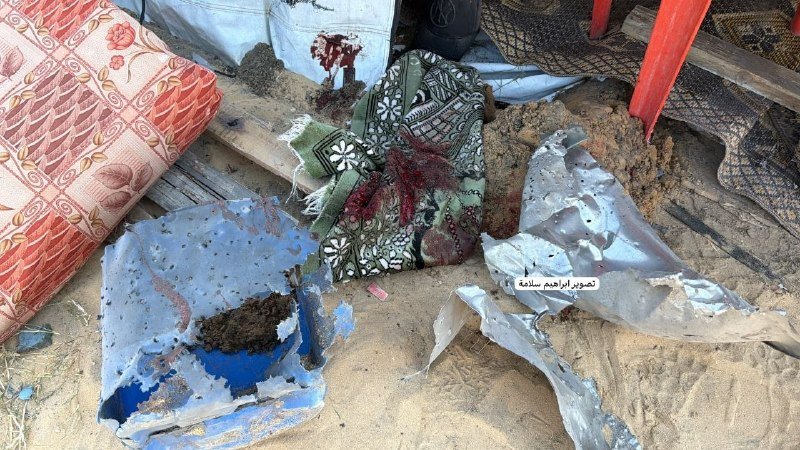
Two Israeli airstrikes hit the Al-Mawasi displacement zone in Khan Younis before 08:00 UTC on 6 July 2026. According to the Gaza-based newsroom alanpa (@gazaalanpa), an Israeli drone struck a tent sheltering displaced civilians on Roni Street in Al-Mawasi at roughly 08:05 UTC; roughly fifty minutes earlier, a separate strike hit a civilian vehicle near the Al-Istabl junction on Al-Rashid Street, with medical sources reporting two killed and several injured. The reporting carries the cadence of a working newsroom under fire: short, datestamped, geographically specific, naming streets, junctions and medical sources by category. It is, at this hour, also largely the only record English-language readers will encounter.
This publication is not arguing that the events of the morning are the most consequential of the war. We are arguing that the way the events reach the rest of the world — and do not — is itself the story, and that editors who would not accept this sourcing in any other conflict are accepting it here.
What alanpa actually reported
The three items posted to the @gazaalanpa Telegram channel on the morning of 6 July are operationally precise in a way that is often missing from the second-hand summary that follows. The 07:11 UTC update names the location — Al-Establ Street, Al-Mawasi — and quantifies the outcome: two dead, several injured, a civilian vehicle. The 07:18 UTC follow-up adds a second location, the Al-Istabl junction on Al-Rashid Street west of Khan Younis, and again cites medical sources. The 08:05 UTC item is the tent strike, a separate event, on Roni Street. Three posts, two distinct strikes, each anchored to a street and a timestamp.
The press freedom and conflict-monitoring community has documented alanpa's work in earlier phases of the war; it is a functioning newsroom, not a single anonymous account. That distinction matters when a piece like this one is being written: it is possible to cite the channel's reporting without inflating it into something it does not claim to be. alanpa reports from the ground; it does not, and cannot, adjudicate the wider campaign.
The wire silence
The more revealing fact about the morning is what did not happen. As of the time of writing, the major Western wires have not carried confirmable, on-the-record items naming the streets, the medical source, or the casualty count for either strike. That is not because the wires are ideologically opposed to reporting civilian harm in Gaza — they have done so, extensively, in earlier phases. It is because the operational infrastructure for independent verification inside the displacement zone has collapsed to a point where most Western newsrooms are no longer staffed on the ground in the manner their stylebooks still assume.
When a wire cannot put a correspondent in the tent, it falls back on three things: official Israeli statements, official Egyptian and Qatari intermediaries, and remote-analysis pieces filed from Jerusalem, Cairo or London. None of those sources is going to name Roni Street, because the Israeli briefing officer has not been asked about Roni Street, and the Egyptian mediator is not in a position to confirm civilian casualties in a tent. The street name exists; the institutional apparatus that would normally carry it to a Reuters or BBC reader does not.
This is how a war becomes a press story. Not by what the camera sees — there are no longer cameras in Al-Mawasi on most mornings — but by what the wire can attribute.
The structural frame, in plain English
What is happening in Gaza's information environment is the same thing that has happened in earlier conflicts where one side controls access and the other side does not. The side with the press office sets the menu of what gets discussed; the side without one fills the menu with what it can. The first side's narrative dominates English-language coverage not because its claims are always more credible, but because they are pre-formatted for institutional wire distribution. The second side's narrative, however accurate at street level, is treated as a secondary input — to be cited, qualified, and weighed against a counter-claim that is itself treated as primary.
This is not a moral judgment on the reporters who do that weighing. They are operating inside a sourcing hierarchy built up over a century of Western war reporting, a hierarchy that puts the official spokesperson above the hospital administrator above the named civilian above the unnamed civilian above the Telegram channel. The hierarchy is invisible most of the time. It becomes visible when a Telegram channel is, for several hours, the only outlet that has named a street where a tent was struck.
What readers should take from this
Three things. First, the casualty count of two killed and several injured is sourced to medical personnel on the ground via alanpa, and should be read as a floor rather than a ceiling until an independent body — a UN agency, the ICRC, or a wire with a correspondent in Khan Younis — confirms. Second, the pattern of strikes inside Al-Mawasi is consistent with the long-running humanitarian complaint that the declared "humanitarian zone" is not functioning as one, a complaint the UN has been making in roughly this language for over a year and that does not depend on any single incident for its force. Third, the absence of a wire item is itself a data point. Editors who would refuse to file a story sourced to a single Telegram channel in, say, the Donbas are publishing the same channel's material here, often without the sourcing caveat. The asymmetry is real, and it should be named.
Desk note: Monexus is publishing the morning's three alanpa items as the record they are — a ground-level newsroom's datestamped, street-named reporting — and is explicitly flagging that the wider wire has not yet corroborated. We are not using the items to make a claim about the wider campaign; we are using them to make a claim about how the campaign is being read.
Wire provenance
This editorial synthesis draws on the following public wire/social posts:
- https://t.me/gazaalanpa/
- https://t.me/gazaalanpa/
- https://t.me/gazaalanpa/