A Kindergarten Principal, a Drone Strike, and the Cost of Reporting From the Wire
Three people died in Nabatieh Fawqa on 6 July 2026 after an Israeli drone struck a car. The killing of a school principal is now a test of whether the wire still reports it.
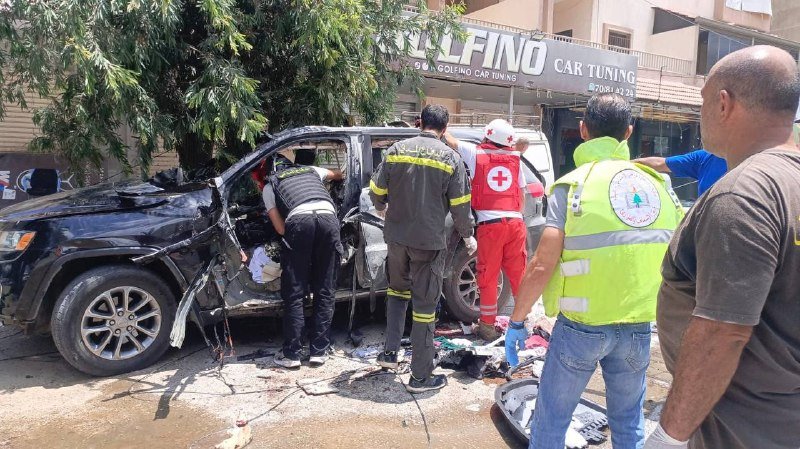
At 11:15 UTC on 6 July 2026, a Telegram channel that monitors the Israel–Lebanon frontier posted a single-line alert: an Israeli drone had targeted a car belonging to a kindergarten school principal in the town of Nabatieh Fawqa, in southern Lebanon's Nabatieh Governorate. By 11:44 UTC the same channel had filed a follow-up, citing L'Orient Today, the English-language Lebanese daily: three people had been killed, including the principal, her mother, and a municipal worker. A fourth alert at 11:45 UTC placed the wider pattern in view — a separate drone hit the town of Kfartebnit, and Israeli demolition activity was continuing in Kounin, inside what the channel described as a security zone along the border.
The wire carried it. The wire carried it the way the wire carries most strikes in southern Lebanon: a principal's name, a schoolhouse's name, a mother's relationship, a municipal worker's job title, and the geometric coordinates of the car they were in. None of that is decoration. It is the minimum the grammar of war reporting requires to convert a flash into a fact. What the wire did not yet carry — at the time of writing — was anything from the Israeli military explaining why a vehicle carrying a school principal, her elderly mother, and a local government employee met the test for lethal targeting under the laws of armed conflict. The IDF spokesperson's daily briefings, which routinely appear on Israeli wire feeds, had not yet published a clarification naming this incident.
The facts as the wire presently has them
Three named deaths, sourced to L'Orient Today via the @wfwitness channel, in a single drone strike on Nabatieh Fawqa. The principal has been identified in the channel's reporting as Asbranza Fakheri Ghandour, who ran the Salman Shamun kindergarten. The framing in the channel's posts is unambiguous on the agent — Israeli drone — and on the location — a vehicle, in a populated district of a southern Lebanese governorate that has been a repeated flashpoint since the war in Gaza began in October 2023. The Lebanese authorities' count of three dead is consistent across both the principal-strike and the Kfartebnit strike posts; the Kfartebnit post does not yet carry a casualty figure, only the targeting report.
For a reader unfamiliar with Nabatieh: it is the largest city in the governorate of the same name, a Shia-majority urban centre perhaps 15 kilometres from the Israeli frontier and a city the IDF has hit repeatedly over the past two and a half years, most often on the stated premise of degrading Hezbollah's local infrastructure. That premise is contested. Lebanese and Hezbollah-aligned outlets frame the strikes as collective punishment against a border civilian population; Israeli framing characterises them as precision operations against military assets embedded in civilian surroundings. Both framings are part of any serious report. The principal-strike post on @wfwitness does not editorially adjudicate between them. It states the drone was Israeli; it does not say what the target list said.
What the wire is not yet telling us
Two things. First, the relationship, if any, between Asbranza Fakheri Ghandour and any armed formation. L'Orient Today is not an outlet that publishes identifications without checking; its reporting over the past decade on strikes in south Lebanon has generally matched later IDF confirmations when those have come. But L'Orient does not, on its own, settle the targeting question. The IDF does. So far it has not, on this incident, in the time window covered by the three Telegram posts.
Second, the question of proportionality and distinction under international humanitarian law. A kindergarten principal killed in her car is, on the face of it, the textbook civilian end of any targeting calculus. Under the law of armed conflict that does not in itself prove illegality — combatants may travel with civilians, military objectives may sit in vehicles that also carry non-combatants — but it raises the burden of explanation sharply. The Israeli military's own spokespeople have set, in other contexts, a high threshold for justifying civilian-adjacent lethal action. This wire post will resolve into a story only when that threshold is either met or visibly declined.
Why this matters beyond Nabatieh
The pattern is not new. Over the past 32 months the southern Lebanon front has produced a steady drip of named-civilian strike reports — teachers, paramedics, agricultural workers, municipal staff. Each one is a separate filing on the wire; collectively they are the basis on which outside observers, including UN agencies and international NGOs, judge the calibration of the Israeli campaign north of the border. Each one is also a test of the regional press infrastructure. L'Orient Today and its counterparts at the Lebanese wire level have stayed operational through the war; their reporters and stringers are still in the south, still filing under conditions the IDF has, at several points since late 2023, formally restricted press access to. Without them, the world would be reading this strike on the basis of an Israeli military statement and a Hezbollah press release. The latter is partisan. The former is unilateral. Both are necessary; neither is sufficient.
The structural frame is plain. Reporting on a war in which one side dominates the airspace, the press credentials, and the post-strike narrative requires a third leg — independent local reporting with the standing to publish names and the independence to absorb the consequences. The wire that just carried this strike is part of that leg. Whether it gets read that way, or whether it gets folded into the louder frames coming from Tel Aviv, Beirut's partisan outlets, and the Gulf-based pan-Arab press, depends on what comes next: the IDF's clarification, or its absence.
Stakes
If the IDF confirms Ghandour was a Hezbollah operative or was travelling alongside one, the strike enters the standard precision-strike ledger and the controversy narrows to the question of whether her and her mother's civilian status was known. If the IDF does not confirm, or cites a generic "terror infrastructure" framing without naming the target, the strike becomes part of a different ledger: named civilians, no published justification, rising weekly count. That ledger is what feeds the casualty tallies at OCHA, at UNICEF's Lebanon office, and at the International Committee of the Red Cross — institutions whose numbers international prosecutors and journalists alike treat as a baseline. The wire's job in the next 24 hours is to keep this strike legible before it is absorbed into either ledger.
What remains genuinely uncertain: whether the IDF will issue any statement at all tying this specific drone strike to a named target; whether L'Orient Today's identification of Ghandour will be challenged by Israeli sources; and whether the parallel Kfartebnit and Kounin reports from the same channel will resolve into separate incidents or a single combined operation across the governorate. The wire so far carries three alerts; it does not yet carry a verdict.
This publication treats L'Orient Today, via the @wfwitness monitoring channel, as a primary source on southern Lebanon strike reporting — a higher floor than Western wires, which have largely thinned their permanent correspondent presence in the south since late 2023.
Wire provenance
This editorial synthesis draws on the following public wire/social posts:
- https://t.me/wfwitness/1
- https://t.me/wfwitness/2
- https://t.me/wfwitness/3