Kyiv missile strike exposes a debate the West keeps postponing
A pre-dawn barrage of Iskander-M and Kh-101 missiles hit an ammunition storage site in Kyiv on 6 July 2026. The pattern is now routine; the political question it raises is not.
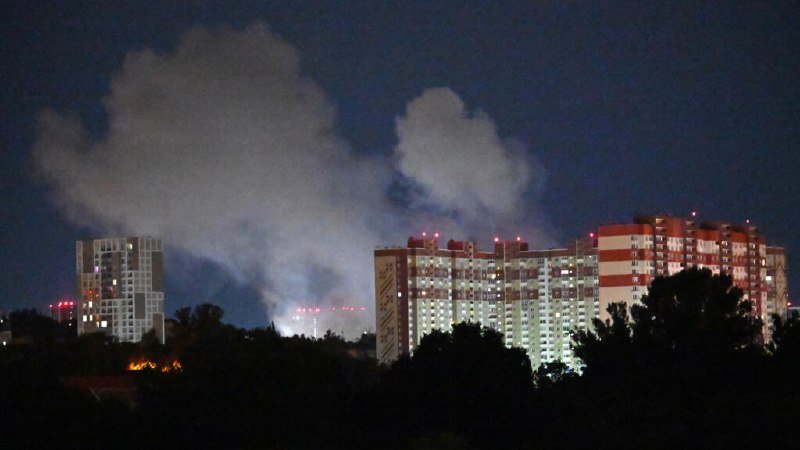
At approximately 01:53 UTC on 6 July 2026, the first of several large secondary detonations began rippling across a suspected ammunition storage site in Kyiv. Open-source mappers tracking the strike, working from geolocated video, identified the incoming ordnance as Russian Iskander-M short-range ballistic missiles and Kh-101 air-launched cruise missiles, and by 03:42 UTC the chain of secondary blasts was still unfolding across the Ukrainian capital. There is no public confirmation yet of the volume of stock destroyed, or of whether interceptor batteries engaged the salvo before impact. What is already certain is the political question the strike forces back onto the agenda: what kind of defensive umbrella Kyiv is being asked to fight under, and for how long.
The war's industrial arithmetic has been settled for some time. Russia's missile and drone production lines are running at a tempo the West's analysts underestimated in 2023 and have been catching up with ever since. Ukraine's intercept rates have fallen, its Western-supplied surface-to-air missile stockpiles have thinned, and the gap between what is fired at Ukrainian cities and what can be shot down is widening. A salvo that detonates an ammunition storage site in central Kyiv in the small hours is no longer an outlier; it is the new median. The wire coverage treats each strike as a discrete event. The pattern demands a structural answer.
The interceptor gap, stated plainly
For the better part of two years, the public debate inside NATO capitals has circled around delivery timelines, training pipelines and budget cycles. Those are real constraints and they matter. But the underlying mismatch is simpler and older than any of them: Russia is producing ballistic and cruise missiles at a rate calibrated to a long war of attrition, while Ukraine's interceptor inventory is replenished on a calendar dictated by donor parliaments. When those two clocks are out of sync, the side with the longer clock wins the air war in slow motion.
The Kyiv strike illustrates the cost of the lag with cinematic clarity. A pre-dawn salvo — Iskander-M ballistic missiles optimised for hardened targets, paired with Kh-101 cruise missiles launched from strategic bombers — reached a suspected ammunition storage site and produced the secondary detonations that lit up the city's skyline for the better part of an hour. The ordnance mix is the giveaway: this was not a terror salvo aimed at residential blocks. It was a strike package aimed at a legitimate military target, even if its effects were felt across a wide area of the capital.
What the counter-narrative gets right — and what it ignores
The Russian framing of the war, propagated through state media and the louder corners of the Telegram ecosystem, treats strikes like this one as calibrated, professional and aimed at military infrastructure rather than civilians. On the strict evidence of this single salvo, that framing is partially defensible: the target appears to have been a storage site, not a residential block. It is also a framing designed to be repeated until it becomes boring. The accumulated weight of four straight years of strikes on Ukrainian cities is harder to sanitise. A defence-of-military-objective narrative, applied to a war that has killed thousands of Ukrainian civilians and reduced Mariupol, Bakhmut and Avdiivka to rubble, does not so much describe reality as curate it.
The honest reading sits between the two poles. Strikes on ammunition depots are lawful. The systematic bombardment of a country's energy, water and rail infrastructure is something else, and has been extensively documented by independent monitors, the UN and Ukrainian civil society. Conflating the two — as Russian-aligned channels routinely do — lets a single legitimate strike launder the broader campaign. The Kyiv salvo of 6 July should be reported for what it was: a military strike that hit a military target and that, in doing so, demonstrated a Russian capacity Kyiv's defenders currently lack a clean answer to.
A structural frame, without the jargon
What we are watching, in plain language, is the slow conversion of an emergency aid relationship into something closer to a long-term defence compact — except that the compact is being negotiated under fire and never quite completed. Western publics have grown accustomed to headlines about a Patriot battery delivered here, an IRIS-T squadron delivered there, a SAMP/T system promised for next quarter. Each delivery is real. None of them, taken together, constitutes the layered, deep, continuously replenished air-defence architecture that a country the size of Ukraine would need to deny Russia its current tempo of strikes.
The political obstacle is not mysterious. Sustained air-defence supply at the necessary scale is incompatible with the diplomatic posture several Western governments still maintain — the posture that frames support for Ukraine as a finite, conditional exercise rather than as the standing defence commitment that the operational picture now demands. Every salvo that lands on a Ukrainian ammunition depot pushes that contradiction closer to the surface.
The stakes, named without euphemism
If the present trajectory continues, Kyiv will continue to take strikes that its defenders could plausibly have intercepted had the inventories been deeper. Ukrainian civilian casualties from mass salvoes will continue. The political energy inside European capitals to sustain or escalate support will continue to be spent, in part, on arguing with itself about red lines, escalation risk and political timing. And the Russian side, which has its own deep economic and demographic pressures, will continue to find in air superiority a substitute for the battlefield momentum its ground forces can no longer reliably generate.
The alternative trajectory is less dramatic on cable news and more consequential in practice: a multi-year, contractually anchored, domestically co-produced Ukrainian air-defence stack — interceptors, radars, command-and-control — funded at a level set by the threat rather than by the donor's fiscal year. The Kyiv strike of 6 July is not the argument for that trajectory. It is, at most, the latest reminder that the argument is being had on the wrong clock.
This publication has argued throughout that the Russian invasion of Ukraine is a single, continuous act of aggression that Western support must be sized to defeat, not to manage. The Kyiv salvo of 6 July 2026 does not change that framing. It sharpens it.
Wire provenance
This editorial synthesis draws on the following public wire/social posts:
- https://t.me/AMK_Mapping/
- https://t.me/wfwitness/