Strikes, Shrapnel, and a Failed Interceptor: What Kyiv's Long Night Actually Tells Us
Russia says it hit a guided-missile plant near Kyiv. A Ukrainian interceptor appears to have fallen on a residential courtyard. Both stories are now in play — and the gap between them is the story.
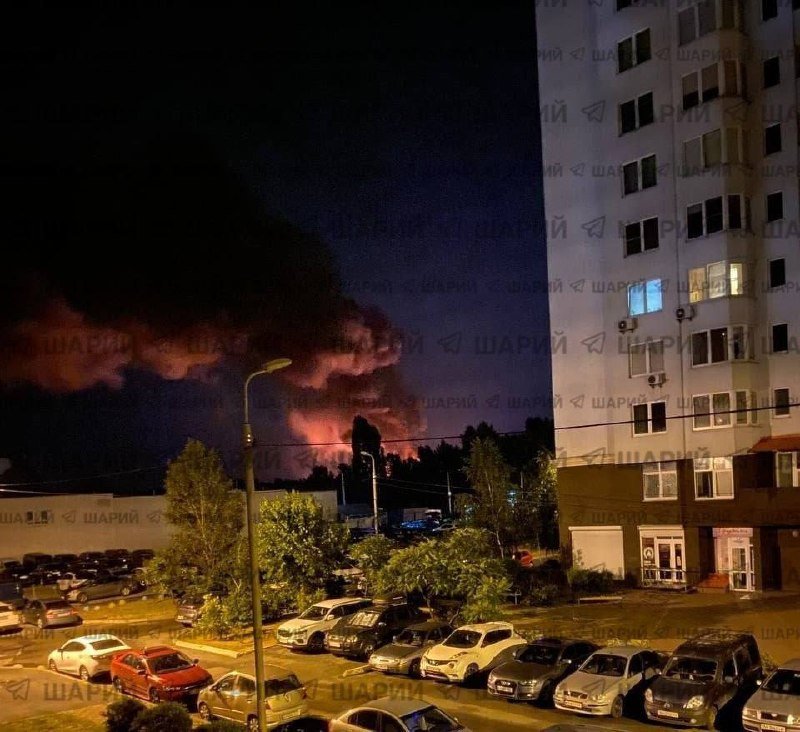
In the early hours of 6 July 2026, two distinct stories arrived almost simultaneously from the same corner of the Kyiv region, and they sit uneasily side by side. Russian sources claim a successful strike on the Vizar machine-building plant, a Ukrainian aviation-industry facility they describe as producing guided surface-to-air missiles, including the Neptune system. Within minutes, a separate account emerged of a Ukrainian air-defence interceptor apparently failing mid-flight and coming down in a residential courtyard in Kyiv. The first is a Russian claim of offensive success; the second is an admission, filtered through Telegram channels, of friendly-fire risk in the air-defence umbrella over the capital. Read together, they sketch a more honest picture of the war than either tells alone.
The pattern is now familiar: a Russian strike package reaches the airspace, Ukrainian mobile and point-defence crews engage, debris falls somewhere inside the city, and the question of attribution becomes a small information war of its own — fought between Russian-aligned channels asserting hits on strategic targets and Ukrainian or open-source accounts documenting what actually came down on streets, balconies, and courtyards. On this evidence, the contested object is not just the Vizar plant. It is the public narrative of who hit what, and at what cost to the civilians underneath.
The Russian claim, in plain terms
The Russian framing, carried by channels reporting from Russian military sources, is that Vizar — characterised as a producer of guided surface-to-air missiles including Neptune — was struck, and that the same facility has been hit before. The strategic pitch is straightforward: degrade Ukraine's ability to manufacture the kind of interceptor-class systems used against Russian cruise missiles and combat aircraft. Neptune, in Moscow's telling, is a particularly pointed target, both for the threat it poses to Russian naval assets in the Black Sea and for what it symbolises about Ukraine's defence-industrial base. The Russian claim is also, notably, an admission of priority: a missile is a missile, but a factory that builds missiles is treated as a different order of target, and the propaganda effort around it is calibrated accordingly.
The interceptor problem
The second report, from the same operational window, is the harder one. A Ukrainian air-defence missile is said to have failed and landed in a residential courtyard in Kyiv during the engagement. The account is sourced to Telegram channels monitoring the strike wave, not to an official Ukrainian statement, and it carries the usual caveats of unverified frontline reporting. But the underlying phenomenon is not new. Throughout 2024 and 2025, residents of Kyiv and Kharkiv documented fragments of Patriot, IRIS-T, and older Soviet-pattern interceptors falling on parks, courtyards, and parked cars. Western-supplied systems have an interception rate that is high but not perfect, and interception itself is a kinetic event: a missile that detonates, fragments, or veers off course is still a piece of ordnance returning to earth inside a densely populated city. The new detail in this incident is the suggestion that the failing round was a Ukrainian-operated interceptor rather than a piece of inbound Russian ordnance. If confirmed, it underlines a constraint that Kyiv rarely speaks about publicly: defending a capital from above is a defensive act that also carries domestic risk.
Why both stories matter
There is a temptation, in the heat of a strike, to pick the version of events that flatters one's side and move on. That is also the version that does the most analytical damage. The Russian claim, taken at face value, lets Moscow argue that escalation is paying off and that Ukraine's industrial base is being attritted. The Ukrainian interceptor account, taken at face value, lets critics in Western capitals argue that expensive Western systems are creating new categories of risk for Ukrainian civilians. Both readings are too clean. Vizar may well have been hit; the Russian account of what is produced there and what the damage entails is unverifiable in the moment. And a failed interceptor is one engagement, not a policy, in a defensive fight that has kept Kyiv functioning through years of strikes. The honest position is to hold both stories, attribute each to its source, and refuse to let either settle into a tidy conclusion.
The structural frame
What the night actually illustrates, beyond the immediate damage assessment, is the dual contest that defines the fourth year of this war. On one front, Russia is trying to compress Ukraine's defence-industrial capacity — the missile, the drone, the interceptor — through long-range strike packages aimed at factories, depots, and assembly halls deep inside Ukrainian territory. On the other, Ukraine is trying to keep a layered air-defence shield intact over a capital that, by any reasonable standard of military logic, should not still be governable. Both efforts are expensive, both produce contradictory evidence on any given night, and both generate the kind of fragmentary, partisan, real-time reporting that crowds out the slower, more verifiable story underneath. The slower story is that interception is a probability game, that missile defence over cities is a problem no country has fully solved, and that the public's trust in any single nightly claim — Russian or Ukrainian — is, at this point, partially exhausted. That exhaustion is itself a strategic asset, and both sides know it.
The sources disagree on outcomes, on attribution, and on the scale of damage. They do not disagree that Kyiv is now a city that lives, night after night, between a Russian claim of success and a Ukrainian admission of risk. That is the part of the story worth holding onto while the rest of the night's details are still being verified.
Desk note: Monexus has carried both the Russian-claim framing and the open-source reporting of the failed interceptor without endorsing either, on the principle that a single night's strike produces two real stories, and the gap between them is more useful to readers than a forced synthesis.
Wire provenance
This editorial synthesis draws on the following public wire/social posts:
- https://t.me/osintlive
- https://t.me/ClashReport
- https://t.me/ClashReport