Maine Democrats turn on Platner as the assault allegation forces a reckoning the party can't defer
Within hours of a new assault allegation surfacing on Monday, two of Maine's most prominent Democratic endorsers walked away — exposing how thin the coalition around the Senate candidate has become.
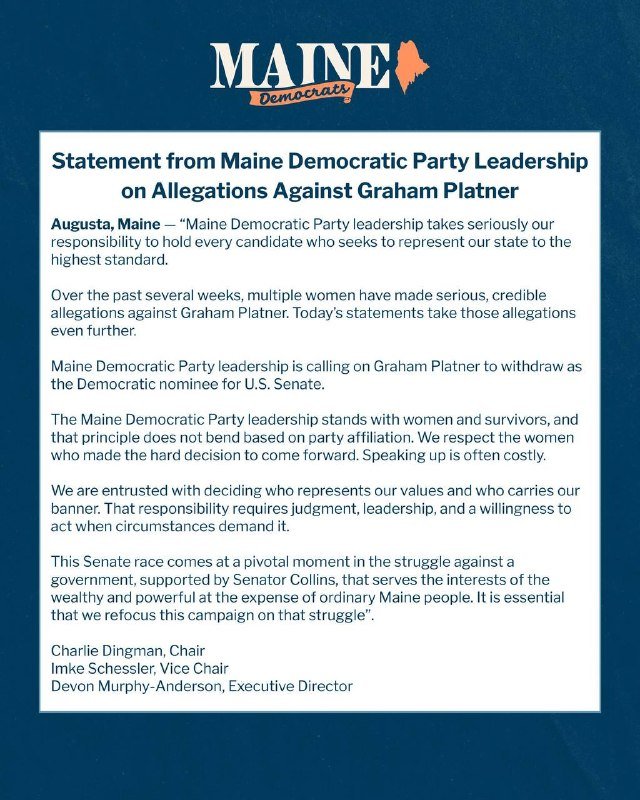
By the close of business on Monday, 6 July 2026, the political scaffolding around Maine Democratic Senate candidate Graham Platner had begun to come apart in plain view. Within hours of a new public allegation that Platner had grabbed a woman by the pelvis during a 2024 social encounter, two of his highest-profile national endorsers — Representative Ro Khanna of California and Representative Ruben Gallego of Arizona — withdrew their backing, according to a Telegram wire summary circulated at 23:21 UTC. The Maine Democratic Party's own leadership, the same wire noted, was calling on him to exit the race. The sequencing matters: endorsements evaporated on the same calendar day the allegation became a national story.
The accuser's account, summarised in the same Telegram wire at 21:31 UTC, is graphic and specific. She describes Platner "grabbing her pelvis" and being "really forceful," and adds that she recalls the precise moment "where I thought to myself, like, 'This is no longer my choice.'" Al Jazeera English's breaking-news desk framed the matter in cooler institutional language at 23:10 UTC, characterising the allegations as the latest in "a long string of controversies surrounding the Maine Democratic Senate candidate" — a phrase that concedes, without saying so directly, that Monday was not a single isolated incident but the latest weight on an already-strained structure.
A pattern the party tried to absorb
The "long string" matters. Monexus has previously noted that Platner's path to the Democratic nomination has been punctuated by disclosures — past Reddit posts, a tattoo associated with a Nazi SS insignia that he has acknowledged and said was obtained in his twenties, and earlier questions about his military record — each of which the campaign attempted to absorb through a combination of apology, contextualisation, and an appeal to the left-populist base that lifted him to the nomination. The assault allegation functions differently. It does not lend itself to the "context from years ago" framing, because the alleged conduct is the kind of conduct voters, donors, and party officials are trained to treat as disqualifying on its face. There is no obvious textual or temporal loophole through which the campaign can route it.
The behaviour Khanna and Gallego are modelling is the one that political coalitions adopt when they conclude the cost of association now exceeds the cost of separation. That calculation, in Maine's case, is sharpened by the November general election calendar: a Democratic nominee who enters the autumn carrying a credible unresolved assault allegation is a nominee who will be defined by that allegation in every paid ad cycle until the votes are counted.
Why the defection accelerated
Three forces are at work simultaneously. First, the allegation is detailed enough — body part, force, the victim's own internal monologue — that downstream coverage will quote it directly, which removes the rhetorical space for a "denied and disputed" characterisation. Second, national Democratic office-holders have spent the last two election cycles publicly sharpening their standards for what behaviour merits withdrawal of support; the cost of being seen as the holdout is now a quantifiable reputational risk. Third, the Maine Democratic Party leadership has its own institutional exposure: if it is seen as defending the nominee past the point where the national party has peeled off, it owns the wreckage alone.
The Telegram summary from 23:21 UTC indicates that "more Democrats are expected to denounce him until he drops out." That phrasing — until he drops — is itself an admission. The party is no longer waiting to see whether the allegation is corroborated; it is operating on the assumption that the political environment around Platner will become uninhabitable within days.
What remains uncertain
Monexus cannot verify from the available wire items whether Platner has been contacted by law enforcement about the allegation, whether additional accusers are likely to come forward, or whether the nominee himself intends to contest the allegation, concede it, or attempt the contextualisation play that worked for his earlier disclosures. The Al Jazeera summary characterises the accusations as serious but does not name corroborating witnesses, and the Telegram-sourced account of the accuser's own words does not include an on-the-record denial from the campaign. A second accuser, if one emerges, would shift the story from a contested single-encounter dispute into a pattern narrative — at which point the calculus for any remaining endorsers becomes binary rather than graduated.
There is also an open question about the institutional choreography. Maine's filing deadlines and ballot-access rules will determine whether a withdrawal now actually clears the path for a replacement nominee, or whether the party will need to thread a more complicated procedural needle in the weeks ahead. The sources reviewed for this article do not address those mechanics, and this publication will not speculate on them.
The structural read
The Platner collapse is being framed in much of the national coverage as a story about one candidate's bad week. Read more carefully, it is a small case study in how modern Democratic infrastructure handles a non-textual scandal — that is, a scandal in which the offending material is not a decade-old post or a tattoo but a body and a moment. The party's playbook is built to metabolise words; it is much less practised at metabolising physical-conduct allegations whose evidentiary weight does not depend on interpretation. When the latter arrives, the response is not deliberation but rapid triage: distance the brand, withdraw the endorsement, and wait for the candidate to read the room.
That is what is happening in Maine on the night of 6 July 2026. Whether Platner reads the room is the only variable the party cannot control from Washington or Augusta.
Desk note: Monexus framed this story around the institutional response — who walked away and when — rather than around the allegation itself, on the principle that the news value of the day was the speed and visibility of the defection, not a re-litigation of the underlying conduct.
Wire provenance
This editorial synthesis draws on the following public wire/social posts:
- https://t.me/rnintel
- https://t.me/rnintel