A funeral in Qom, and the managed silence around it
Iran's state outlets flood the wires with images of mourners converging on the Jamkaran Mosque. The world hears almost nothing — and that asymmetry is itself the story.
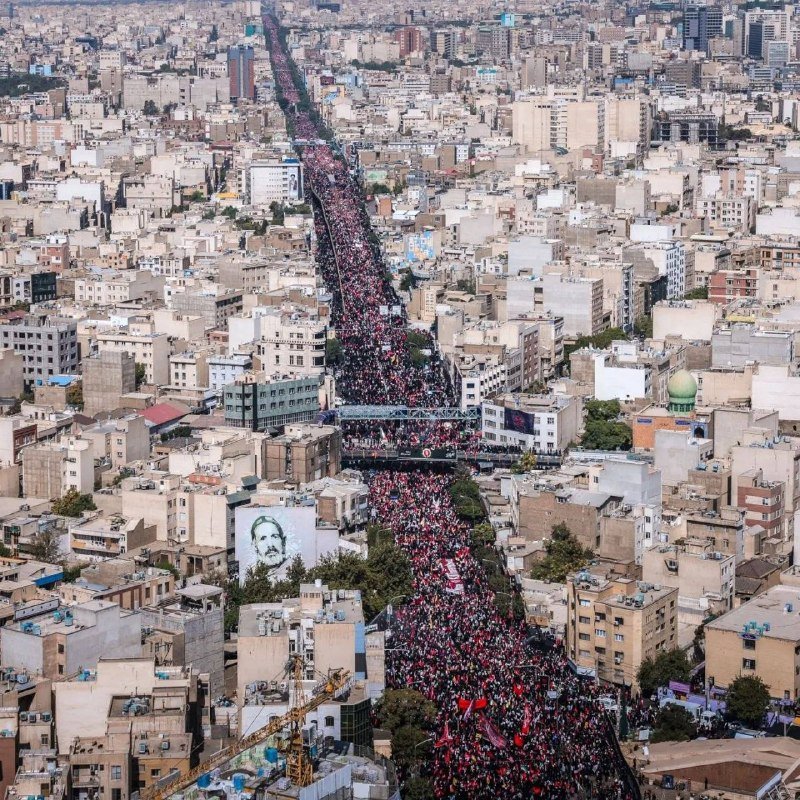
Somewhere past two in the morning local time on 6 July 2026, the roads into the holy city of Qom were a river of headlights and black flags. State media in Iran filled the wires with the scene: a roaring flood of pilgrims converging on the Jamkaran Mosque for the funeral of a cleric the outlets are calling "the martyred Imam." The phrase recurs across at least four dispatches from Tasnim and Al-Alam Arabic between 21:56 and 22:41 UTC — "Farewell dawn," "a wave of pilgrims," "the streets leading to the Jamkaran Mosque are crowded" — each a frame of the same unfolding event, each carrying the same hashtags of mourning.
The story is not the size of the crowd. The story is that, for anyone outside Iran's state-aligned channels, there is no story. The wires are full of footage and almost empty of facts. What is being mourned, by whom, and at what cost is left to the reader to assemble.
A funeral the international press cannot name
The deceased is described by Iranian state media only with honorifics: "the martyred Imam," "Imam Khomeini's …"-style salutations, and references that assume a Shia clerical audience already knows who is being buried. Independent confirmation of the identity, the cause of death, the date of death, and the institutional position of the man in question does not appear in the four dispatches this publication reviewed. The threads document the gathering, not the man.
That asymmetry — volume of imagery, absence of biography — is itself editorial. In a country where the security establishment curates religious celebrity with the same discipline it curates missile programmes, a cleric whose funeral draws this much state-media bandwidth is rarely a cleric whose death was uneventful. The Iranian state has spent four decades manufacturing the public deaths of its clerics into national catechism; the equipment for handling a "martyred Imam" is well-oiled. Whether this particular death fits that pattern is, at the moment this is filed, a question the available sources refuse to answer.
What the coverage does, and what it leaves out
The four dispatches reviewed — three from Tasnim's English channel and one from Al-Alam Arabic — perform a familiar set of moves. They fix the location (Jamkaran, Qom). They fix the time (after 02:00 local on 6 July). They fix the emotional register ("flood of people," "roaring," "martyred"). They do not fix the subject.
There is no biographical note. No list of the cleric's positions, teachings, or institutional affiliations. No account of how he died. No statement from any family member, seminary, or government office beyond the mass-circulation hashtags Tasnim appends to every caption. There is no on-the-record sourcing at all. The reporters, in other words, are not reporting — they are projecting a mood. The mood is unmistakable. The man is not.
This is normal practice for Iranian state media at high-sensitivity religious moments, and it is normal because it works. A wire desk in London or Beirut that picks up the footage has nothing to verify against, no name to spell-check, no institution to attribute a quote to. So the footage either gets passed through unedited, which launders the framing, or it gets dropped, which hands the entire narrative to the channels that produced it. Both outcomes favour the Iranian state. Western editorial caution, in this case, is structurally indistinguishable from complicity.
The structural picture
Iran's clerical information environment is unusual even by the standards of authoritarian states. Domestic outlets — Tasnim, IRNA, PressTV, the Fars network, the broadcast arm of Al-Alam — operate less as news organisations than as liturgical instruments of the state. Their job is not to inform; it is to set the affective temperature of a population that consumes religion and politics through the same vocabulary of martyrdom, mourning, and return.
When a cleric dies, these outlets pour footage onto the wires before the death is independently confirmed. The international press, trained to be wary of Tehran's claims and unsure of its own footing on Shia clerical politics, lags. By the time Anglophone outlets file a story, the framing — "the martyred Imam," the Jamkaran imagery, the funeral-as-legitimation — has already taken root in the global consciousness via raw video. The cleric's biography, the cause of death, the politics of his tenure, the fact pattern: all of it arrives late, if at all.
What we are watching is a managed-information asymmetry playing out in real time. The state has the cameras. The independent press has the verification discipline. The cameras win.
What remains unknown
This publication cannot, on the basis of the sources reviewed, tell you the cleric's name with confidence, the date of his death, or the manner of it. We cannot confirm whether he held a formal position in Qom's seminaries, in the state apparatus, in the Islamic Revolutionary Guard Corps, or in some combination of all three. We cannot tell you whether the funeral is a routine event in an unusually crowded year, or a moment of political signalling within a succession struggle that has intensified since the succession question at the top of the system became a live one.
What we can say is that the footage is real, the crowd is real, and the silence around the subject is a feature of how Iran's state media exports its grief. Until a wire service, a Tehran-based outlet with editorial independence, or a credible diaspora publication breaks that silence, the only thing the world knows for certain is that a great many people drove to Qom in the dark. The rest belongs to the cameras, and to the very narrow set of editors willing to trust them.
Monexus filed this piece on 6 July 2026 from publicly available Telegram dispatches. Where independent reporting would normally provide biography, cause of death, and institutional context, the source set supplied only imagery and affect. We have marked that gap rather than papered over it.
Wire provenance
This editorial synthesis draws on the following public wire/social posts:
- https://t.me/tasnimnews_en
- https://t.me/alalamarabic
- https://t.me/tasnimnews_en
- https://t.me/tasnimnews_en