The funeral the world didn't see: how Qom buried a 'martyred Imam' under the wire
State-aligned channels painted Qom's funeral rites as a national outpouring. Independent reporting from the scene is thin — and the framing is doing most of the work.
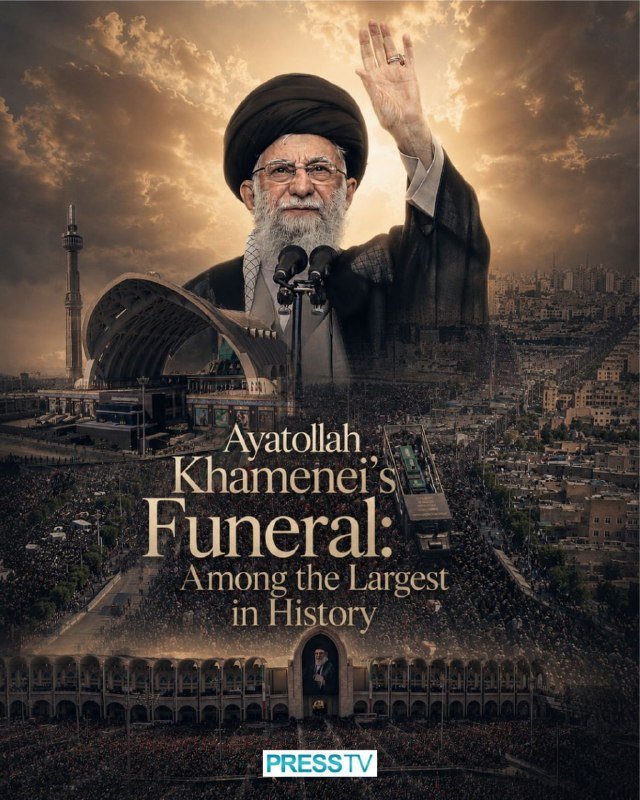
The footage, distributed on 6 July 2026 by Tasnim News, a state-affiliated outlet aligned with the Islamic Republic's security establishment, shows tens of thousands of pilgrims converging on the holy mosque of Jamkaran in Qom, walking what the channel describes as a seven-kilometre route to bid farewell to a figure it calls "Imam Shahid." By evening, at 18:55 UTC and again at 20:44 UTC, Tasnim's English wire was broadcasting a single, unified frame: an elderly pilgrim weeping uncontrollably, the faithful walking in long columns, a "night of tears and farewell" organised around a missing or dead cleric whose title the channel elevated to a religious office he did not publicly hold.
What is being staged in Qom is not just a funeral but a piece of political theatre. State-aligned channels are doing what they always do in moments of succession or martyrdom: deciding, in real time, who counts as a saint, and broadcasting the verdict to a domestic and regional audience before any independent picture of the man, the cause of death, or the political faction behind the canonisation can form. The rest of the world's wire services are largely absent from the frame.
A single wire, one script
Tasnim's English service ran the same story five times between 18:55 and 21:01 UTC on 6 July 2026, with diminishing variation. The earliest post is the most revealing: it is not framed as breaking news about a specific individual, but as the announcement of a category. The "martyred leader" is referred to reverentially, with no surname attached on first reference, and the editorial choice is to lead with the crowd, not the man. The second post, at 19:42 UTC, packages the same scene into a short video clip tagged with the slogan "#Badarqa_Aghai_Shahid_Iran" and a directive, "#must_rise," — a hashtag that reads as mobilisation language rather than mourning language, even as the imagery shows tears rather than fists. By 20:44 UTC the framing has hardened into a religious elegy: a "night of tears and farewell to Imam Martyr," with a voice-over cue describing a "familiar voice" that "leads the hearts to the same" destination. The final post, at 21:01 UTC, escalates the scale claim to a national pilgrimage: "pilgrims from all over Iran came to Qom."
The pattern matters more than the particulars. Five posts in two hours, each reinforcing the same beat, each shifting the scale claim upward, each introducing a slightly more reverential title. This is not reportage. It is the production of consensus in real time.
The man behind the title
Tasnim's posts do not identify the deceased cleric by full name, date of death, or cause of death. The English wire refers to him only as "Imam Shahid" or "the martyred leader." The hash-tag "#Badarqa" — translatable roughly as "sword-bearer" or "possessor of the sword" — is a title of religious-military honour, and using it as a primary identifier rather than a surname is itself a framing choice: it tells the audience which slot in the political cosmology the channel wants him to occupy. For Western and regional readers who rely on the major wire services, the absence of a Reuters, AP, AFP, BBC or Guardian byline on this story is the story. As of the time of writing, the only English-language feed producing continuous, on-the-ground coverage from Qom is a state-aligned outlet with a long record of functioning as a mouthpiece for the Islamic Revolutionary Guard Corps. Independent Iranian diaspora outlets have not, in the materials available to this publication, produced a confirming dispatch.
What the structural frame looks like
Every state has a monopoly on the official version of its own grief. What is unusual here is the speed and the uniformity of the consolidation. In most succession crises — the death of a supreme leader, a high-profile assassination, a war casualty elevated to national-symbol status — there is a brief contested period in which rival factions, regional papers, and opposition channels produce competing accounts before the state version hardens. In Qom on 6 July 2026, the contested period is invisible in the open-source record. Tasnim's English service is not arguing against an alternative frame; it is, in effect, pre-empting one. The seven-kilometre walk, the elegiac voice-over, the slogan hashtag, the elderly pilgrim — these are not raw materials of a story. They are the finished product, distributed before the fact-checking layer of the international press has had a chance to engage.
For audiences outside Iran, the practical consequence is that any conversation about who this man was, what he did, who killed him, and which faction benefits from his elevation will proceed on the back of a state-curated emotional baseline. The image of the weeping grandmother in Qom is now the visual that travels.
Stakes and what remains unclear
If the canonisation holds, the cleric becomes a permanent fixture of the Islamic Republic's martyrology — and a tool in the hands of whichever faction controls his legacy. The hashtags embedded in Tasnim's own posts suggest the channel intends to convert the funeral into a recruitment and mobilisation moment rather than a closure moment. The "#must_rise" tag, in particular, sits uneasily with the elegiac tone of the surrounding captions; the implied audience is not Iranian Shia alone, but a regional axis. Iran International, the opposition-aligned channel broadcasting from outside the country, has not, in the materials available to this publication, been able to place a correspondent in Qom. Western wire services have not, in the open record, confirmed the cleric's identity, the cause of death, or the scale of the gathering. The picture of Qom on 6 July 2026 is, for now, a Tasnim picture.
That is the point. The most consequential political fact about the funeral is not the funeral itself; it is that, two hours into the biggest religious-political spectacle in Qom in years, the only continuous English-language feed on the ground is owned by the state.
Desk note: Monexus treats state-affiliated outlets such as Tasnim as legitimate primary sources, not as neutral observers, and reads their framing choices as evidence in their own right. The five Telegram dispatches cited above are best understood as one actor's account of an event, not as the event itself.
Wire provenance
This editorial synthesis draws on the following public wire/social posts:
- https://t.me/s/tasnimnews_en
- https://t.me/s/tasnimnews_en
- https://t.me/s/tasnimnews_en
- https://t.me/s/tasnimnews_en
- https://t.me/s/tasnimnews_en