Qom's farewell: what the Jamkaran turnout tells us about the post-conflict order
Two days after the cortege moved through Qom, the Iranian state was parsing turnout, blast reports in Golestan, and a deputy minister's threat that force is the only idiom Washington understands. The funeral was the staging; the optics are the message.
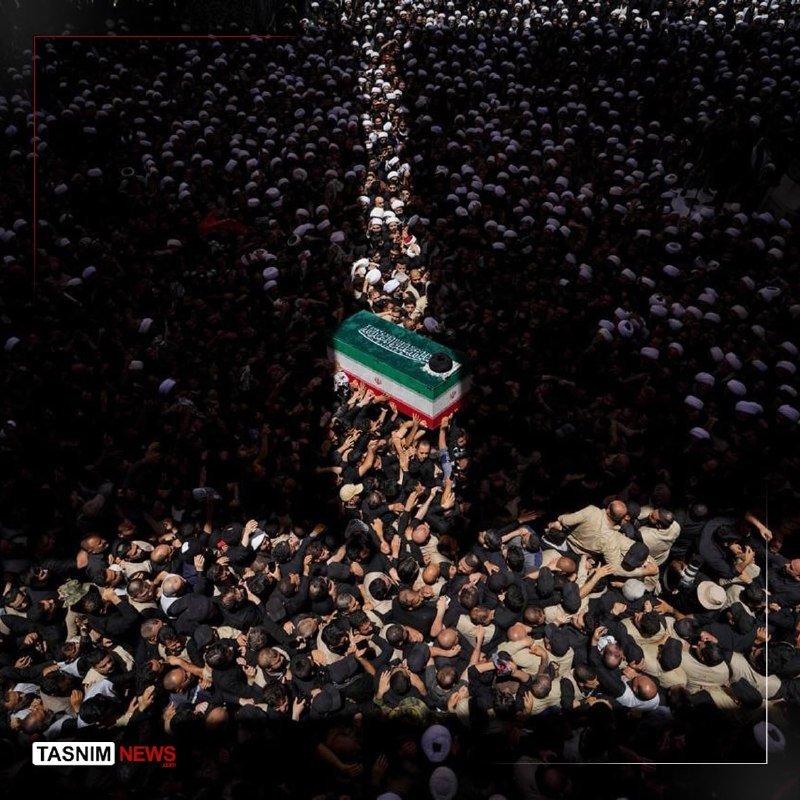
On July 8, 2026, two days after the funeral cortege moved through the holy city of Qom, the Iranian clerical establishment faced an awkward arithmetic problem. The turnout that state-aligned outlets had spent days choreographing was being read against a backdrop of explosions in Aqqala, a deputy foreign minister publicly declaring that "Trump understands language of force better," and an open-source intelligence account walking back a strike image it had attributed to that night's operations.
The cleric buried at Jamkaran was, by the standards of the Islamic Republic, a minor clerical figure. What matters is not who he was, but who showed up, who did not, and what the optics reveal about an Iran that has just absorbed a punishing exchange with the United States and Israel and is now performing normalcy at the same moment its proxy axis is being systematically dismantled. The wire framing calls this a "state funeral." Read it instead as a state instrument: a piece of political theatre designed to project continuity at a moment when the ground has shifted.
What Qom actually showed
Tasnim News, the outlet closest to the Islamic Revolutionary Guard Corps, and the Khamenei-aligned Arabic-language channel that carried the official framing both emphasised the volume of mourners and the gravity of the clerical loss. Their photographs and video were selected to fill the frame: black-clad crowds, clerics in turban, banners with the conventional elegiac vocabulary.
The selection tells you everything about the editorial intent. The same outlets were, on the same day, running footage of a deputy foreign minister explaining why Tehran had concluded that the US president "understands language of force." The juxtaposition is not accidental. A funeral is, in the grammar of the Iranian state, a moment to reassert that the system retains its emotional grip on the street and its deterrent credibility abroad. The two claims reinforce each other: we are still loved by our people, and we are still feared by your president.
The counter-frame, visible in the same record
Two days after the Qom procession, Iranian and Russian state-adjacent Telegram channels were trying to make sense of explosions near Aqqala, a small city in Golestan province close to the Turkmen border. Fars News, Mehr News and IRNA's English service all carried the basic report: residents heard blasts, the location was unclear, no official detail had been released. The OSINT account that initially posted a strike image later retracted it, acknowledging the picture had been misattributed.
The choreography is familiar by now. First the sound, then the speculation, then the correction, then the silence. What is notable is that the explosion chatter was being absorbed into a public conversation in which the Iranian deputy foreign minister was already framing the moment as one in which Tehran had successfully demonstrated that "language of force" was the only idiom Washington understood. That is the language of a state that believes it has just delivered, or absorbed, a punishing blow and is now deciding how to capitalise on the perception.
A state at the hinge
This is what a regional hegemon looks like in the late stage of a rebalancing. Iran's sphere of influence has contracted sharply over the past two years. Hezbollah's leadership has been decapitated. The Assad regime in Syria fell without Tehran's ground forces being able to prevent it. The Houthi project in Yemen survives but no longer projects. The Iraqi militias that once gave Tehran a second land border with Israel have been degraded. What remains is the nuclear file, the missile programme, and the claim to martyrdom as a recruiting tool.
The Jamkaran funeral sits inside that contraction. A clerical death that would, a decade ago, have drawn a tightly scripted response from Beirut, Damascus and Baghdad now produces mostly Iranian optics. The Arab-language channels carrying the message are operating in a region whose centre of gravity has moved.
What the turnout does not show
Iranian state media has a long, well-documented history of selecting camera angles, timing releases, and using telephoto compression to make crowds look larger than they are. The same outlets are also the principal source for any claim about attendance figures. The honest reading of the available material is that the clerical establishment wanted a large turnout, believed it had engineered one, and is now using that belief as evidence of domestic resilience.
There is no independent verification of the size of the Qom crowd. There is, however, plenty of independent verification that the Islamic Republic is under economic strain, that its regional proxies have been weakened, and that its leadership is publicly auditioning the doctrine that only force is understood in Washington. The Grayzone's interview with the University of Tehran researcher Setareh Sadeqi, published the same day, captured that mood precisely: ordinary Iranians and some politicians calling for retaliation against Trump and Netanyahu.
The post-conflict order Qom is auditioning for
The order Tehran is hedging toward is one in which restraint is read as weakness, force is read as the only intelligible language, and martyrdom is read as leverage. It is a familiar Iranian bet, and it has produced familiar results. The question the Jamkaran turnout cannot answer is whether the street that turned out for a cleric will still turn out when the next escalation demands a cost measured in oil exports, currency stability and access to international banking.
The next legible signal will not be another funeral. It will be what happens the next time explosions are reported near Aqqala or anywhere else along Iran's northern or western frontier, and whether Tehran responds with the force its deputy foreign minister insists is the only idiom Washington respects, or with the silence that an isolated state eventually learns to keep.
Sources: Tasnim News (t.me/tasnimnews_en); Khamenei Arabi (t.me/Khamenei_arabi); Fars News (t.me/farsna); Mehr News (t.me/mehrnews); IRNA English (t.me/Irna_en); Open Source Intel (t.me/osintlive); Rybar (t.me/rybar_in_english); The Grayzone (t.me/TheGrayzoneNews).
Desk note: Monexus framed this piece around the political economy of the funeral, the staging, the contested vocabulary, and what the optics tell us about Iran's position in a region whose balance has shifted, rather than around the cleric's biography, which the available sources do not detail. The dominant wire framing will be "state funeral"; we read it as a state instrument.