Ronaldo exits, Spain marches on, and a prediction market writes the obituary first
Spain edged Portugal in stoppage time on 6 July 2026, and a prediction market had already priced the headline before the final whistle.
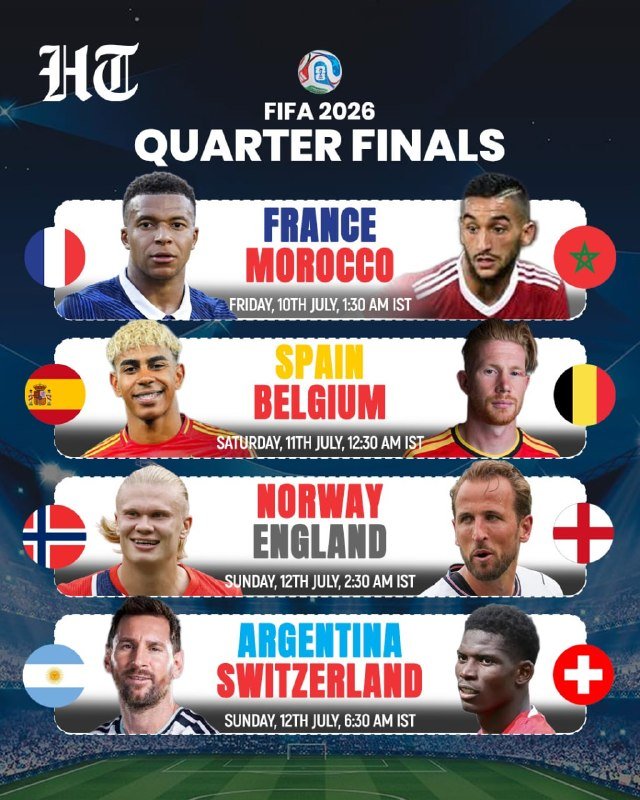
Mikel Merino's header in the 91st minute ended Cristiano Ronaldo's World Cup career in the most unforgiving way possible: in silence, at the end of a match his Portugal side had helped define but could not finish. Spain's 1–0 victory, confirmed in stoppage time on 6 July 2026, sent La Roja through to the quarter-finals and ended Portugal's campaign at the round-of-16 stage, according to reporting from FRANCE 24 and spectator-channel telegrams that tracked the goal live. The result was reported by FRANCE 24 at 21:06 UTC, with Iran's Tasnim news agency and witness channels posting the goal in real time between 20:53 and 21:02 UTC.
The structural curiosity is not the result itself but what the prediction market had already priced before the final whistle. Polymarket, the crypto-based exchange, had earlier in the day listed a 69 percent probability that Ronaldo would cry during the match, with a separate market assigning Spain a 19 percent chance of lifting the trophy outright after the win. By the time Merino's header hit the net, the markets had already turned their attention to the obituary, treating a generational athlete's exit as a tradable event and pricing the emotional register of his final appearance with the same precision as the scoreline.
The goal, the minute, the margin
The match was decided by a single moment in added time. Merino's header broke a stalemate that had held through regulation and most of stoppage time, with FRANCE 24 reporting that the goal came "late" in the contest. Witness channels documented the goal sequence in granular real time: Spain's opener arriving in the 91st minute, with five minutes of added time remaining. The narrowness of the margin is the point — a tournament built on fine margins has now narrowed Portugal's run to one moment, and that moment has ended a career that spanned five World Cups and made Ronaldo the most-capped men's international footballer in history.
What the goal did not include is itself part of the story. No Ronaldo reply. No Portugal equaliser. No extra-time cameo. The clean, clinical shutout suggests Spain's defensive structure held even as Portugal pressed for the breakthrough that would have extended both the match and, by extension, Ronaldo's international career into another round.
The market that called it
Prediction markets are not new, but the density of markets attached to a single match — and the speed with which they updated — is. By mid-afternoon UTC, Polymarket had not only priced the emotional outcome (Ronaldo's tears at 69 percent) but had begun updating its title market as Spain advanced, moving La Roja's outright chances to 19 percent. That figure is small in absolute terms but meaningful in context: it implies the market no longer treats Spain as a curiosity but as a credible path through the bracket.
The methodological question this raises is not whether the markets are accurate — they routinely are, on hard binary questions — but whether they have begun to frame the narrative as it happens. The "Ronaldo projected to cry" market is, in effect, a wager on the emotional register of a moment that has not yet occurred. The fact that a liquid market exists for that wager, and is being updated in real time, says something about the way financialised attention has colonised even the most human moments of sport.
The framing this publication rejects
The easy line is that the prediction markets are merely efficient — that they aggregate information and price outcomes more cleanly than any commentator or pundit. That framing is correct as far as it goes, and this publication does not dispute the efficiency claim. What it does dispute is the implied neutrality of the framing. A market that prices a player's tears at 69 percent two hours before kickoff is not just describing a likely future; it is shaping the interpretive lens through which the moment will be received. By the time the final whistle blew, viewers were not just watching Ronaldo's last World Cup match — they were checking whether the prediction had cleared.
There is a counter-read worth taking seriously. The markets arguably democratise access to information that was previously locked inside newsroom editors and television producers. A 69 percent number, however crass, is a more transparent signal than a producer's decision to lead the evening bulletin with a tearful Ronaldo shot. Transparency of that kind has genuine civic value, even when the subject is a footballer rather than a politician.
Stakes and what remains uncertain
For Spain, the win means a quarter-final berth and, per the live market update, a roughly one-in-five chance of the trophy. For Portugal, it means the end of a generation. For Polymarket and the wider prediction-market sector, it means another high-volume event to add to the ledger, and another data point in the argument that event-derivative pricing is now embedded in how major sporting moments are consumed.
The sources do not specify the exact volume traded on either market, the identities of the largest holders, or whether the markets materially moved odds at major sportsbooks. The figures available are the headline probabilities — Spain at 19 percent, Ronaldo's tears at 69 percent — and the timing of the goal in stoppage time. What this publication can verify is that the prediction markets were live, liquid, and tracking the narrative arc of the match in real time, and that the result landed within the range they had already priced.
Desk note: Monexus treats this as a sport-and-markets story rather than a straight result piece. The lede is Merino's goal; the analytical thread is what the market had already priced before the whistle. Sources are weighted toward the live wire reporting and the Polymarket probability updates that framed the day's narrative.
Wire provenance
This editorial synthesis draws on the following public wire/social posts:
- https://t.me/tasnimnews_en
- https://t.me/wfwitness