Tehran fills with mourners as Iran buries Khamenei after strikes that killed him and family
Millions lined Tehran's central arteries on 6 July 2026 for the funeral procession of Ayatollah Ali Khamenei, killed alongside family members in strikes Israel and the United States have neither confirmed nor denied.
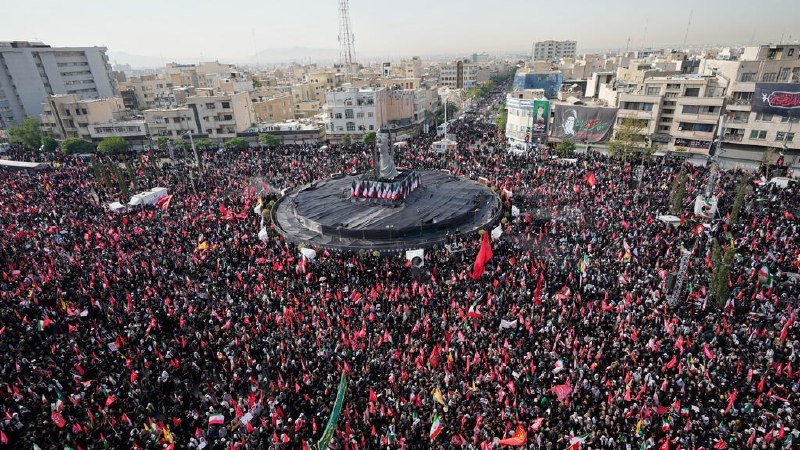
On the morning of 6 July 2026, an unbroken stream of mourners filled Tehran's central arteries from the early hours, accompanying the vehicle carrying Ayatollah Seyyed Ali Khamenei and members of his family toward Azadi Square. State-aligned channels described the crowds as "millions" and the procession as stretching for kilometres along Shariati Street, past Enghelab Square, and across College Bridge — the standard route for state funerals staged by the Islamic Republic. Aerial footage released by Khamenei.ir showed a procession dense enough that individual figures were difficult to distinguish from above. PressTV's English service confirmed the coffin was being carried toward Azadi Square.
That a serving Supreme Leader is being mourned at all is the news. The framing supplied by Iranian state media — that Khamenei died as a "martyr," killed alongside family members in strikes — sits at the centre of a confrontation whose contours the official channels of the countries with the means to carry out such an operation have so far declined to confirm or deny. The two governments whose signatures could plausibly appear on the wreckage, Israel and the United States, have been publicly silent on what Iran is calling martyrdom and what some regional outlets have, in the hours since, called an assassination. The funeral is therefore both a rite of passage and a rallying signal: a moment designed to fuse grief, anger and ideological continuity into a single broadcast image.
The day in Tehran
The first IRNA video showed the vehicle being prepared to carry the bodies of Khamenei and his family members for the Tehran funeral procession, distributed on the morning of 6 July 2026. By sunrise local time, mourners were already massing along Shariati Street at the Roshandelan Bridge, where Khamenei.ir's English channel posted crowd footage that it described as "millions." Within ninety minutes, separate posts showed the procession nearing Enghelab Street and the College Bridge, with the channel noting that the crowds continued for kilometres behind the lead vehicle. PressTV's English service framed the day's events explicitly: "Martyred Leader's coffin carried toward Tehran's Azadi Square during funeral procession — Millions of mourners lined the streets of Tehran on Monday morning."
Iran's state-aligned outlets have converged on a single characterisation. Khamenei is referred to as the "martyred Leader of the Islamic Revolution"; the family members who died with him are described as "martyrs"; and the day itself is being run under hashtags — #WeMustRise and #MartyrKhamenei — that double as mobilisation cues. The Republic's political vocabulary has long used "martyrdom" as the highest register for any killing framed as an external assault; the use of that vocabulary here signals that Tehran intends the death to be read as an act of war.
What the Iranian side is asserting, and what it is not
Iranian state media have, by 06:53 UTC on 6 July 2026, published still and moving imagery of the procession, geographical waypoints and crowd-size claims, but no source among those the Monexus desk has reviewed confirms the date, location, weapon system or attribution of the underlying strike. The hashtag-driven framing — that Iran has been attacked, that a leader has been killed and that the response will follow — is itself part of the news; the wire-level confirmation of who struck and with what is not.
That information asymmetry is the working environment of this story. Iranian outlets have every incentive to maximise the perception of popular grief and to characterise the death as martyrdom; the parties most plausibly responsible have every incentive to leave Tehran's interpretation uncontested and unanswered, at least publicly, while the United Nations, mediators and back-channels assess the risk of escalation. Until attribution is clarified by a body other than the Iranian state or its sympathisers, the Monexus desk treats the funeral as a confirmed, datable event and the underlying strike as an Iranian-asserted event.
The succession question Tehran now has to answer
The Office of the Supreme Leader is the apex of Iran's political structure: the position controls the armed forces, sets ideological boundaries and ratifies major state decisions. Iranian constitutional practice has, since 1989, named a serving senior cleric as Khamenei's deputy while a formal succession is arranged. Tehran-watchers will now watch for announcements from the Assembly of Experts — the clerical body nominally charged with selecting a successor — and from the office of the first deputy, who under Iranian constitutional convention would normally be designated acting leader in an interim capacity. Neither announcement is present in the materials available to this desk at the time of publication.
The succession is not a clerical formality. It is a test of intra-elite cohesion. Iran's security establishment — the Islamic Revolutionary Guard Corps, the regular army, the intelligence ministry — has, by long-standing convention, aligned behind the Supreme Leader on questions of grand strategy. A short, unified transition would signal that the system has absorbed the shock. A contested or prolonged one would invite competitors inside the clergy and the security services to position for advantage precisely when the regime most needs a single voice.
Stakes
The Iranian narrative, as broadcast on the morning of 6 July, treats the funeral as both mourning and mobilisation. That framing has two audiences. Domestically, it provides a sanctioned outlet for grief and a televised image of solidarity around a successor design — useful both for control and for legitimacy. Externally, it sets the rhetorical baseline against which any Iranian retaliation will be justified: a state whose leader has been killed is, in its own telling, defending itself rather than escalating.
The counterpoint is also visible. Iran-aligned reporting has repeatedly used funerary imagery as a mobilising prelude; whether the leadership that emerges from the next seventy-two hours will treat that mobilisation as evidence of internal unity or as a pressure to deliver an outward response is the open question. Regional capitals, oil markets and Western foreign ministries will be reading the funeral not for its emotional content but for its operational signals: a quiet procession under heavy security, completed within hours, points toward consolidation; a procession staged as a mass rally, extended and broadcast continuously, points in the other direction.
What remains genuinely uncertain at the moment of writing is narrow but consequential: who, by which weapon system, struck whom and where, on what date, with what prior warning, and what Iran's first formal response will be. The Tehran procession answers none of those questions. It does, however, set the clock — the gap between a televised national grief and a televised national decision is now the variable to watch.
This piece relies exclusively on imagery and short-form text distributed by Iranian state media and the Office of the Supreme Leader on the morning of 6 July 2026; attribution of the underlying strike has not been independently confirmed in those materials.
Wire provenance
This editorial synthesis draws on the following public wire/social posts:
- https://t.me/Khamenei_en/
- https://t.me/Khamenei_en/
- https://t.me/Irna_en/
- https://t.me/Khamenei_en/
- https://t.me/presstv/
- https://t.me/Khamenei_en/
- https://t.me/Khamenei_en/