Tehran's farewell and the choreography of grief as statecraft
Crowds surged through central Tehran before dawn on 6 July 2026 for the funeral of a senior Iranian figure killed alongside the wartime leadership. The optics are unmistakable; the political arithmetic underneath them is more interesting.
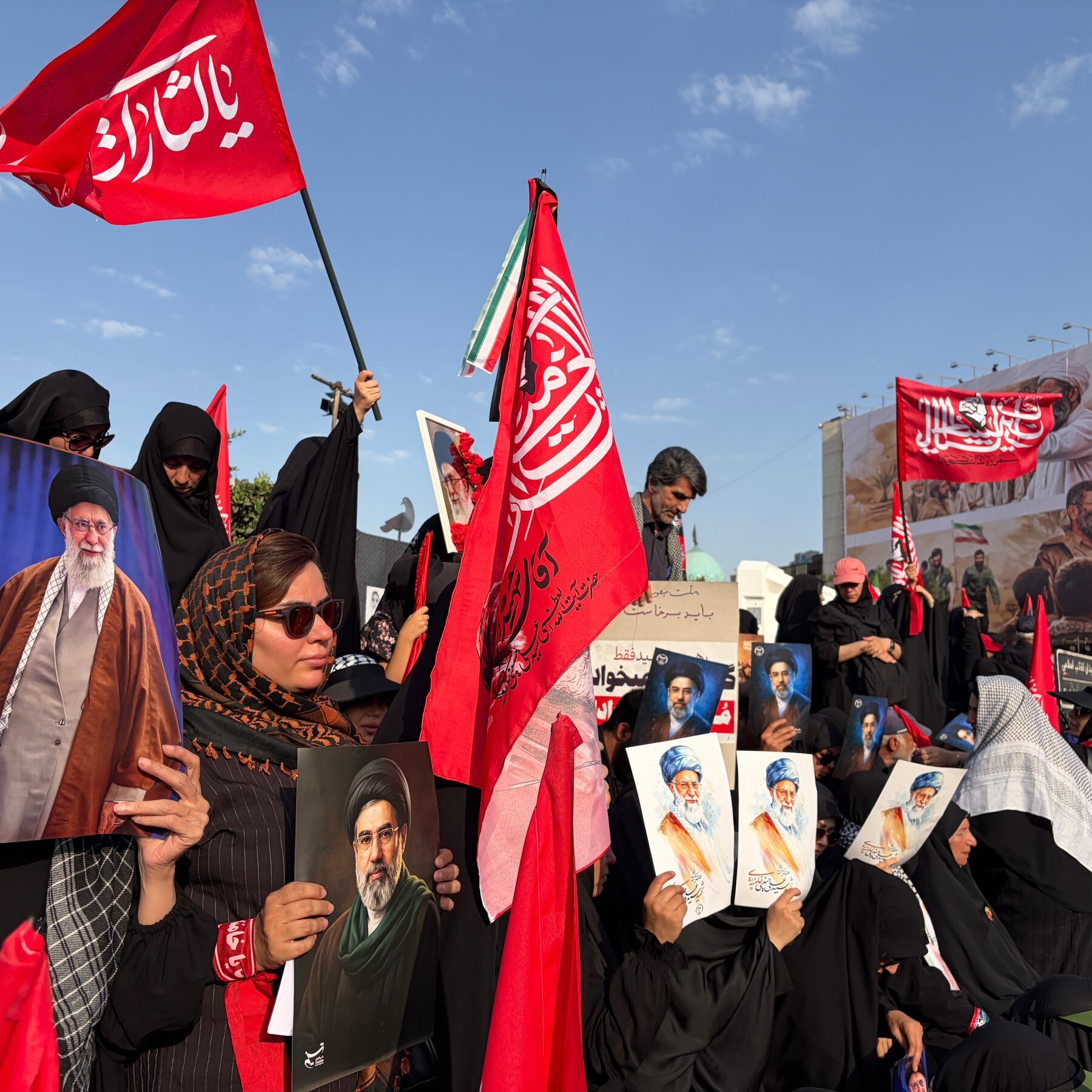
Tehran's central axis filled before sunrise on 6 July 2026. By 03:21 UTC, state broadcaster Al-Alam's Persian channel was carrying footage of crowds moving toward Imam Hussain Square for the funeral procession of a senior figure being honoured as "Imam Shahid" — the martyr's title reserved, in the Islamic Republic's political lexicon, for those who fall in service to the Supreme Leader and the revolutionary project. By 04:27 UTC, aerial footage showed Islamic Revolution Square packed to its edges. By 05:18 UTC, the vehicle carrying the casket was inching through a corridor of bodies. Children waved flags at the convoy; on the Tehran Metro, passengers chanted "Death to America" and "Death to Israel." The choreography was as deliberate as the grief was real.
The script has been written before
Mourning in the Islamic Republic is never only mourning. The vocabulary deployed by Al-Alam's correspondents — "pure bodies of the martyrs," "the funeral path," the careful use of imam shahid rather than a plain death notice — tracks a ritual the state has refined over four decades. The square becomes a stage; the metro becomes a delegation hall; the child's flag becomes a credentialing device for the next generation. The point is not to convince an outside audience. It is to demonstrate, inside the country and to aligned audiences across the region, that the killing produced resolve rather than fear.
The same template was used after the November 2020 assassination of Mohsen Fakhrizadeh, after the January 2020 killing of Quds Force commander Qassem Soleimani, and after every senior martyrdom since the war with Iraq ended in 1988. The variable is the crowds; the constant is the script. And the script has always assumed that the United States and Israel are listening.
What the frame is — and what it leaves out
The western reading of these images tends to flatten them into "regime rallies" and stop there. That reading isn't wrong — the funeral is unquestionably an instrument of domestic mobilisation — but it leaves two things on the table. First, the depth of popular involvement. Iranian society is not a society of coerced unanimity; the decision to spend the night in a city centre in summer is personal, and the price of absence for the wrong person is reputational, not penal. Treating the crowd as a backdrop misses the negotiation between state and citizen that the funeral does in public. Second, the regional signalling. The "Labik Ya Husayn" refrain heard on Al-Alam's feed is a Karbala echo, and it lands not only in Tehran but in Basra, Baghdad, Beirut, and Sanaa — the four capitals of the so-called Axis of Resistance that view the killing as the killing of one of their own.
The structural ledger
The Islamic Republic is not the only state that converts grief into choreography. Washington's militarised patriotism after 9/11, the choreography around presidential funerals, the ritualised memorialisation of fallen soldiers — all of these are variations on the same instrument. What distinguishes the Iranian version is its scale relative to the country's relative isolation. With much of the western press corps barred or self-thinned, and with Iran International and the Persian-language diaspora broadcasts amplifying the alternative reading, the state-owned channels become simultaneously the primary record and the primary narrative. The pictures we are watching were selected, edited, and broadcast by the institution that staged the event. That doesn't make them false. It does mean the editorial finger is heavier on the camera than usual.
What it tells us about what comes next
For the Iranian state, the value of the funeral is exhausted quickly. Within forty-eight hours, the crowds will be back at work; the commentary on Al-Alam will pivot to succession and retaliation; and the Supreme Leader's office will begin signalling what kind of response the killing will yield. The question the images cannot answer — and that this publication cannot answer from the available footage — is the operational one: whether the next move is calibrated or escalationary, whether it is choreographed collectively with allied movements or unilaterally. The square is loud. The room where that question gets answered is quiet.
Wire provenance
This editorial synthesis draws on the following public wire/social posts:
- https://t.me/s/alalamfa
- https://t.me/alalamfa
- https://t.me/s/alalamfa/142