Tehran's funeral choreography: a state performing its own mourning
As mourners are routed from Revolution Square west to Azadi Square, the choreography of an Iranian state funeral reveals as much about power as the grief it claims to carry.
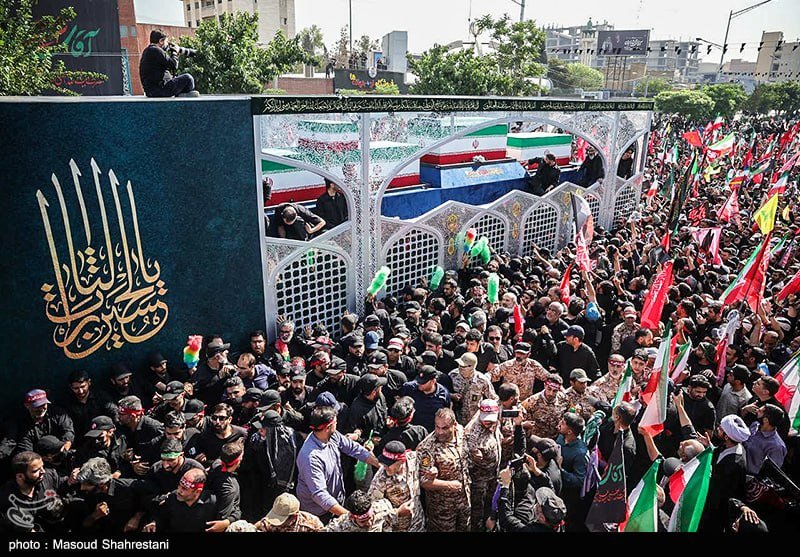
Before dawn on 6 July 2026, a stream of short, on-the-record statements from a man named Sardar Hassanzadeh began circulating through Iranian state-aligned Telegram channels. Hassanzadeh identified himself as chief of staff for what was described as the funeral ceremony of the "Imam Martyr of the Ummah." His announcements were logistical, almost municipal: the route had not changed; mourners should move from east to west; the procession would pass Revolution Square on its way to Azadi Square; the vehicle carrying the body had been prepared and was moving; people should stay on the path. Read in isolation, the messages look like civic instructions for a city bracing for an enormous crowd. Read together, they are something more interesting — the operational grammar of an Iranian state funeral, broadcast live through outlets including Tasnim and Fars.
Funerals in the Islamic Republic are not neutral civic events. They are the rare public ritual in which the regime is permitted to script mass emotion at scale, and the state has spent four decades refining the form. The 6 July announcements illustrate the mechanics: a single named coordinator issues repeated, narrow updates; the route is fixed in advance; "calm" is the word used to describe how participants should approach the central square. Each instruction doubles as a reassurance to the system that produced it.
What the choreography tells you
The logistics are themselves the message. Hassanzadeh's repeated insistence that the path had not changed — issued twice in roughly two minutes, at 04:11 and 04:13 UTC — is the kind of detail that becomes newsworthy only when there is reason to suspect it might. In Iranian state media, redundancy of that kind is a hedge against both crowd disorder and the perception of disorder. The mention of the "nearest point" to Revolution Square as a place to position the bodies of martyrs is similarly deliberate: the bodies are routed to the people, not the other way round. Tasnim framed the sequence as an instruction to mourners to "move towards west and Azadi Square" — a westward procession whose endpoint is the square most associated in Iranian political mythology with the mass rallies of 1979.
Fars, which has historically operated with a slightly more emotive register than Tasnim, broadcast the imagery: the car carrying the bodies of martyrs moving; people "calmly" approaching Azadi Square. The word "calmly" does useful work. It is the descriptor a regime reaches for when it needs to demonstrate that a crowd of unmanageable size is, in fact, manageable. It also pre-empts the framing that international observers will reach for if anything goes wrong: the assurance that order prevailed is built into the vocabulary of the announcement itself.
The counter-read
It is tempting to read these announcements as pure stage management — the securitisation of grief, the conversion of mourning into a choreographed display of institutional authority. There is a counter-read worth taking seriously. Iranian public funerals are also one of the few spaces in which the Islamic Republic permits itself to be visibly porous. Millions of Iranians attend these processions not as conscripts but as mourners, and the dense, slow movement of a westward procession through central Tehran is, for participants, a genuine civic act with its own affective weight. The fact that the regime scripts the route does not dissolve the crowd's reasons for being there.
The honest framing sits between the two. State funeral choreography in Iran is not a Potemkin exercise in the crude sense — the bodies are real, the mourners are present, the grief is widely shared — but it is also not a spontaneous civic outpouring. It is a managed convergence in which a regime with dwindling instruments of legitimation invests heavily in the one ritual that still reliably produces mass attendance.
Why the language matters
Three small linguistic choices in the 6 July announcements are worth pausing on. First, the title "Imam Martyr of the Ummah" — the Arabic ummah rather than the Persian mellat — positions the deceased and the mourning crowd within a transnational Islamic frame rather than a national Iranian one. Second, the consistent designation of Hassanzadeh as "chief of staff for the funeral ceremony," with the military-style rank intact, signals that the operation is being run as a command-and-control exercise, not a civilian-orchestrated memorial. Third, the routing of the procession along an axis that terminates at Azadi Square — the physical site at which the legitimacy of the current order was first publicly proclaimed — is a deliberate piece of urban political symbolism. None of this is hidden. It is simply stated, in the flat operational language of Telegram updates, because it does not need to be hidden from the audience for whom it is intended.
Stakes
The stakes of reading this correctly are modest but real. Western wire coverage of Iranian state funerals tends to oscillate between two tired registers: the regime-as-pantomime frame, which treats the choreography as evidence of a brittle system performing legitimacy it does not possess, and the regime-as-threat frame, which treats mass public rituals as a leading indicator of mobilisation. Neither fits a procession whose operational language is closer to municipal traffic control than to political theatre. The pattern worth tracking is the refinement of the form — the degree to which the Islamic Republic can keep producing mass rituals that read, to international audiences, as orderly and voluntary. On the evidence of 6 July, the system still knows how to do that. The sources do not specify the scale of attendance, and independent verification of crowd numbers at Iranian state funerals is notoriously difficult to obtain; what the Telegram record does establish is the deliberate, repeated, narrowly logistical tone in which the event is being narrated to its own public.
This piece reads the Iranian state-aligned coverage of the 6 July funeral procession as primary source material. Wire services should be treated as downstream corroboration, not as the originating frame.
Wire provenance
This editorial synthesis draws on the following public wire/social posts:
- https://t.me/tasnimnews_en/0
- https://t.me/farsna/0
- https://t.me/tasnimnews_en/0