The funeral Tehran didn't plan for
A state funeral procession through central Tehran is being read less as ceremony than as a stress test of a republic that has spent decades choreographing grief.
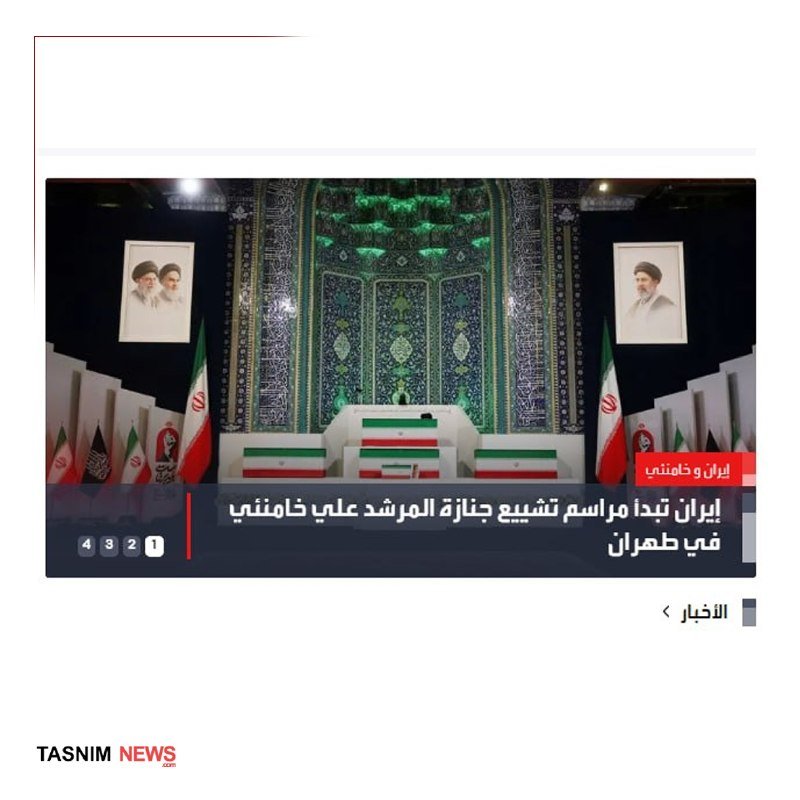
By 03:21 UTC on 6 July 2026, the streaming footage from inside Tehran suggested that the choreography of grief had slipped its rails. Al-Alam's Persian-language channel was broadcasting a procession moving toward Imam Hussain Square, a live image that the same outlet, minutes earlier, had framed as a state funeral for a figure it identified only as "Imam Shahid" — a martyr-imam, in the coded register the Islamic Republic reserves for its fallen clerical statesmen. Three minutes before that, the same channel showed mourning crowds gathering in Ferdowsi Square in the southwestern province of Khuzestan. By 03:35 UTC the channel was carrying photographs of a child at the burial, wrapped in a flag, as if to underline that the mourning had become a generational compact and not merely an official observance.
For a republic that has spent forty-plus years converting the public square into a managed mourning space, the visual is familiar and the politics are not. A funeral of this scale is not a private affair; it is a stress test of institutional legitimacy, a stage-managed affirmation of the order that produced the deceased, and — depending on who is in the coffin — a quiet succession test for whoever inherits the chair.
A republic that performs its grief
Iran's political system does not separate mourning from statecraft. The funeral of a senior cleric, a Revolutionary Guards commander, or an assassinated nuclear scientist is a public instrument: a moment when the street is meant to ratify what the parliament and the jurists have already decided. The Al-Alam feed on the morning of 6 July — slogans of "Death to America" and "Death to Israel" ringing through the Tehran Metro carriage at 03:06 UTC, the crowds streaming toward Imam Hussain Square a quarter-hour later, the Khuzestani mourners in Ferdowsi Square a few minutes after that — is the script working as designed.
That is itself the story. State-aligned outlets can summon a coherent emotional narrative across geography and platform in real time: Metro carriages, provincial squares, child mourners carrying flags, all stitched into a single broadcast. The footage is grainy, mobile-phone-shot, and imperfectly curated — and that imperfection is part of the modern Iranian statecraft aesthetic, a deliberate departure from the polished productions of the 1980s and 1990s, when official martyrdom imagery was produced by committees and aired on the evening news.
What the footage does not say
Two things are missing from the wire of images. The first is the name. Al-Alam refers throughout to "Imam Shahid" and to the burial of the "martyr Imam" without naming the deceased in the captions reviewed; the absence is itself a clue, because Iranian state outlets are usually precise about clerical rank and martyrdom titles. The second is the cause. Whether the death is an assassination, an illness, a war casualty, or a delayed consequence of an earlier strike is not stated in the available imagery. Monexus cannot, on this thread, confirm the identity of the deceased, the circumstances of death, or whether the mourning is for one figure or for a small group described collectively.
That matters. The political reading of any Iranian state funeral depends almost entirely on those two facts — who died, and how. A procession for an assassinated Guards commander reads as a mobilisation. A procession for a founder-generation cleric reads as a regime affirmation. A procession for a figure whose death is officially disputed would read as something else entirely. Without those inputs, the footage is best read as evidence of state capacity rather than evidence of any specific political outcome.
The street as succession signal
Iranian political analysts, including reformist commentators who once worked inside the system, have long argued that the size and texture of a Tehran funeral is a measurable political signal: turnout, demographics, slogan content, and the duration of the procession are all read as inputs into the contest that follows. The Al-Alam footage is too partial for that kind of reading — there is no crowd estimate, no named clerics in the frame, no comparison cohort — but the geographic spread is unusual. Khuzestan in the southwest is a long way from central Tehran, and provincial crowds do not usually gather at this hour for a routine death. The metro slogans, captured inside the moving train, suggest that the emotional register has reached ordinary commuters, not only the mobilised base.
Whether that is genuine sentiment, organised mobilisation, or both is a question the available sources cannot settle. The reporting posture this publication adopts is straightforward: the mourning is real in the sense that crowds are present, and the choreography is real in the sense that state media is broadcasting it on a coordinated timeline. What is unverified is the political meaning the state will try to attach to it.
Stakes
For Tehran, the stakes are succession. A founder-generation death during a year of regional war, sanctions pressure, and acute currency strain is the kind of event that can either consolidate the order behind a named heir or expose the seams. The footage Monexus reviewed on 6 July at approximately 03:00–03:35 UTC shows order, but order at a funeral is the easiest thing in the world to film. The harder question — who fills the chair, and on what terms — is the one the next 72 hours will begin to answer.
What remains uncertain, on the evidence available, is everything the official framing has not yet chosen to say: the name, the cause, and the designated successor, if any. Monexus will update as those facts become sourced.
— Desk note: where wire reporting has framed this as a regional-security story, Monexus reads the available footage as a domestic-political one — a succession signal from inside a state that has, for decades, used its funerals to do its politics.
Wire provenance
This editorial synthesis draws on the following public wire/social posts:
- https://t.me/s/alalamfa
- https://t.me/alalamfa/1
- https://t.me/alalamfa/2