Crowds gather in Tehran at dawn for funeral of 'martyred leader' as state media shapes the frame
State-aligned outlets show packed pre-dawn metro trains and a Revolution Square stage dressed with a clenched-fist symbol as Iran stages a high-emotion farewell to a leader it already calls a martyr.
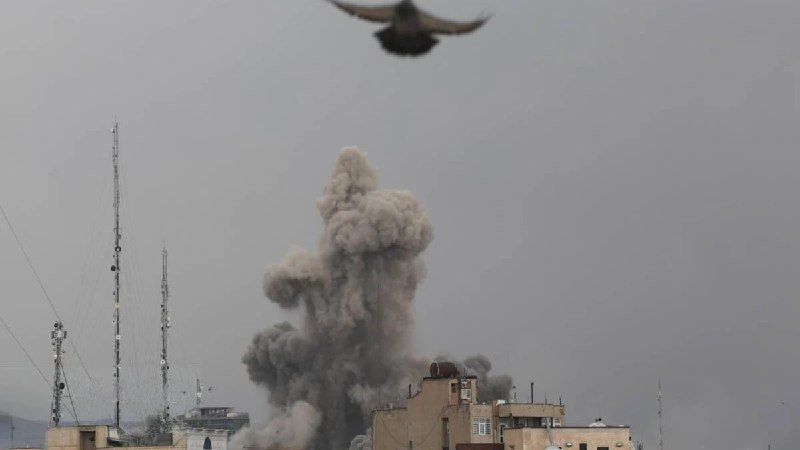
It was barely five in the morning in Tehran on 6 July 2026, and the metro was already overflowing. According to posts on the Middle East Spectator Telegram channel timestamped 01:54 UTC and 02:47 UTC, women mourners filled subway cars on the way to a funeral ceremony officials had labelled a farewell to a "martyred leader," while Tasnim News, the outlet closest to Iran's Islamic Revolutionary Guard Corps, broadcast images of Revolution Square dressed with a giant clenched-fist symbol an hour before the official start of the ceremony.
What is unfolding is not a standard state funeral. It is a state funeral staged as martyrdom theatre — a ritual in which the Islamic Republic's preferred vocabulary ("shahid," "martyred leader," "must rise") has been installed in stage design, hashtags and crowd choreography long before the procession begins. The frame is being set by the broadcasters, and the broadcasters are the IRGC-adjacent ones.
A choreography built on hashtags and symbols
Tasnim's English service, in a post at 02:36 UTC, carried the line "Mr. Ma is leaving Tehran forever" alongside the hashtags #Badarqa_Aghai_Shahid_Iran and #must_rise, with the @TasnimNews handle pinned into the caption. The phrasing is unusually direct: not "the late," not "the deceased," but a call to "rise." The Tasnim Farsi service, at 01:49 UTC, paired imagery of Revolution Square with a clenched-fist installation and the line "a large crowd of people" already gathering an hour before the formal ceremony opened. Both posts were captured before dawn local time, when official attendance figures can still be photographed against an empty square.
The Middle East Spectator feed, an aggregation channel rather than an outlet with its own newsroom, filled in the human texture: trains at 05:00 local time "literally impossible to walk" through, women in mourning travelling in groups to the venue. The Tasnim Farsi post at 02:47 UTC recorded the same scene from inside the system — a group of women in the Tehran subway heading to the funeral — without naming a count, a route or a neighbourhood.
What the four posts share is vocabulary, not verification. Three of them explicitly invoke the "shahid" frame. None of them supplies independent corroboration of who exactly has died, the cause of death, the official title held by the deceased, or the institutional role that entitled him to a Revolution Square funeral. The sources do not specify.
The counter-narrative that isn't there
In a domestic Iranian information environment, the absence of a counter-narrative is itself a story. Opposition outlets based outside the country — Iran International, BBC Persian, IranWire — have not, on the evidence of the four items in front of this publication, been cited by the broadcasters driving the frame. Tasnim's bilingual reach and its direct ties to the IRGC's media apparatus give it the ability to set a single, repeatable caption in two languages before external outlets can ask follow-up questions. The hashtags function less as discovery tools than as loyalty tests: the phrasing the state wants is the phrasing you copy.
A skeptic would ask why this matters for readers outside Iran. It matters because the framing — martyrdom, leader, must rise — is precisely the lexicon associated in international coverage with activation of the regional deterrent posture Iran has built over the last two decades. Whether or not the symbolism is meant to travel that far, it travels. The text is the policy in shorthand.
The structural picture, in plain language
Iranian state-aligned outlets have spent the last several years refining a template for high-emotion national moments: secure the venue, dress it with the symbol, prime the crowd before dawn, and let the broadcasters release the imagery while foreign reporters are still filing overnight. The template has two effects. Domestically, it compresses the window in which any alternative read of the event can circulate — the funeral is over before the diaspora has had time to translate, annotate and rebut. Internationally, it forces wire services into a default of either reproducing Tasnim's framing or refusing to characterise the event at all.
This is not a media story unique to Iran, but it is a particularly tight example of it. Where commercial outlets have to balance access against accuracy, an IRGC-adjacent outlet can subordinate accuracy to access and still reach a global Farsi-speaking audience at speed. The economic logic is different: the outlet is paid in legitimacy, not in clicks. That changes what counts as a successful piece of journalism inside the system.
What the sources do not tell us
The four Telegram items in front of Monexus do not name the deceased's full title, do not state the date of death, do not identify the specific shrine or square beyond "Revolution Square," and do not carry a casualty count, an attendance figure or a foreign-presence list. They also do not record a statement from the office of the Supreme Leader or from the Foreign Ministry, nor any reaction from neighbouring capitals. The framing is domestic-only and is being delivered in a closed-loop pattern: Tasnim to Tasnim, Tasnim to aggregator, aggregator to global Farsi feeds.
The plausible alternative read is straightforward. Theatrical staging, pre-dawn crowd-priming and IRGC-adjacent broadcaster control do not, by themselves, prove that the underlying event is anything other than what the state says it is. Many countries stage elaborate funerals for fallen leaders. But the question worth asking is whether the staging itself is also policy — whether the clenched fist, the hashtags and the dawn choreography are designed to do something beyond honour a death. The four source items do not let this publication answer that question. They let it ask it.
Desk note: Monexus is reporting this from a four-item Telegram cluster dominated by Iranian state-aligned channels and one aggregator. Wire services have not yet been cited because they had not, on the evidence in front of this publication, published in the window covered. The piece is deliberately understated: the sources do not yet support a verdict on what the ceremony signals beyond the frame Iran itself is putting on it.
Wire provenance
This editorial synthesis draws on the following public wire/social posts:
- https://t.me/tasnimnews_en
- https://t.me/tasnimnews_en
- https://t.me/Middle_East_Spectator
- https://t.me/tasnimplus
- https://t.me/tasnimnews