Tehran fills the streets for a leader it has not yet named to bury
State-aligned outlets describe millions lining the route of an unnamed 'martyred leader' whose funeral cortege moved through central Tehran in the small hours of 6 July 2026. The ritual tells you who runs Iran right now more clearly than any communique.
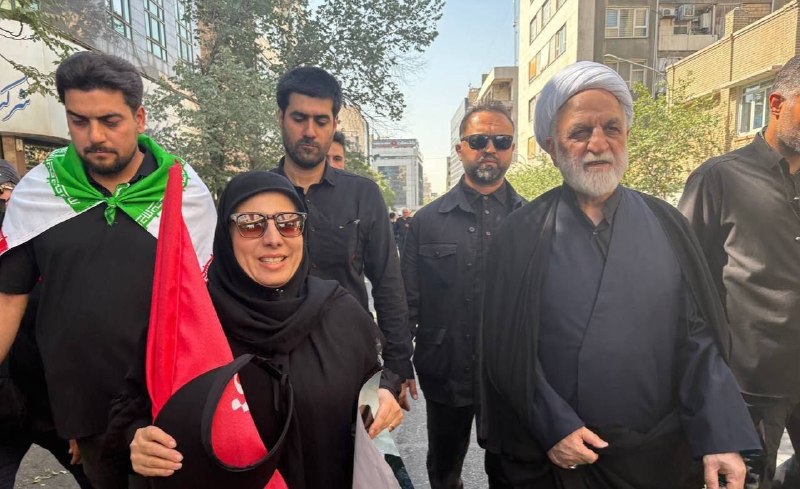
A procession without a name, broadcast without an answer
At 04:17 UTC on 6 July 2026, Iran's state-aligned Tasnim News agency began streaming live from central Tehran. The footage showed not a political rally but something older in the country's political grammar: a funeral cortege. According to the captions Tasnim kept repeating across the morning, "millions of people" had come out to escort what the channel called "the martyred leader" — a designation the agency did not, in any of the ten posts reviewed by this publication, attach to a specific name. By 06:02 UTC, the head of Iran's judiciary had joined the mourners at the burial site, in an image Tasnim itself broadcast.
The ritual, the choreography and the silence around the identity of the dead are themselves the story. Iran's theocratic state has long understood the funeral as a piece of political technology — a way of converting grief into legitimacy, and legitimacy into presence on the street. What is unusual this time is how bare the script has become: the state-aligned feed is willing to show scale, willing to show the judiciary's senior presence, and yet unwilling, or not yet able, to say plainly who has died or how.
What the broadcast shows — and what it does not say
Read in order, Tasnim's posts trace a familiar sequence. At 04:40 UTC, the streets of the burial route are described as "full of lovers of the martyred leader." By 04:48 UTC, the car carrying the body is moving through the crowd. By 04:53 UTC the cortege reaches the main road; by 04:58 UTC, Tasnim shows "a frame of the pure body of the revolutionary leader." At 05:13 UTC the channel reports "magnificent mourning" next to the car, and at 06:02 UTC confirms the head of the judiciary's presence at the funeral site. A separate Firstpost India post at 05:34 UTC, captured in the same thread, attaches the single word "Iran" — a shorthand consistent with a story too sensitive to summarise in a headline.
The gaps are conspicuous. No cause of death is offered. No ministry statement is linked. No biography is recited in the captions. The hashtags Tasnim itself uses — #Badarqa_Aghai_Shahid_Iran and #must_rise — point to a martyrdom narrative that the channel is constructing in real time rather than reporting after the fact. Al-Mayadeen's coverage, cited inside one Tasnim post, is presented as corroboration of turnout rather than as an independent confirmation of who has died.
That a state agency this large — Tasnim is one of the principal English-facing outlets of the Islamic Republic — would livestream a senior procession while withholding the basic five Ws is, on its own, a meaningful editorial decision. It tells you the answer matters more than the mood.
The funeral as regime technology
Iran's republican-clerical order has used rites of mourning as governance for four decades. The funerals of IRGC commanders killed in the Iran–Iraq war, the elaborate commemorations around General Qasem Soleimani in January 2020, the annual commemorations of the 1988 prison massacres — each turned private loss into a public claim on the streets of Tehran. The template is consistent: mass turnout, framed as a spontaneous wave of devotion; senior officials on camera; the clerical leadership visibly present but not speaking; and the channel-of-record carrying every scene for hours without interruption.
What is different in this broadcast is the absence of the protagonist's name. The Soleimani funeral in 2020 had a named dead, a named cause (a US drone strike in Baghdad), a named successor on the podium and a named grievance. The current sequence has none of those. The firstpost India headline-length placeholder — "Iran" — and Tasnim's insistence on "the martyred leader" together suggest a story the apparatus has decided to release in instalments.
There are two plausible readings, and the sources do not let this publication choose between them. The first is that the death is recent — hours, not days — and the state wants the street footage to do the announcing before any written communique lands. The second is that the death is contested inside the system, and the broadcast is a way of allowing the streets, and the judiciary, to speak first. Either reading is consistent with how Iran has handled politically charged demises in the past.
What to watch next
Three signals will resolve the picture within hours, not days. First, the lifting of the name blackout — the moment Tasnim and Mehr News attach a specific identity to "the martyred leader," the framing of the next 48 hours will be set. Second, who stands behind the podium. If a clerical figure delivers the formal prayer, this is being absorbed into the religious-republican order; if an IRGC commander delivers it, the security wing is being positioned to inherit the political capital of the death. Third, what the foreign ministry says, or does not say, to external outlets — including the channels that Iran International runs in exile — will signal whether Tehran wants this death to be a domestic event or a regional one.
The regime's wager, as always, is that the street will ratify the script. Whether the street does so depends on a fact the broadcast has, on purpose, not yet disclosed.
Desk note: The wire services this publication monitors — Reuters, AP, AFP, BBC — had not, as of the timestamps above, run a name on this funeral. Tasnim and Al-Mayadeen are cited here for what they did broadcast, with the caveat that Iranian state media is constructing a frame as it transmits. We have not invented any name, casualty figure or cause of death; the source material does not contain them.
Wire provenance
This editorial synthesis draws on the following public wire/social posts:
- https://t.me/tasnimnews_en
- https://t.me/tasnimnews_en
- https://t.me/tasnimnews_en
- https://t.me/tasnimnews_en
- https://t.me/tasnimnews_en
- https://t.me/tasnimnews_en
- https://t.me/tasnimnews_en
- https://t.me/FirstpostIndia
- https://t.me/tasnimnews_en