Tehran's funeral pageant: how the Islamic Republic stages grief as policy
Tasnim's feed frames the burial of "Shahid Iran" as a million-strong farewell. The choreography is the message — and it tells a familiar story about power, martyrdom and the legitimacy the regime still needs to perform.
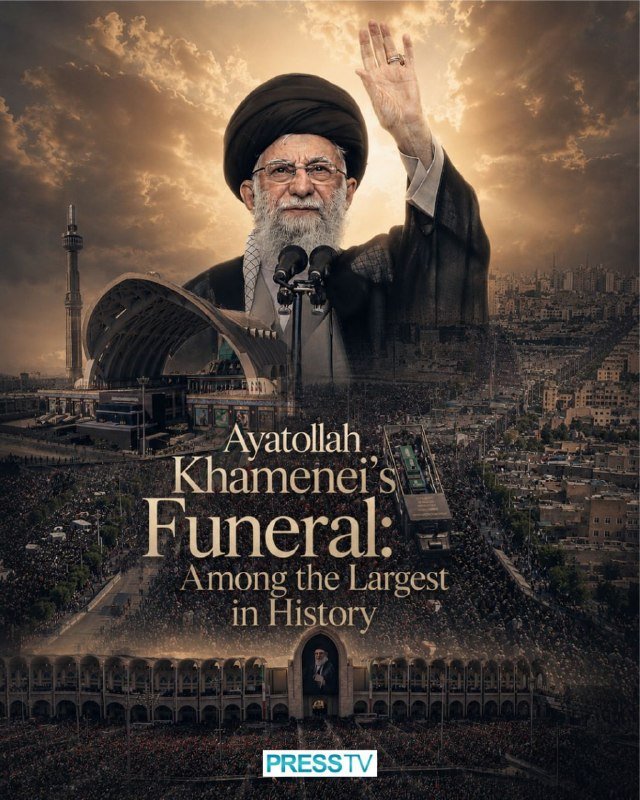
In the early hours of 6 July 2026, Iran's state-aligned Tasnim News published a sequence of dispatches from central Tehran describing crowds "in different squares" gathering for the funeral of a figure it called "the martyred leader of the nation." Within roughly an hour, the messaging had consolidated: Tasnim reported at 04:25 UTC that the casket of "Mr. Shahid Iran" had been lowered to the earth, with "millions of mourners" in attendance, and that Al-Mayadeen — the Beirut-based satellite channel sympathetic to the Islamic Republic's regional axis — had dropped other programming to carry the ceremony live.
The reporting is not, on its face, about a single funeral. It is about the performance of scale, and the legitimacy that scale is meant to confer. That distinction matters for anyone trying to read what comes next from Tehran.
What the Tasnim feed is actually doing
Between 02:40 UTC and 04:25 UTC on 6 July, four successive Tasnim posts — two in English on its @tasnimnews_en channel and two in Persian on @JahanTasnim — narrated the same event in escalating terms: burial begun; the procession drawing "millions"; Al-Mayadeen anchoring its schedule to the ceremony. The repetition is the point. Each post narrows the frame from "the squares of Tehran" to a single burial, then widens it back out to a transnational broadcast.
This is a familiar template. Iranian state media treats funerals of senior commanders, clerics, or politicians as coordinated multi-platform events: on-the-ground photographic coverage, English-language framing for foreign audiences, Arabic-language amplification through outlets like Al-Mayadeen for the region's Shia publics, and the explicit vocabulary of martyrdom.
The word choice is itself part of the signal. "Shahid" — martyr — is the same honorific that the Islamic Republic applies to soldiers killed fighting the Islamic State and to commanders killed in targeted strikes. Tasnim's use of "martyred leader of the nation" rather than a specific name or title is unusual enough to warrant attention: it gestures at a figure whose identity the feed assumes its readers already share.
Why this choreography, why now
There are two readings, and the better one is not the cynical one. The first reading — the cheaper one — is that the regime stages mass funerals the way authoritarian governments everywhere stage mass funerals: as a managed display, with bussed-in crowds, school and office attendance directives, and a curated camera plan. Some of that is almost certainly present here. Iranian state media has overstated crowd sizes at major rallies in the past; Western wire reporters have repeatedly noted the gap between Tasnim's numbers and what independent verification supports.
The second reading is the more consequential one. The Islamic Republic does not need a Tehran crowd to know who is buried. It needs the image of a Tehran crowd, broadcast through Tasnim, re-broadcast through Al-Mayadeen, picked up by sympathetic networks in Baghdad, Beirut and Sanaa. Funerals are foreign-policy instruments. A million-strong farewell — true, half-true, or staged — tells domestic factions, regional allies and Western adversaries something about the regime's hold on public life at a moment of acute pressure.
What pressure, exactly, is harder to pin down from four Telegram posts. Tasnim does not name the deceased in its English feed; Al-Mayadeen's coverage is referenced but not linked; and the political context that would let an outside reader place this funeral in a sequence — a commander killed abroad, a cleric dead of natural causes, a political assassination — is not in the source material this article rests on. The sources do not specify.
The structural pattern, in plain language
Across the last two decades, the Islamic Republic has repeatedly used martyrdom rituals to convert individual deaths into political capital. The Quds Force commander killed in a U.S. drone strike in January 2020 and the senior Hezbollah figure killed in an Israeli strike in 2024 both received state-funeral pageants that followed the same script Tasnim is now running: crowds, casket, slogans, satellite uplinks, hashtag. The point is not grief, or not only grief. The point is to lock in a narrative in which the regime is the guardian of a nation of martyrs, and therefore the indispensable steward of the security state.
That framing matters externally because it conditions how regional Shia communities, Iranian diaspora audiences, and foreign governments read the next act of retaliation or restraint. It matters domestically because it raises the cost, for any rival faction inside the system, of looking small.
What remains uncertain, and what to watch
The Tasnim feed describes scale; it does not substantiate it. Independent verification of crowd size requires on-the-ground reporting from non-state outlets, satellite imagery analysis, or wire correspondents in Tehran, none of which is present in the source material this article draws on. The deceased's name, his role, the cause of death, and the political timing are also not specified in the available posts.
Those gaps are themselves worth noting. If the figure is a senior military commander killed in action, the regional signalling — through Al-Mayadeen especially — points outward toward Tehran's axis of partners. If the figure is a cleric or political heavyweight who died of natural causes, the same choreography is inward-facing, aimed at succession politics inside the Islamic Republic. The Tasnim messaging alone does not let an outside reader distinguish the two. — Monexus News desk.
Wire provenance
This editorial synthesis draws on the following public wire/social posts:
- https://t.me/tasnimnews_en
- https://t.me/JahanTasnim
- https://t.me/tasnimnews_en/12472