The funeral in Tehran and the framing of a regime's inheritance
PressTV's funeral coverage is doing the framing work the rest of the world's cameras will follow — and the inheritance question underneath is being staged in advance.
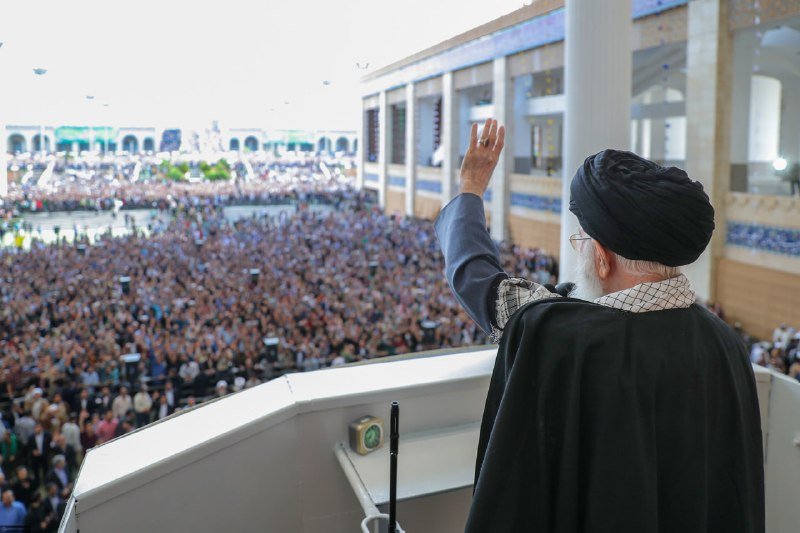
The cortège rolled into central Tehran in the small hours of 6 July 2026. State television carried the footage live: a slow procession bearing the coffin of the Supreme Leader, flanked by the coffins of martyred family members, moving from the Grand Mosalla toward a funeral route the Islamic Republic had spent two days preparing. PressTV's early-morning bulletin, filed at 04:18 UTC and refreshed at 04:28 and 04:56 UTC, called it, in its own capitals, "A VERY HISTORIC DAY."
There is no honest way to write about a state funeral inside the Islamic Republic without confronting the gap between the cameras and the institution. PressTV is, by its own description and by every reasonable external assessment, the English-language voice of Iranian state media. Its framing — the word "martyred" applied to the leader and his family — is not a translation of public sentiment. It is the production of public sentiment. That is the actual news: when the entire visible apparatus of a state-orchestrated mourning event is also its own broadcaster, the line between documenting history and scripting it dissolves on the page. Coverage that uncritically borrows the regime's vocabulary inherits the regime's argument. The wire services covering the procession will, by deadline pressure and the absence of alternatives, borrow it.
The English-language ministry of grief
PressTV's three Telegram dispatches in a 38-minute window do not describe a funeral. They sequence a liturgy. First the vehicle is "prepared." Then the coffins are placed. Then the procession moves. Each frame is captioned to instruct the reader on what they are seeing, and what to call it. The word "martyred," repeated for the leader, his family, and the framing of the event itself, does significant constitutional work — it positions the deceased within a theocratic register that fuses political authority and religious sacrifice, and it tells the diaspora, the opposition, and foreign capitals how the state intends the transition to be remembered.
The functional problem is not that PressTV is biased. Every broadcaster covering its own country on a day of national mourning is. The problem is structural: in the hours when global wire desks are filing from the same footage, PressTV is the only producer of the canonical English-language record. Reuters, AFP and the BBC will run their own video; they will not, in real time, re-translate the Persian frame. The language of the dispatches — the procession route, the Grand Mosalla, "millions of mourners" — travels downstream into global coverage faster than the press corps on the ground can contextualise it.
What the cameras are not showing
The two-day mourning period PressTV referenced took place against a backdrop that the same cameras have been instructed, for years, to keep at the edges. The dress code for female journalists reporting from the official pool has tightened. The reporters who might have asked an inconvenient question at a previous succession — the reformist newspapers, the women who covered the 2022–23 protests, the diaspora outlets — are not in the broadcast booth at the Grand Mosalla. The PressTV captions are not lying about the size of the crowd; they are selecting which crowd gets to count.
There is a counter-narrative that the dominant framing will, by design, fail to absorb: the line of succession inside the Islamic Republic is being staged not only in the streets of Tehran but in the editorial language surrounding the event. "Martyred" is a choice. "Leader of the Islamic Revolution" is a choice. "Historic day" is a choice. Each one pre-loads the answer to the question every foreign desk will be filing on by 7 July: who was he, what did his rule mean, and what comes next. The Iranian state has, in effect, become its own first draft of its own history.
The succession under the procession
The deeper editorial question is not the procession. It is the inheritance. Iran does not have a codified public mechanism for transferring supreme authority; the Assembly of Experts deliberates, the Revolutionary Guard enforces, and the public learns. A state funeral that is also a state broadcast is therefore not just a memorial. It is the first act of a transition in which the framing of the deceased determines the legitimacy of the successor. PressTV's vocabulary — the family in the procession, the chosen religious register, the scale of the gathering — is a soft launch for the figure who will, within days or weeks, be presented as the continuity candidate.
This publication's reading is that the funeral coverage should be treated as an artefact of the transition, not as neutral documentation of it. The western wire lines will file through the night; some will quote PressTV's word "martyr" because the dispatch is in English and the deadline is now. The diaspora papers and the opposition networks will file in Persian and in tones PressTV will never carry. Both are part of the record. Neither is the whole record. The honest journalistic posture is to print what the camera showed, name the producer of the language, and reserve judgement on what "historic" turns out to mean once the next Supreme Leader is named.
What we cannot verify, and what we should not pretend to
The available dispatches establish that the procession occurred, that PressTV framed it in the language described above, and that the state apparatus controlled the broadcast channel. They do not establish the actual size of the crowd, the internal dynamics of the succession, or the reaction inside Iran beyond the camera's frame. They do not tell us what the women of the Grand Mosalla, the minorities in the periphery, the prisoners whose names were not read, will remember of the day. Those silences are not PressTV's alone; they are the structural condition of every state funeral, in every system. The job of the foreign desk is to mark the silence, not to fill it with imported vocabulary.
This piece treats PressTV as both subject and source. Where the wire is the only signal in the room, the editorial posture is to credit the producer, quote the language, and refuse to inherit the frame.
Wire provenance
This editorial synthesis draws on the following public wire/social posts:
- https://t.me/presstv/1
- https://t.me/presstv/2
- https://t.me/presstv/3