Tehran's funeral square and the limits of state-managed grief
Tasnim and Mehr frame the burial in Imam Hossein Square as a mass mourning for a 'martyr of Iran' — a tightly choreographed ritual that tells us more about the regime's hold on grief than about the crowds themselves.
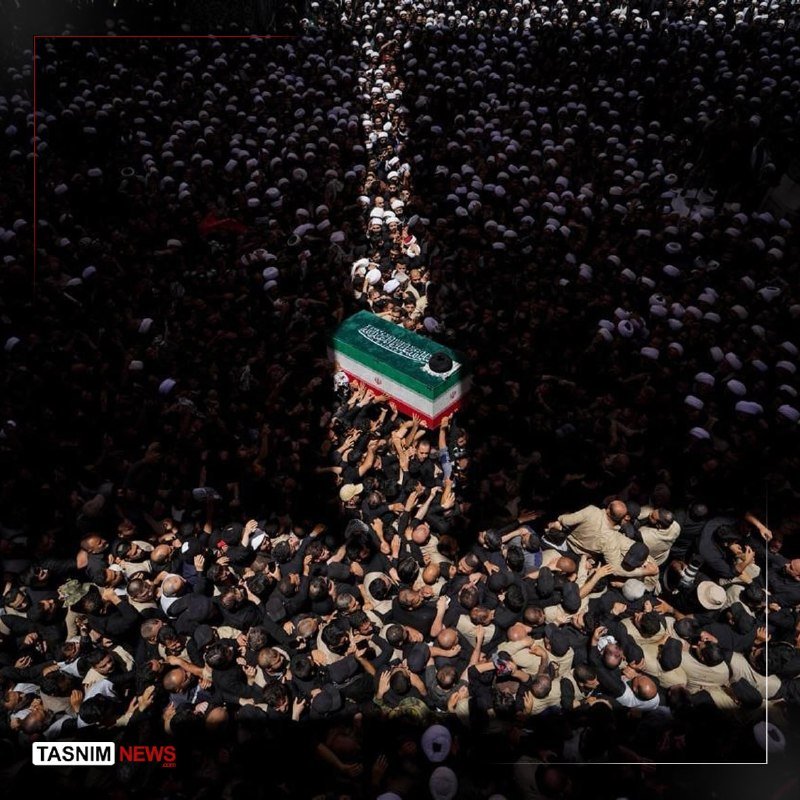
At roughly 02:53 UTC on 6 July 2026, Iran's Mehr News wire pushed the first frames from Imam Hossein Square in central Tehran: a crowd, said to be in the tens of thousands, filing into the square for the opening moments of a state funeral ceremony. Within the next hour, state outlet Tasnim was posting video of the national anthem and aerial shots of the same square, hashtagging the event "Badarqa Aghai Shahid Iran" — a frame that translates, roughly, to "the martyr of Iran must rise." By 04:31 UTC, Tasnim's English channel was broadcasting imagery of an effigy of Donald Trump being symbolically hanged above the same crowd.
The Iranian state press is doing exactly what it is built to do in such moments — saturate the frame, define the meaning, and deliver the crowd to international observers in a single, controlled package. Read carefully, the footage tells two stories at once: one about an event in Tehran, and another about who gets to narrate it.
What the wire footage actually shows
The Tasnim feed runs in near real time: crowd shots at 03:05 UTC, the anthem at 03:29, a capacity square at 03:32, the Trump effigy at 04:31. Mehr, the other state-aligned outlet in the cluster, corroborates the open moments of the ceremony at 02:53 UTC. Both outlets describe the deceased as "Mr. Martyr of Iran" — a translation choice rather than a name — and direct viewers toward a single shared hashtag.
What is missing is more telling than what is present. Neither outlet has, in this thread, named the figure being buried, given a cause of death, listed a date of death, or identified the family receiving condolences. The architecture of the coverage privileges ritual over biography. The square is the subject. The martyr is the occasion. The crowd is the proof.
The ritual script
Iranian state funerals are not news events so much as choreographed political theatre, and this one follows the standard script: gathering at Imam Hossein Square, the national anthem, a martyr framing, and at least one effigy designed for international consumption. The Trump effigy, in particular, is not aimed at Iranians in the square. It is aimed at the cameras that will rebroadcast the footage abroad — a way of registering alignment, grievance, or defiance for an external audience that has no way to verify whether the moment was spontaneous or staged.
This is the part Western coverage routinely flattens. The image of a crowd at a state funeral is read, in much of the Western press, as evidence of mass sentiment. The more accurate reading is that it is evidence of an organised political surface — a moment in which the regime has spent weeks preparing a stage, mobilising participants, and selecting the foreign-policy message it wants the day's footage to carry.
Counter-reads worth taking seriously
Two counter-reads deserve air. First, a structural one: in a country where independent media is constrained, state outlets are the only game in town, and the footage they release is what the outside world sees. Crowds do turn up — Iranians are not automatons — but the camera's permission to be present is itself a political fact. Second, an incentive-based one: the martyr framing, the effigy, and the hashtag are not designed to convince sceptics. They are designed to consolidate the regime's base at a moment when internal pressure, sanctions strain, and the cost of regional confrontation make ritual unity useful.
The dominant Western frame — "Iran stages massive funeral" — captures the staging but misses the function. The dominant Iranian frame — "the nation mourns" — captures the function but denies the staging. Neither is wrong, exactly. Both are incomplete.
What remains uncertain
The sources do not specify who is being buried, when they died, or how. They do not give an independent crowd estimate; "large number" is the only scale offered. They do not name any Western wire outlet that has independently verified the scene from inside the square — a meaningful gap, given how thoroughly Iranian state media controls visual access to events of this kind. Until at least one independent corroboration lands, the footage should be read as the regime's authorised account of itself.
The harder, more durable question is what these rituals accomplish at this moment. If Tehran is signalling escalation, the square is doing the talking. If it is signalling internal cohesion under pressure, the square is doing that too. The ambiguity is the point.
Desk note: Monexus treats Iranian state outlets as primary sources for what the Iranian state wants shown, not as neutral documentation. The framing here reflects that distinction and resists the easy binary of "genuine mourning" versus "stage-managed theatre" — both descriptions are partly right, and the overlap is where the political work happens.
Wire provenance
This editorial synthesis draws on the following public wire/social posts:
- https://t.me/tasnimnews_en/
- https://t.me/tasnimnews_en/
- https://t.me/tasnimnews_en/
- https://t.me/tasnimnews_en/
- https://t.me/mehrnews/