Tehran's farewell as choreography: state media, martyrdom, and the management of public grief
Tasnim and Mehr footage of a Tehran funeral procession reveals less about a death than about who gets to author a national grief narrative — and at what cost to the public record.
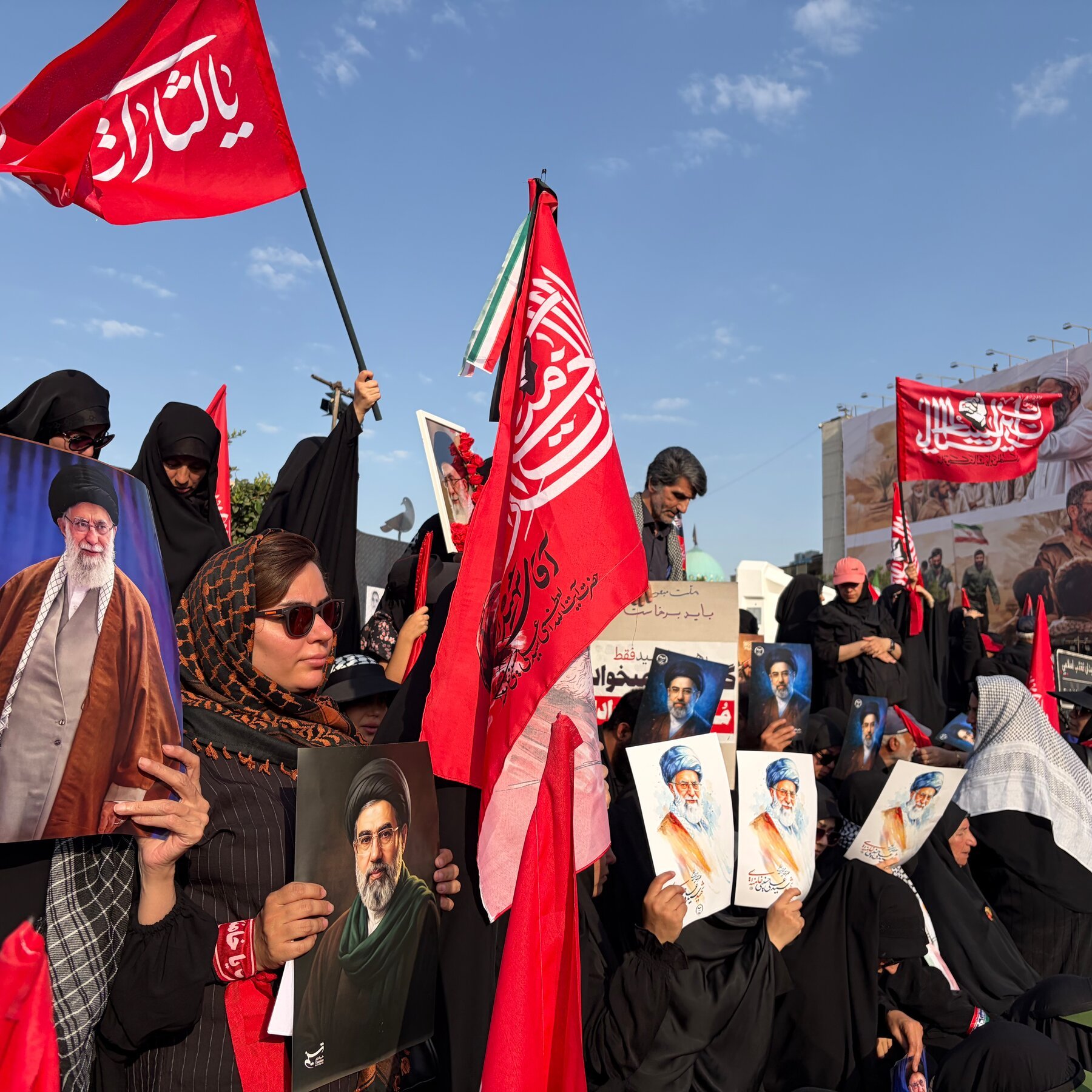
At 04:54 UTC on 6 July 2026, the English desk of Iran's Tasnim News Agency pushed a single dispatch: the vehicle carrying the coffin had turned onto Azadi Street, bound for Azadi Square in central Tehran. Eight minutes later Tasnim was reporting a "huge crowd" lining the route, and by 05:12 UTC the agency was using language not of politics but of liturgy — a "historic farewell to a leader whose name will remain in the memory of this land forever." Iran's Mehr News, minutes later, described Revolution Square as "full of lovers of the Martyr of Revolution."
The picture that emerged across four near-identical state-feed dispatches between 04:54 and 06:03 UTC was not a news event as much as a coordinated performance of public grief — a procession whose meaning had largely been settled before the hearse moved.
A procession with its script already written
What matters about this morning is not the crowds themselves, which may well have been genuinely enormous; what matters is the rhetorical frame Tasnim and Mehr wrapped them in. The dead man is referred to across all four dispatches as the "Martyr of the Revolution," as a "Quaid," and as a figure whose name now belongs to the national memory. Mehr's dispatch places "lovers" at the symbolic center of the capital. Neither Tasnim nor Mehr name the deceased individual in the dispatches reviewed here; both treat his identity as already settled cultural fact.
That is its own kind of editorial decision. The state-aligned wire services of the Islamic Republic have spent two decades turning major political funerals into coordinated media events, and the production language is now characteristic: crowd size reported as devotional witness, martyrdom as the unifying political category, and the square itself as a site of binding national ritual rather than a contested political claim.
The choreography extends beyond Tehran
These Telegram-side dispatches from Tasnim English and Mehr News are not lone voices. They are the tip of a much larger state communications system that includes Arabic-language Al-Alam, Farsi Press TV, and the IRNA backbone, all synchronized at moments of high symbolic load. By the time a Tasnim English reader in London clicked open their phone at 06:00 UTC, a coordinated set of visual materials, hashtagged slogans — #Badarqa_Aghai_Shahid_Iran circulated alongside #must_rise — and named places (Azadi Street, Azadi Square, Revolution Square) had already been pushed across at least two languages and several platforms.
The alternative read is straightforward: this is what grief looks like in a managed public sphere. Iran has a long tradition of mass public mourning, including for casualties of the eight-year war with Iraq in the 1980s, and citizens do turn out in their millions without state instruction. The presence of large crowds at a Tehran funeral is, by itself, unremarkable. What is worth naming is that this morning the wire services did not record the crowds; they authored them, into a martyrdom narrative already drafted.
What the footage is doing as media
The dispatches offer no casualty count, no independent witness, no verification of the claim that the procession is "historic," and no competing frame for the dead man's career. In their place, four discrete bits of content converge on the same message: devotion is total, grief is unified, the body's passage through the city is a national event. That convergence is the content.
Internationally, this kind of state-feed synchronization is often parsed by readers as either eyewitness journalism or as flat propaganda, and both readings miss the operational point. The morning's Tasnim and Mehr wires worked exactly as designed: they produced a single, repetitive, faith-forward account of a contested political figure, moved the account into global English-language Telegram feeds before Western wires could file independently, and locked the day's visual vocabulary — martyrdom, leadership, unity — into the rest of the news cycle.
Stakes for the public record
The reason to flag this morning's four dispatches is not to question the sincerity of the mourners, whose presence is reported at the level of crowd size across two outlets. The reason is that the public record of an Iranian political death is being assembled by a narrow set of state-aligned actors, that the categories used (martyr, qaid, beloved of the nation) are pre-loaded with political meaning, and that the spacing of the dispatches over barely an hour suggests not breaking coverage but a release schedule. For an international readership trying to understand what happened in Tehran on 6 July 2026, those four wires are the first frame everything else will hang on. That deserves to be named plainly.
Desk note: this piece reads the morning's Tasnim and Mehr dispatches as primary documents of state-aligned mourning media rather than as factual reporting, distinguishing eyewitness crowd presence from editorial interpretation of what those crowds mean.