Tehran stages a farewell and a warning: what the Jamkaran scenes actually signal
State media broadcast an enormous farewell in Qom for an unnamed 'martyred Imam' and his family. The choreography of the footage tells the reader more than the captions do.
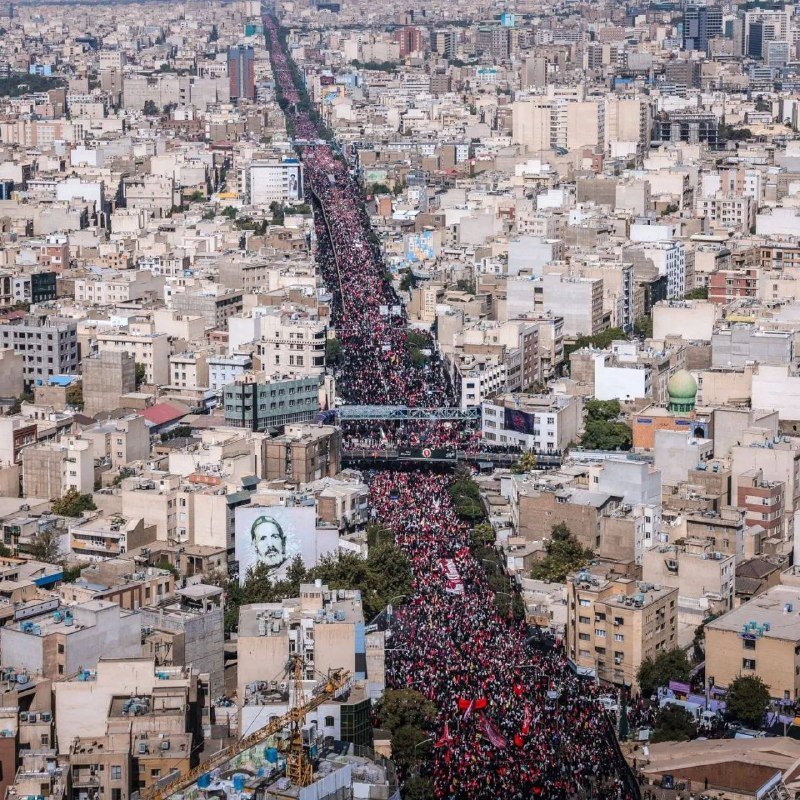
By 22:30 UTC on 6 July 2026, Iranian state-aligned channels were broadcasting the same scene on a loop: a mother in a wheelchair being helped toward the Jamkaran Mosque in Qom to say goodbye to a man the captions call "Imam Martyr." Crowds pressed the streets. Drones captured aerial views. Pilgrims interviewed on camera wept and chanted. The two outlets driving the coverage — Tasnim and Mehr — did not name the dead man, did not name the circumstances of his death, and did not name the family members buried alongside him. They named the place, the ritual, and the grief.
The point of that omission is the story. The Islamic Republic has learned, over four decades, that the most powerful political instrument in its toolkit is an unnamed martyr, surrounded by named devotion. Jamkaran, the domed mosque south of Qom that has served the ruling order as a stage for everything from contested Mahdi narratives to Ahmadinejad-era spectacles, is the right backdrop. So is the timing: a regional order under open strain, an Axis of Resistance that has bled fighters in Gaza, Lebanon, and Syria, and a domestic leadership transition that has been the worst-kept secret in the file for months.
A choreography the captions refuse to explain
Tasnim's English channel posted at least six video items on 6 July covering the farewell, beginning with aerial footage of the Jamkaran courtyard and building through the evening to the wheelchair-bound mother and a crowd "from all over the country" (Tasnim, 22:23 UTC). Mehr added a long-form video conversation with pilgrims, distributed through its main feed (Mehr, 22:15 UTC). The captions repeatedly use the phrase "Imam Shahid" — a clerical honorific — and refer to "the martyrs of his family," plural, but stop short of identifying the central figure. The hashtagged framing — #Badarqa_Aghai_Shahid_Iran and #must_rise — is presented as devotional rather than editorial.
Read alongside one another, the items describe a state-orchestrated display of popular grief in a cleric's holy city, broadcast in real time to a domestic audience, with no outlet willing to put a surname on the central corpse. That silence is not modesty. It is the regime's standard operating procedure for a specific class of event: a senior figure killed, almost always by foreign action, and the political utility of the death preserved until the controlled reveal is complete. The state gets the catharsis without the analyst's autopsy.
What the camera sees that the press release does not say
Three details carry weight. First, the choice of Qom. Jamkaran is not Tehran, not Khomeini's mausoleum, not the grand Friday prayer venues. It is a seminary city, the heart of the clerical estate. A farewell staged there is a message to the ulama — a signal that whoever is being mourned is being elevated into the clerical register, not just the security one. Second, the disability detail in the lead Tasnim clip. A mother in a wheelchair, pushed to a martyr's bier, is a deliberately chosen image. The regime's visual vocabulary treats the elderly, the disabled, and mothers at funerals as load-bearing pillars of the "popular" frame. It is the same vocabulary that produced the 2020 Soleimani funeral, scaled down to a family. Third, the timing of release. Footage is being cut, captioned, and pushed out to English-language state feeds as the crowd assembles. That is not journalism; it is direction.
The structural read: a regime rehearsing succession in public
For years the outside world has speculated about the post-Khamenei arrangement. The factional fight between principlists, the moderating camp around the previous administration, and the Revolutionary Guards' own political ambitions has been reported in granular detail by outlets from Reuters to the BBC to Iran International, and argued over inside Iran by economists and clerics who know the timeline is finite. The Jamkaran scenes suggest the system is now rehearsing the transitions it has been reluctant to name. Funerals are how clerical regimes convert power into legitimacy. A senior martyr, given a Qom farewell, with his family in the same grave, supplies the system with a usable saint and a usable lineage at once.
The geopolitical extension is plain. The head of the Axis of Resistance, weakened by the losses of the past two years, needs a martyrdom narrative to recharge its recruitment and its deterrence. A single high-profile clerical killing, in Iran rather than in a forward theatre, gives the propagandists an event that cannot be explained away as battlefield attrition. It also gives Tehran a reason to harden a posture that has been publicly flexible on a range of files, from nuclear talks to regional de-escalation.
The counter-read, taken seriously
The honest counter is that the footage may show exactly what it says it shows: an authentic funeral, a private family loss being mourned by a real community, with state media doing what state media does everywhere — running wall-to-wall coverage. Iran has a long tradition of devotional gatherings at Jamkaran, and large crowds at clerical funerals are not, on their own, a signal of crisis management. The disabled-mother shot, in particular, is the kind of footage that any competent photo desk would have on the wire because it is emotionally legible without translation. The state-aligned framing should be discounted accordingly. What is not in doubt is that the outlets chose to put these images in front of an English-language audience tonight, under hashtags, with English captions, on a date that coincides with an unusually active diplomatic calendar in the Gulf.
What remains genuinely unknown
The sources do not name the dead cleric, do not specify how he died, do not identify which family members were killed alongside him, and do not state the date of the killing that preceded the funeral. None of the eight items reviewed carries an attribution to a security service, a coroner, or an official spokesperson. The official Iranian outlets have, in past episodes of this type, withheld the name of the deceased for hours or days while the political audience was prepared; the same pattern is consistent with the items in this thread. Until a name is published, the reader is being asked to receive a martyrdom story with the martyred subject held back. That is itself a tell — and the only honest verdict an analyst can reach from this side of the wall.
Desk note: Monexus is treating the Tasnim and Mehr items as primary state-aligned source material. We have not named the deceased cleric because the source items do not name him, and we will update this piece on publication of a confirmed identity. Western wire coverage is absent from this thread; that absence is itself part of the story.
Wire provenance
This editorial synthesis draws on the following public wire/social posts:
- https://t.me/tasnimnews_en/
- https://t.me/tasnimnews_en/
- https://t.me/mehrnews/
- https://t.me/tasnimnews_en/
- https://t.me/tasnimnews_en/