Tehran turns a martyr's funeral into a state ritual — and a stage for what comes next
IRGC-aligned outlets publish the choreography of a mass funeral in Tehran. The political signal — about succession, doctrine and coercion — is the real headline.
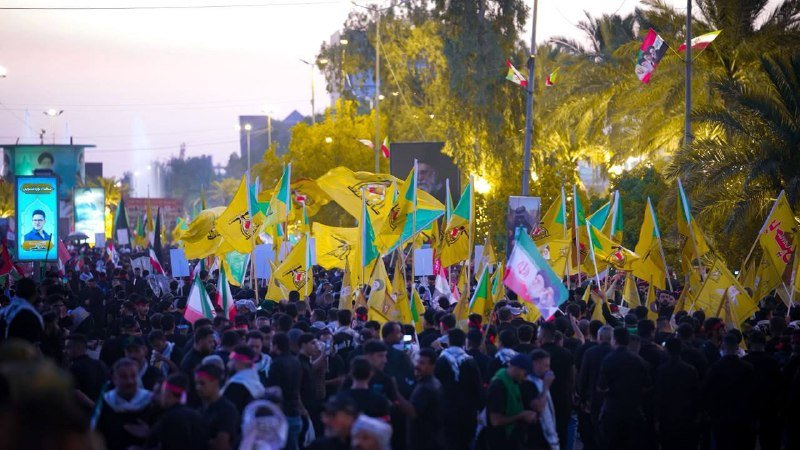
Iranian state-aligned outlets on Monday published the choreography of a funeral intended to do more than bury the dead. Telegram channels Tasnim and Fars, both closely tracked for the contours of Iranian decision-making, carried almost identical briefings from IRGC commander Sardar Hassanzadeh: the procession will run "from east to west" through central Tehran, with organisers attempting to "start from the nearest point" so that the bodies of those killed can be placed where the public can reach them. The first photograph of the vehicle carrying the remains of Supreme Leader Ali Khamenei — "the martyred leader of the Revolution and his martyred family," in Fars's words — circulated within minutes.
The signal is at least as important as the ceremony. After the 13 June Israeli strike that killed Iran's supreme leader, his family and a senior IRGC echelon, Tehran is using a state funeral to perform three things at once: demonstrate institutional continuity, re-anchor the doctrine of resistance around martyrdom, and warn adversaries that the leadership — and the security apparatus built around Khamenei's tenure — remains operational. The funeral is the velvet glove. Everything that follows the procession is the steel underneath it.
A route as political speech
Funeral choreography in the Islamic Republic has rarely been incidental. The 2020 procession for Quds Force commander Qassem Soleimani turned western Tehran into a stage for an explicit Iranian policy declaration — to the United States, to Israel, and to Iranian publics who were being told that the dead man's network had been vindicated by the size of the crowd. Hassanzadeh's announcement that the route has "not changed" and will still cut "from east to west" reads as continuity rather than improvisation. Iranian state media is signalling that the rituals used to consolidate Soleimani's martyrdom are now being repurposed for a much larger claim: that the supreme leader's death does not interrupt the system.
The geographic detail matters too. Funerals that pool traffic through central plazas function as soft-mobility exercises; the regime briefly controls the streets of the capital, the cameras are permitted, and the line between mourning and mobilisation blurs by design. By vowing to bring the bodies "from the nearest point" to where mourners can gather, the organisers are also managing the optics of crowd density — a numbers game in which overstatement has historically been the rule rather than the exception.
What is being asserted, and against whom
Strip the religious language away and the briefing does three pieces of political work. First, it asserts that the Iranian state can still organise a mass ritual in the capital nine days after a decapitation strike — implying that Israeli and American planners who anticipated paralysis miscalculated. Second, it asserts that the doctrine of martyrdom retains its mobilising force among the IRGC's base; the repeated word "shaheed" in the Fars captions is not decorative but doctrinal, the theological glue that binds the Basij, the families of the dead, and the clergy into a single political constituency. Third, it signals to Tehran's partners — in Baghdad, Beirut, Sanaa and Damascus — that the centre has not hollowed.
There is a counter-reading worth airing. Mass funerals in the Islamic Republic have also functioned as pressure valves, occasions where the state licenses public grief to reduce the temperature around contested decisions. Seen this way, the elaborate choreography could be evidence not of strength but of anxiety: an establishment reaching for the most emotionally saturated ritual in its repertoire precisely because lower-cost signals would not suffice. The same footage that demonstrates capacity can be read, by a sceptical observer, as a system spending legitimacy it cannot afford to spend.
The structural frame
Iran's regional posture has long been carried, more than any other institution, by the Islamic Revolutionary Guard Corps and by the political theology of the supreme leader's office. The loss of both in a single strike is not a routine succession; it is a discontinuous event. State-aligned media's choice to publish the procession logistics publicly, in advance, on Telegram — a platform that ranks among the most-cited information channels inside Iran despite periodic throttling — is itself a doctrinal statement about who the regime wants to address: a domestic and regional audience that consumes IRGC-curated content in ways Western wires cannot directly replicate.
Inside Iran, the next weeks will reveal whether the Assembly of Experts produces a new supreme leader in a process that reads as credible to the system's own insiders, or whether friction between the clerical and security wings becomes visible. The funeral, by design, will be the moment in which the system demonstrates to itself that there is a system left.
What remains uncertain
Several things are not in view. The source materials do not name a date for the funeral beyond confirming that arrangements are under way on 6 July 2026; they do not specify a location for burial; and they do not record whether any foreign delegation has confirmed attendance. The casualty count from the 13 June strike — beyond Khamenei, his family, and senior IRGC figures — has not been disclosed in the material at hand. The Iranian state has historically used the gap between "the martyrdom" and its fuller accounting to manage both domestic grief and external signalling. How long that gap stays open is itself a tell.
The deeper question sits outside the choreography. The Islamic Republic's claim that martyrdom is a productive political resource is being stress-tested by the death of the figure under whose authority that claim was elaborated. If the funeral reads as a national consolidation, Tehran's negotiating posture with Washington, and its tolerance threshold for further Israeli action, are unlikely to soften. If, instead, the procession is policed tightly and the broadcast imagery is scant, the signal runs the other way. Right now, the choreography is broadcasting loudly. That is the data point.
Desk note: Monexus reads this as institutional signalling first and grief second; the choreography is the message, and the message is that the IRGC intends the post-Khamenei order to look like the Khamenei order.
Wire provenance
This editorial synthesis draws on the following public wire/social posts:
- https://t.me/farsna
- https://t.me/tasnimplus