Tehran stages mass funeral for Khamenei as regional shockwaves reach Beirut
Tens of thousands packed Azadi Square on 6 July 2026 for the funeral procession of Iran's Supreme Leader, with Lebanese outlets framing the scenes as a 'human storm' — a display whose political weight extends well beyond Tehran.
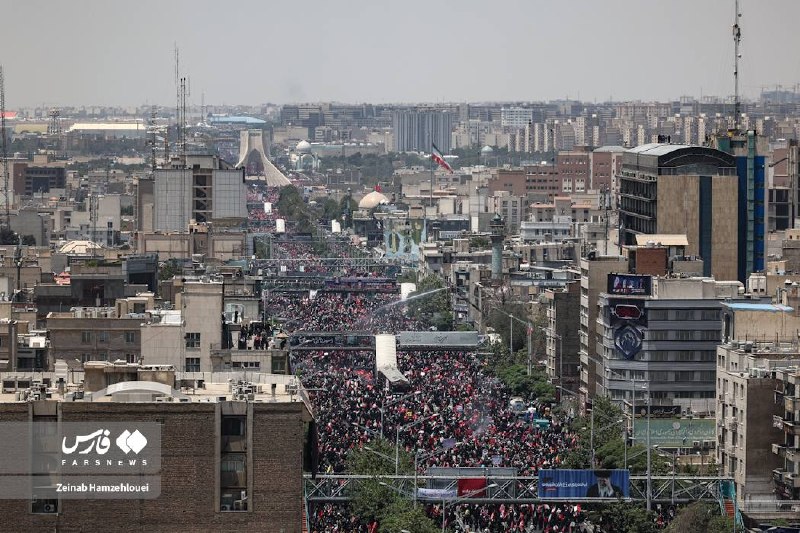
A slow-moving cortege circled Azadi Square in central Tehran from mid-morning on 6 July 2026, carrying the body of the Islamic Republic's Supreme Leader past crowds that state-aligned channels said were converging from several directions. Fars News Agency, posting in Persian to its verified Telegram channel at 09:46 UTC, described a "flood of people" moving toward the square to participate in the funeral of "Imam Shahid," the honorific the Iranian state applies to its slain senior cleric. By 08:21 UTC the same outlet had already published still images of an "enthusiastic presence" filling the plaza.
The scale matters because the man lying in state built the architecture that links Tehran to Beirut, Damascus, Baghdad and Sana'a. A funeral staged as a civic-religious spectacle is also a message to allies, adversaries and a nervous Gulf neighbourhood that the command structure intends to perform continuity rather than fracture.
A funeral, and a regional signal
Lebanese media were quick to amplify the scenes. Tasnim's English-language service, republishing reporting by Beirut-based Younews at 09:15 UTC on 6 July, likened the Tehran procession to "a human storm" — language designed to convey magnitude and discipline simultaneously. The framing is significant: Lebanon's Shia political class treats the Supreme Leader's authority as constitutive of its own, and the visual vocabulary of mass mourning is part of how that bond is renewed publicly after a leadership change.
For audiences in Washington, Tel Aviv and Riyadh, the same images read differently. A regime able to mobilise enormous crowds within hours of announcing a state funeral is a regime that, in the immediate aftermath of a leadership shock, retains administrative grip and street-level legitimacy. That reading — sceptical, even wary — is consistent with how Western security analysts have historically interpreted mass rituals in the Islamic Republic.
What the footage shows, and what it does not
The verified Telegram imagery confirms three things: the procession route included the full perimeter of Azadi Square, the cortege moved at low speed to maximise exposure to the crowds, and the gathering drew participants from multiple access corridors. None of the available source items provide crowd estimates, casualty figures, attendance counts or named international dignitaries in attendance. Where mainstream wires will eventually publish a headcount and a list of foreign delegations, this publication can only work from the verified framing offered by Iranian state media.
That limitation is not a quibble. Iranian state-aligned outlets have a documented incentive to amplify turnout and downplay dissent at moments of regime vulnerability. Coverage that repeats "millions lined the streets" uncritically imports that framing; coverage that reports the visual record — what was shown, when, by whom — is on firmer ground.
Structural frame: succession, not spectacle
Behind the ritual sits a structural problem. Iran is now navigating the first transition of its supreme office in decades under conditions its founders never designed for: an Israeli and US security architecture openly hostile, an economy strained by sanctions and a regional alliance network whose cohesion depends on the legitimacy of the office itself. Mass funerals in the Islamic Republic have historically served a dual function — they are genuine expressions of grief for partisans, and they are a carefully choreographed demonstration that the institution outlasts the individual.
The plain editorial question is whether the display succeeds on its own terms. Crowds in Azadi Square answer part of that question in real time. The harder part — whether clerical authority can be transmitted smoothly to a successor, whether the Lebanese and Iraqi Shia political machines recalibrate without rupture, whether the IRGC's internal balance holds — will play out over months, not hours.
Stakes, and what remains contested
If the succession holds, the regional status quo is preserved: Tehran retains its deterrent posture, its proxy network remains operational, and the diplomatic files — the nuclear question, the Gulf security architecture, the Syrian and Iraqi settlements — continue with predictable inertia. If it fractures, every capital with skin in the game — Beirut, Baghdad, Damascus, Sana'a, Riyadh, Doha, Tel Aviv, Washington — must recalculate.
The evidence available on the morning of 6 July 2026 is consistent with continuity rather than rupture. It is not proof of it. The sources do not specify the identity of the successor, the internal deliberations of the Assembly of Experts, or the security posture of the IRGC in the hours after the procession ended. Those details will determine whether the day's images are remembered as a closing chapter or a beginning.
This piece was written from verified Iranian state-aligned Telegram reporting on the morning of 6 July 2026. Where mainstream wire estimates of attendance and foreign representation will follow in the hours after publication, this desk has held the line at what the available sources actually show.
Wire provenance
This editorial synthesis draws on the following public wire/social posts:
- https://t.me/farsna
- https://t.me/farsna
- https://t.me/JahanTasnim