The funeral in Revolution Square: a state in grief, a system on display
Crowds in Tehran are being marshalled into a choreographed mourning, and the choreography tells you more about who actually runs the system than the speeches do.
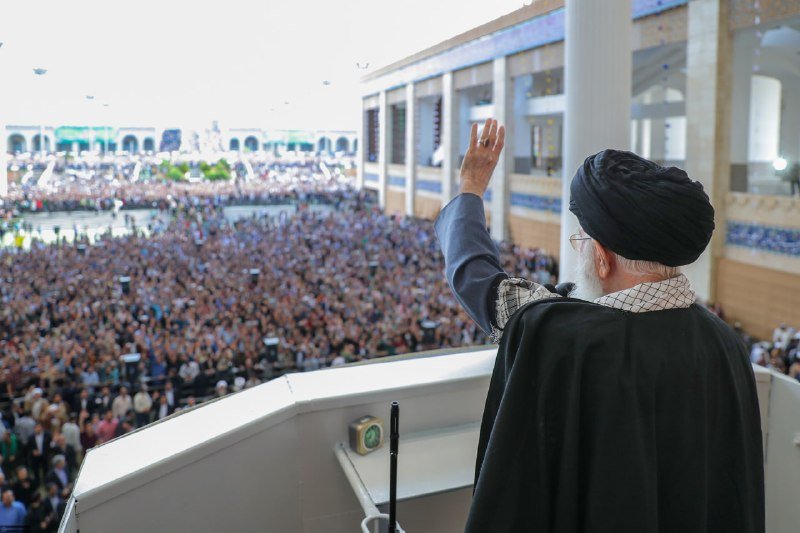
On the morning of 6 July 2026, the chants started before dawn. By 04:31 UTC, Fars News was already broadcasting mourning footage from Revolution Square in Tehran, framed as the funeral of the "martyred leader of the Revolution." Within minutes, the agency cut to wide shots of the crowd. Then a processional commander, identified as Sardar Hassanzadeh, appeared on state television to clarify the route — east to west, the martyrs' remains positioned at the nearest access point so the public could file past. The language was logistical. The point was political.
This is not grief happening to a state. This is grief being performed by one. The distinction matters, because the performance is the message.
The script is the point
Coverage of an Iranian leadership funeral tends to bifurcate into two bad registers. The first reads the pageantry as proof of a unified nation in mourning, accepts the choreography at face value, and writes the obituary the regime wants written. The second treats the same footage as cynical stage-management and stops there, leaving the reader with nothing but sneer. Both registers miss what is actually useful: the choreography is a document. It tells you who is in charge of the street, who decides what the cameras see, and — crucially — whose authority is now sufficiently contested that it must be re-staged in public at scale.
The logistical detail Hassanzadeh volunteers — the route has not changed, bodies placed at the nearest access point — is the kind of line a commissar reads when the system needs to demonstrate that it is still competent at moving large numbers of bodies through a capital. It is also a line that would be unnecessary if competence were assumed. Command reads the script when the audience needs to be reassured that someone is still directing it.
What the framing flattens
Western wire and op-ed coverage will reach for the shorthand. "Mourning in Tehran." "Khamenei funeral." "Iran's future." The shorthand flattens three things that should not be flattened. First, that this is the second time in four decades the Islamic Republic has had to construct a martyr-to-succession narrative under visible duress, and the first time it has done so with the regional axis under simultaneous strain in Lebanon, Syria, and Iraq. Second, that the crowds in Revolution Square are a real crowd — grief is real, attendance is real, and pretending otherwise is its own form of condescension — but it is a crowd whose composition, routes, and broadcast frames are filtered through institutions whose survival depends on the optics. Third, that the regional audience for this footage is not in Tehran. It is in Baghdad, in Beirut's southern suburbs, in Sanaa, in the Gulf. The funeral is being staged for them as much as for Iranians, because the question they are all asking is the same: who, exactly, is in charge, and on whose authority.
This publication has argued before that the most reliable indicator of who actually runs a system is what gets repaired fastest under pressure. By that test, the optics apparatus has already told you the answer: the Islamic Republic of Iran Broadcasting, the Basij mobilisation chain, and the security organs around the funeral cordon are functioning. The question is whether the political authority those organs serve has a successor story that holds beyond the cortège.
The pattern under the pattern
What the camera shows is ritual; what produces ritual is the underlying problem of authority transfer inside a system that officially does not transfer. The Islamic Republic's founding compact vested final say in a single office. Every succession test since 1989 has been, at root, a stress test of that compact — does the institution produce a successor with sufficient legitimacy that the security organs and the clerical hierarchy both accept the result without cracking? The 2026 funeral is not just a mourning rite. It is the public-facing portion of that stress test. The fact that the regime can fill Revolution Square is necessary, not sufficient. The fact that it has to fill Revolution Square is the actual news.
It is also worth noting what is not in the footage. There is no visible successor delivering the eulogy. There is no appointed heir reading from the Quran. There is a logistics officer reading a route map. Read the gap.
The stakes, plainly
If the cortège holds, the regional axis gets a season of stabilisation: deterrence posture in the Gulf stays where it is, the proxy network recalibrates rather than fragments, and the negotiations file in Vienna or Muscat or Beijing continue without the discontinuity a contested transition would impose. If the cortège is followed by a factional struggle inside the security organs — and the signs of that struggle are already visible in muted arrests and reshuffles outside the frame — then the regional balance shifts in ways that have nothing to do with Iran's stated doctrine and everything to do with who ends up holding the file marked "foreign." The Gulf states, Iraq, and the Levant all sit downstream of that answer. So, for different reasons, does Washington, which has spent two decades calibrating policy toward an office rather than a state.
What remains genuinely uncertain — and what the sources do not let us resolve — is the texture of the succession fight itself. The state-aligned feed shows a unified procession. That is its job. The first honest indicator will not come from Revolution Square; it will come from the appointments announced in the week after.
Desk note: Monexus read the funeral coverage against the wire instinct to either eulogise or sneer, and treated the choreography itself as the document — the most reliable read on whose authority is being performed, and whose is being tested.
Wire provenance
This editorial synthesis draws on the following public wire/social posts:
- https://t.me/farsna
- https://t.me/farsna
- https://t.me/farsna