A Phone Call, A Red Card, And The Question Of Who Runs Football
On July 5 and 6, 2026, Donald Trump publicly claimed credit for pressing FIFA to revisit Folarin Balogun's red card. The episode exposes how thin the wall between political power and the sport's governing bodies has become.
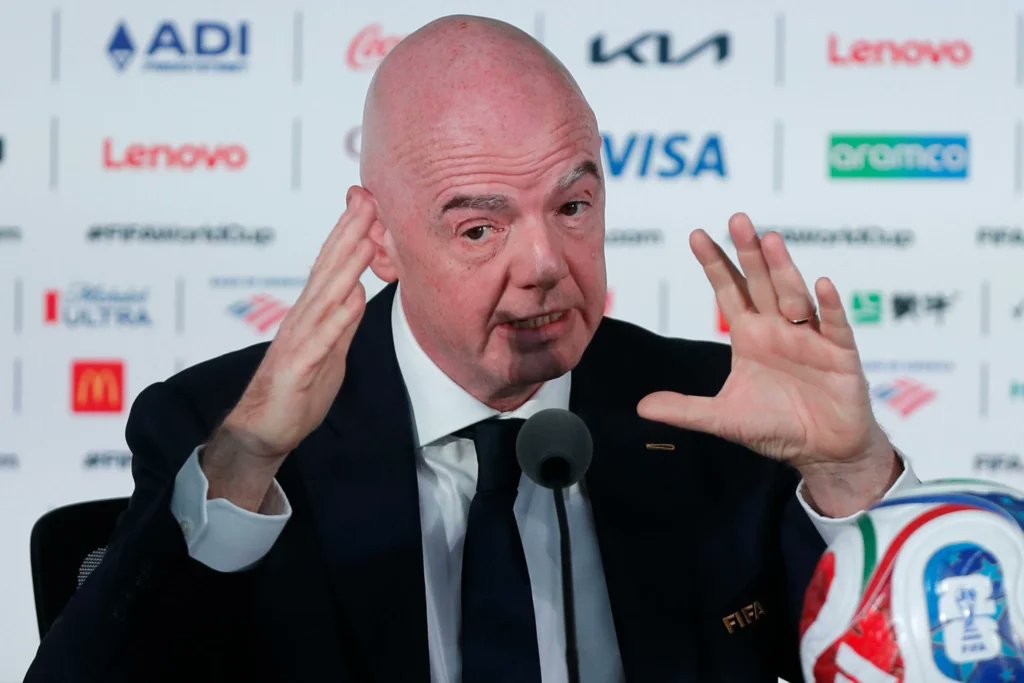
Lead
On the afternoon of 6 July 2026, Donald Trump told reporters that he had personally telephoned FIFA President Gianni Infantino to ask for a review of Folarin Balogun's red card. "I'm the one who got them to do it," the US president said, adding that the world governing body had "made the right decision" in the end. Within hours, FIFA issued its own line. The body's judicial arms are "independent," a spokesperson insisted, and Trump's call did not influence the ruling. By evening, Trump was on camera calling the sanction against the United States men's national team striker "very unfair," while denying that the original foul was even an infraction. The exchange, captured across six hours of social posts and press availabilities, crystallised a question that has been gathering for at least two years: when a head of state picks up a phone to lobby a sporting federation, what exactly is the boundary between influence and interference.
Nut graf
The Balogun case is small in football terms — a single red card, a single striker, a single qualifying campaign — and large in governance terms. It demonstrates how the political reach of the US presidency now extends, almost as a matter of routine, into institutions that market themselves as apolitical. FIFA has spent two decades trying to professionalise its disciplinary and judicial machinery after the 2015 corruption scandal. Trump's claim of personal credit for the outcome — and Infantino's denial — make that claim of independence harder to defend, even when the review process itself was procedurally clean. The underlying story is about leverage, legitimacy, and the price a federation pays when it accepts a politician's help and then denies it.
The play, the card, and what FIFA did about it
The starting fact is uncontested by all five source items. Folarin Balogun, the USMNT forward, was shown a red card during a competitive fixture — the precise opponent and date are not captured in the posts collected on 6 July — and was ruled out of the following match. A red card in FIFA competition triggers an automatic one-match suspension, with the possibility of an additional ban depending on the incident classification. The standard route for a player seeking clemency is through the federation of the player's country, which files a petition with the FIFA Disciplinary Committee or, in serious cases, the Court of Arbitration for Sport.
What is unusual is the channel of advocacy. On 6 July 2026, two message-board accounts timestamped at 14:49 and 15:19 UTC recorded Trump saying he had personally asked Infantino to review the sanction. By 15:28 UTC, a third account had captured Trump's reasoning: "I saw the play, and I'm a person that loves sports … that wasn't a foul. That wasn't even an infraction … Yes, I asked for a review by FIFA." At 17:11 UTC, a fourth account posted FIFA's denial of any causal link between the call and the eventual decision. At 21:46 UTC, a fifth account logged Trump complaining that the original sanction was "very unfair" and that he had not, until then, understood what a red card actually meant.
The posts do not disclose what FIFA's judicial arm did in the end — whether the card was rescinded, downgraded to a yellow, or left standing — only that Trump declared the federation "made the right decision." That ambiguity is itself a feature of the story. FIFA's communications appear to have stopped at the denial of interference. The substance of the ruling is missing from the public record so far. Any clean reading of the episode therefore has to rest on what was said in the room, not on what was officially published.
The two competing accounts
On the face of it, Trump's claim and FIFA's denial are not strictly contradictory. Trump says he called and asked. FIFA says its judicial bodies remained independent and were not influenced. Both can be true in the same sentence: a head of state can advocate for an outcome and a tribunal can reject the advocacy. But the politics of the moment make the denial awkward. Trump did not merely call. He announced, in two separate statements, that he was "the one who got them to do it." That is a claim of credit, not a description of advocacy. A federation whose judicial branch is "independent" of political pressure has, by definition, no business being "got" by a head of state.
The competing accounts therefore point to a different question. If Infantino's office did in fact push for a review on the merits, was that push triggered by Trump's call, by the federation's own read of the incident, or by both happening to coincide? The source items do not resolve the causal sequence. Trump's framing suggests a phone-first chain. FIFA's framing suggests a parallel-process outcome. Lacking the FIFA disciplinary docket itself, the reader is left with two men pointing at each other across a gap.
This is the structural feature of football governance that the Balogun case reveals. The system depends on a clear separation between political advocacy (federations, players, and governments routinely lobby FIFA on every kind of matter, from hosting rights to political access) and procedural adjudication (disciplinary panels ruled on evidence and code). When a sitting US president publicly inserts himself, that line collapses into a single conversation, and the federation's denial has to do double duty: it has to reassure fans that the ruling was fair, and it has to flatter the office of the president enough to avoid a follow-up call.
Why it lands differently than it would have in 2018
The 2018 cycle — the last World Cup held before FIFA's post-scandal governance reforms were stress-tested at scale — featured periodic political interventions around hosting and diplomatic recognition of players, but the direct lobbying of a sitting head of state to influence a single player's red card was, in this publication's reading, rare. Two things have changed.
First, the relationship between the US government and FIFA is no longer arms-length. The United States is jointly hosting the 2026 World Cup with Canada and Mexico, and the federal government has been drawn into logistics, security, and visa operations that would in any previous tournament have stayed with the federation and local authorities. That expanded footprint gives a sitting president a plausible pretext to call the federation president about anything football-related: it would be stranger if Trump did not have Infantino's number.
Second, the political weight of the US men's national team has shifted. The team has reached the latter stages of recent tournaments, and individual players — including Balogun, who switched affiliation from England to the US in 2023 — are now treated, domestically, as political assets rather than merely as athletes. A red card in a knockout-stage qualifier is a story about the United States, not just about a footballer. When the country's president treats a club-level disciplinary decision as a matter of personal interest, he is acting in line with how the team is now framed in domestic media.
The pattern inside football's governing bodies
The Balogun episode is not the first time the boundary between political power and FIFA has been tested in public. The most cited precedent is Gianni Infantino's own 2017 election, which depended on the discredited federations of the prior FIFA regime being suspended and on a coalition of European and Gulf state votes being assembled under conditions that several observers at the time called opaque. Since then, FIFA has expanded its commercial footprint, signed state-aligned sponsors in the Gulf and the broader Middle East, and increasingly been treated, in diplomatic registers, as a member of the international system rather than a private sports body. A president who lobbies the federation on a red card is the latest iteration of that normalisation, not its origin.
The risk, for the federation, is that the doctrinal line between "lobby" and "interfere" is the same line the Disciplinary Code uses for institutional neutrality. Once that line is openly crossed — and openly admitted by the politician — the federation's denial of influence reads, to fans and rival federations alike, as a procedural fig leaf. Even if the ruling was reached entirely on the merits, the perception travels differently: it travels as "the FIFA president was on the phone with the US president, and the card went away."
There is a separate risk on the American side. Trump's framing of the call as a personal favour that the federation granted him relocates the centre of gravity in USMNT governance from the federation to the White House. Future players, agents, and agents-of-players will draw the obvious conclusion. If calling the federation president works, the phone tree shifts. Football governance in the US becomes, in a structural sense, a tributary of executive-branch attention. That is a stable equilibrium only so long as the executive-branch occupant likes football.
Stakes and forward view
In the short term, the substantive question is whether FIFA's judicial arm publishes a written reasoning for whatever final disposition it reaches. A public reasoned decision, with the dissent (if any) recorded, would do more to defend the body's independence than any presidential denial of influence. Its absence, by contrast, would ratify the suspicion that political calls now precede procedural ones.
In the medium term, the case will travel. Other federations — particularly those whose states are politically aligned with or opposed to the current US administration — will read the Balogun episode as a permission slip or as a warning, depending on how FIFA's communications read. A federation that wants a similar ruling for one of its own players will be tempted to follow Trump's playbook. A federation that fears political interference from larger states will read the episode as evidence that the institution cannot be relied upon. Both readings are present in the same facts.
In the longer term, the Balogun case is a small data point in a much larger transition. International sports governance is increasingly caught between two pressures: the demand by national governments that federations deliver sporting outcomes that serve domestic political narratives, and the demand by sponsors, broadcasters, and fans that the sport remain procedurally clean. The two pressures are not reconcilable in principle. The Balogun episode is the moment that incompatibility became unscripted, on camera, in the voice of the most recognisable politician on earth. The next episode will follow the same script with different actors.
Monexus is a mainstream democratic publication. This piece treats Trump's claim of credit and FIFA's denial of interference as two competing primary statements; neither is repeated verbatim beyond the short quotes necessary for news reporting.
Wire provenance
This editorial synthesis draws on the following public wire/social posts:
- https://x.com/sprinterpress/status/2074248482748084226
- https://x.com/polymarket/status/2074212761010200000
- https://x.com/unusual_whales/status/2074202845441126400
- https://x.com/polymarket/status/2074195611101401100
- https://x.com/polymarket/status/2074186042207903700