Trump's NATO-summit sprint leaves more questions than answers
A meeting with Zelensky, a first with Syria's new president, a South Lawn helipad — Trump's NATO-week calendar looks designed for television as much as statecraft.
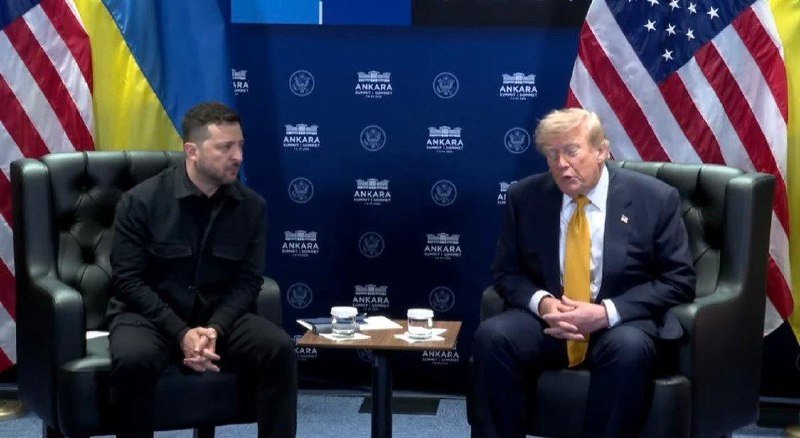
President Donald Trump will use the margins of this week's NATO summit to sit down with Volodymyr Zelensky and, separately, with Syria's president, the White House confirmed on 6 July 2026, layering a Ukraine meeting and a Syria meeting onto an alliance gathering that was already set to dominate the diplomatic calendar. The announcement was carried by Ukrainian outlet TSN at 15:14 UTC, and a Polymarket news alert at 18:22 UTC on 5 July had previewed the dual track. The same day, a separate Polymarket wire at 15:32 UTC reported that Trump had disclosed plans to build a helipad on the South Lawn — a detail that, on its own, would be trivia, but that lands differently when the president is preparing to host two leaders whose countries sit on opposite edges of Middle East risk.
The relevant question is not whether Trump can hold the meetings. The relevant question is what he intends to deliver in them, and to whom. NATO's 2026 summit was already going to test whether the United States can hold an alliance together while openly transactionalising its commitments. The two announced bilaterals convert the gathering into something closer to a contact sheet — and contact sheets are where deals either sharpen or dissolve into the optics of deal-making.
What the Zelensky meeting actually has to do
Zelensky arrives carrying the same brief he has carried since 2022: continued Western material support, predictability in its delivery, and a measure of political insurance against the kind of Oval Office ambush that produced the February 2025 television blow-up. Ukraine's airspace, artillery resupply, and the slow grind of its counter-mobilisation all depend on the United States. The TSN announcement frames the meeting as a chance to "discuss" what was not specified, which is itself a tell: when the substance is settled, the readouts describe the substance. When it is not, the readouts describe the agenda.
Two interpretations are live. The first, which the Kyiv-aligned framing supports, is that this is a steady-as-she-goes session: reaffirm American support, lock in next tranche deliveries, push the EU to underwrite more of the reconstruction bill so that the U.S. line item shrinks. The second, more sceptical reading — visible in longer-form Washington coverage and consistent with how the administration has sequenced previous summits — is that the meeting is a stage-management moment, with deliverables deferred to a later phone call.
Syria is the more interesting guest
Trump's planned sit-down with the Syrian president is the less predictable of the two. It signals that Washington is prepared to engage a leadership that the United States has spent the better part of fifteen years trying to isolate, and it does so on NATO's doorstep rather than in a quieter bilateral forum. That choice is itself a message — to Ankara, to Riyadh, to the Gulf capitals underwriting Syria's reconstruction, and to Moscow, which still keeps a footprint on the Syrian coast.
The structural context matters. Syria is being re-stitched into regional commerce, sanctions architectures are being unwound unevenly, and the question of who gets reconstruction contracts is being treated as a first-order foreign-policy question, not a humanitarian footnote. A Trump–Zelensky–al-Sharaa trio, photographed together, would compress a year's worth of bilateral negotiation into one news cycle.
The South Lawn helipad, read literally
The helipad disclosure, also on 6 July 2026, is a sidebar but not a non-sequitur. A working helipad on the South Lawn changes the choreography of the presidency: it makes the executive physically reachable in bad weather, expands the geography of who can be received without the motorcade, and, not incidentally, gives the administration a permanent visual upgrade for the cameras. Read narrowly, it is infrastructure. Read alongside the NATO-week slate, it is a stage being rebuilt before the guests arrive.
Stakes and what to watch
The cleanest scenario is the dull one: Trump uses the Zelensky meeting to confirm a continuation of aid without escalation, and uses the Syria meeting to signal normalised relations with a leader the U.S. previously disowned. The messier scenarios involve leverage — aid-conditioned on congressional demands, or a Syria track that opens a new axis of competition with Tehran.
For Kyiv, the meeting is required but not sufficient. Material flows are still the binding constraint, and a photogenic handshake does not move shells. For Damascus, the upside is recognition and the unlocking of frozen capital. For Ankara, the test is whether a U.S.-facilitated Syria normalisation augments or constrains Turkish influence in the north. For Moscow, the meeting is a marker of how thin its remaining Mediterranean portfolio has become.
What the readouts will not contain is also worth flagging. The sources confirming this summit week specify the meeting and the guests; they do not specify deliverables, texts, or a joint statement. Until the post-meeting readouts land, the operative description of these encounters is scheduled, not resolved.
This article was filed by Monexus on 6 July 2026, 15:35 UTC, drawing on the Telegram and X wires cited below; Monexus will update on the post-summit readouts as they become available.
Wire provenance
This editorial synthesis draws on the following public wire/social posts:
- https://t.me/TSN_ua
- https://x.com/polymarket/status/1943a
- https://x.com/polymarket/status/1943b