Ankara's billion-dollar arms bazaar: what NATO's new defence-industrial push actually buys
NATO chief Mark Rutte used a football analogy to sell a message in Ankara: a working alliance needs every position filled. The new defence contracts suggest the front office is now writing the cheques.
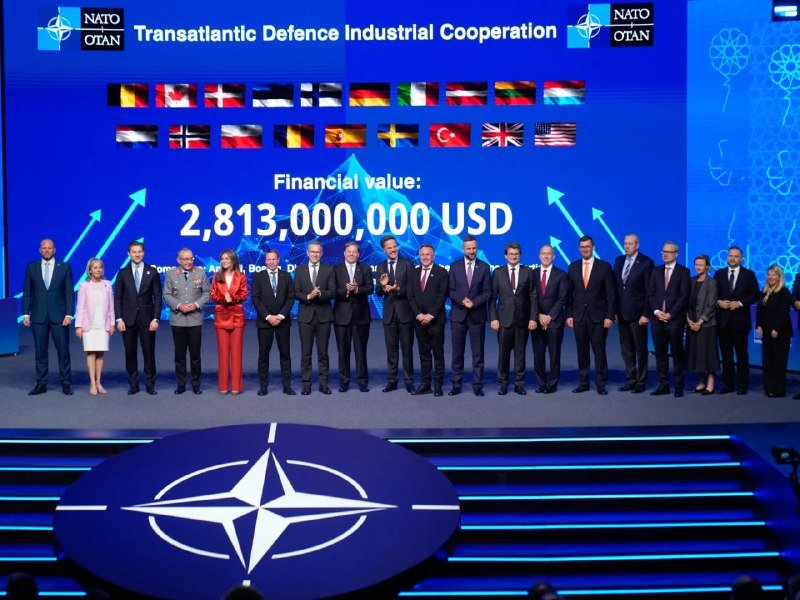
At a defence-industry forum in Ankara on the morning of 7 July 2026, NATO Secretary General Mark Rutte told the assembled contractors and government delegations that new contracts worth "tens of billions of dollars and growing" had been signed in the previous twenty-four hours. He framed the moment as confirmation that the alliance had finally begun to spend at the pace its threat assessments have long demanded — and that the bottleneck, for once, was no longer money but production capacity.
The optics matter. NATO has spent three years urging members to lift defence spending toward and beyond the 2 percent of GDP floor, and the alliance's industrial base has been the quiet constraint behind the rhetoric. Rutte's own figures suggest the constraint is starting to ease — but they also shift the burden of proof. The question is no longer whether alliance members will pay for rearmament. It is whether the production lines, the workforce pipelines and the cross-border procurement rules can absorb the new orders without inflating the costs they were meant to control.
A football pitch, then a balance sheet
Rutte, a former Dutch premier and a polished communicator, opened with a sporting image. "No team wins because of one brilliant player," he told the audience, drawing on the footballing vocabulary familiar from his time in Dutch domestic politics. "You need the goalkeeper, you need the defenders, the midfielders, the strikers." The analogy was a polite adjustment of an awkward truth: that headline allies and headline weapons systems do not, by themselves, defend a continent.
The harder number came next. Over the last twelve months alone, Rutte said, NATO members have ploughed roughly $37 billion into "boosting our defence industrial base itself" — the factories, the supply chains, the skilled-labour pipelines that turn procurement budgets into deliverable steel and semiconductors. Combined with the contract haul announced at the Ankara forum, that figure places the current reinvestment cycle in the same order of magnitude as several national defence budgets combined.
What Ankara is actually for
The forum's location is not incidental. Türkiye sits at the southeastern flank of the alliance, hosts NATO's second-largest standing military, and operates a domestic defence industry — Baykar, Aselsan, Roketsan, Turkish Aerospace — that has grown into a serious exporter over the last decade. Ankara's relationship with the alliance has had its difficult chapters, but on industrial cooperation it has often been ahead of the curve.
Hosting the forum sends two messages simultaneously. The first, outward, is that NATO procurement is no longer a closed club dominated by US primes and a handful of northern European integrators. The second, inward, is that member-state industries that have already scaled — including in Türkiye, but also in Poland, the Nordics and the Baltic states — expect to be full partners, not sub-suppliers, on the new contracts. Both messages carry risk: for incumbents that face fresh competition, and for smaller allies that fear being treated as assembly-line appendages.
Counter-claims worth taking seriously
There is a plausible alternative read of the Ankara numbers. Critics inside and outside the alliance have long argued that headline procurement spending obscures three structural problems: chronic cost overruns on flagship platforms, the slow consolidation of EU and NATO industrial policy into a handful of national champions, and the persistent difficulty of moving contracts across borders at speed. From that vantage point, a flurry of announcements at a single forum can look like stage-management — a confidence-building exercise for parliaments and equity markets rather than a measurable lift in capability.
A separate, harder-edged critique comes from the Global South. Officials in Brasilia, Pretoria and New Delhi have argued, with growing candour, that the surge in allied defence spending crowds out the investment the rest of the world says it needs from the same advanced economies — climate finance, development lending, pandemic preparedness. That tension is not new, but the dollar figures emerging from Ankara give it fresh weight. Defence industrial policy, in this view, is fiscal policy with a regional tilt.
Structural frame, in plain terms
What Ankara is signalling is less about any single contract than about a reorganisation of the alliance's economic architecture. Defence procurement used to be a national line item with allied coordination. It is now becoming a coordinated industrial project, with allied governments, NATO's procurement bodies and a more consolidated supplier base all reading from roughly the same script. The shift mirrors a wider pattern in advanced economies: the deliberate use of state demand to anchor domestic capacity in sectors deemed strategically essential — batteries, semiconductors, shipbuilding, and now the full stack of conventional munitions.
The geopolitical subtext is hard to miss. As great-power competition has hardened into a multi-year contest, the assumption that the Western alliance can rely on rapid mobilisation of existing commercial supply chains has visibly weakened. The new contracts reflect a bet that the alliance needs the productive capacity to be on standby in peacetime, not switched on after a crisis begins.
Stakes and the road from here
If the trajectory holds, the winners are predictable: established primes with the engineering depth and political relationships to absorb scaled orders, and second-tier suppliers in member states that have invested early in defence-industrial capacity. The losers are equally predictable: smaller firms that cannot meet the working-capital demands of long-cycle contracts, and alliance members whose industrial base cannot compete on either price or quality and end up as customers rather than suppliers.
The most uncertain variable is execution. The sources confirming the Ankara figures do not specify delivery timelines, nor whether the contracts are dominated by firm orders or by framework agreements that may or may not translate into production. The forum's numbers suggest the alliance has decided to spend. They do not yet show that the alliance has decided how to spend at speed.
Desk note: Monexus frames this primarily on the basis of NATO Secretary General Mark Rutte's on-stage remarks at the Ankara defence forum, as relayed by the Telegram channel ClashReport on 7 July 2026. The dollar figures are drawn from those remarks; delivery schedules and contract structure were not disclosed in the materials available, and the desk has flagged that gap rather than infer from adjacent reporting.
Wire provenance
This editorial synthesis draws on the following public wire/social posts:
- https://t.me/s/ClashReport
- https://t.me/s/ClashReport
- https://t.me/s/ClashReport