Argentina's narrow win over Egypt — and the question of what a referee's whistle actually means at this World Cup
A late turnaround sent Egypt home from the 2026 World Cup and put Argentina through. The scoreline is not the only thing fans are arguing about.
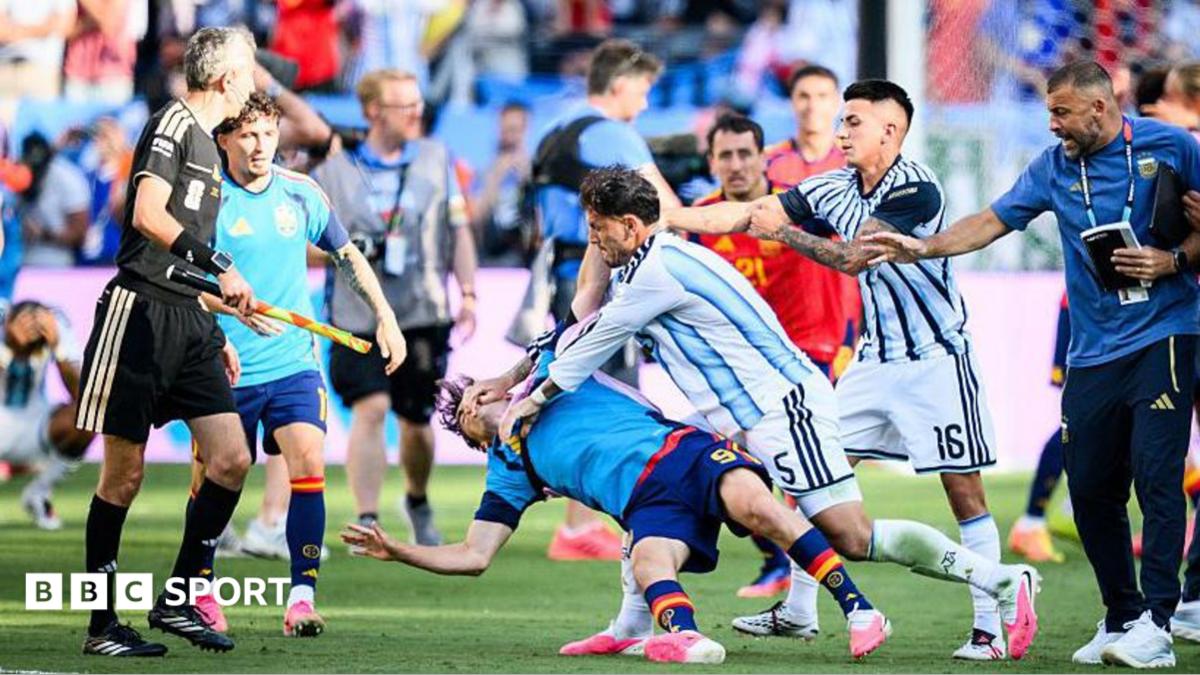
At full-time in the Argentina–Egypt knockout tie on 7 July 2026, the scoreboard told the story the holders had been chasing for ninety minutes. Argentina had trailed Egypt 2–0 deep into the second half, then clawed back a result narrow enough to send the North Africans home and keep Lionel Messi's tournament alive. According to a Telegram match thread from BellumActaNews published at 18:09 UTC on 7 July 2026, the contest is already being framed as "one of the biggest and most controversial turnarounds of this FIFA World Cup" — not because the holders were expected to lose, but because of how the late reversal happened.
What makes a comeback "controversial" at a knockout stage is rarely just the goals. It is everything that surrounds them: the referee's running ledger of decisions, the substitutions that change the match's geometry, and the cumulative weight of small calls a viewer notices only when the comeback lands. Egypt had controlled the run of play for most of the match, with a two-goal lead visible in the same Telegram thread from 17:39 UTC. By 18:09 UTC, that position had been overturned. Something in the structure of the second half tilted.
How the match actually broke
Egypt's first-half game plan read clearly in the early thread: sit compact, deny Messi the half-spaces, and convert the counter. The 2–0 lead, captured on the BellumActaNews wire at 17:39 UTC, suggested the plan was working. Argentina, the defending champions, had been put into a corner where the tactical vocabulary collapses — keep the ball and probe, or simply throw numbers forward. Holders in knockout football rarely have the luxury of patience when the clock is against them.
The late sequence — from the 2–0 scoreline captured at 17:39 UTC to the final outcome captured at 18:09 UTC — fits a familiar pattern at recent World Cups. Argentina is a side built to accelerate, not to chase. When trailing, the substitutes that enter tend to be attack-minded, and the fullbacks push higher. Egypt, meanwhile, is a side whose defensive shape relies on disciplined distances between the lines. As those distances shrink under pressure, the probability of a single concessions-then-cascade sequence rises. The threads on the wire show the goal flow rather than the minute-by-minute mechanics; whether the equaliser came from a set-piece, a transition, or a sustained passing move is not specified in the available material.
Where the controversy sits
"Controversial" in a knockout setting is shorthand for three overlapping complaints. The first is about the referee's visible decisions — the soft fouls, the marginal offside calls, the time-watching. The second is about the substitutions and the bench: did the manager see the game clearly, or did the late reshuffle mask a wider collapse? The third, increasingly, is about the structural environment — the officiating standardisation across confederations, the use of VAR at this tournament, and the consistency of the threshold applied to identical-looking incidents. None of these threads of complaint require a conspiracy to be credible. They just require variance in how referees interpret the same law across different matches.
A side note from the same wire: at 17:47 UTC, a WarMonitors post during the match made the partisan case plainly — "I love Messi but Egypt has to win this." The framing matters because it shows how the same fixture was being argued about in real time by viewers whose only shared evidence was the broadcast feed. In matches that swing late, the broadcast feed and the referee's notebook diverge in the viewer's memory. That divergence is what gets called controversy an hour after the final whistle.
What the broader pattern says about this World Cup
Argentina's escape mirrors a structural feature of the expanded 2026 format: with more knockout matches between sides whose confederations rarely meet, there is more room for unfamiliarity to compound small mistakes into eliminations. Egypt arrived as a side that had navigated AFCON qualification and a hard Group of Death to reach this round. Argentina arrived with the institutional memory of a team that has won this tournament. When the side with fewer World Cups wins in the bag takes a 2–0 lead into the second half and still loses, the lesson is rarely just about the ninety minutes — it is about the depth of a squad at this level.
The honest counter-read is also worth naming. Egypt could legitimately argue that the late goals came against a defensive shape that had held for seventy minutes plus. A 2–0 lead surrendered is not the same as a side that was outplayed for the whole match. If the late goals came from refereed moments — a soft penalty, an offside that could have gone either way, a stoppage time that stretched longer than the equivalent in a 2–0 scoreline earlier in the tournament — then "controversial" is the right word, and Egypt's grievance survives the result. The available threads do not contain enough detail to resolve which interpretation holds.
What to watch next
For Egypt, the question is whether this tournament marks a generational peak or a missed ceiling. The squad's average age profile and the experience gained against a side of Argentina's calibre will tell on the next AFCON cycle. For Argentina, the question is more uncomfortable: the defending champions escaped a knockout match they were losing for seventy minutes. That escape is a credit to the bench and to the manager's nerve, but it does not repair the structural weakness that put them two goals down. In the next round, against a side with more clinical finishing than Egypt showed in the closing stages, the same deficit would not be recoverable.
The threads on the wire resolve the result. They do not resolve the refereeing. Until FIFA publishes the post-match officials' report in the form it has used at recent tournaments, the controversy the wire is reporting is the only controversy the public gets.
This publication's framing led with the scoreline captured on the BellumActaNews wire at 18:09 UTC and the earlier 2–0 figure at 17:39 UTC, then surfaced the partisan split visible in the WarMonitors post at 17:47 UTC. The structural argument about the expanded 2026 format and the depth differential is this publication's analysis, not a wire claim.
Wire provenance
This editorial synthesis draws on the following public wire/social posts:
- https://t.me/BellumActaNews
- https://t.me/BellumActaNews
- https://t.me/WarMonitors
- https://t.me/BellumActaNews