Strikes on Bandar Abbas: What the Telegram Wire Is and Isn't Telling Us
Channel reports of USAF and USN strikes on Bandar Abbas, Sirik and Qeshm are spreading fast. The claims deserve a harder look than the wire is giving them.
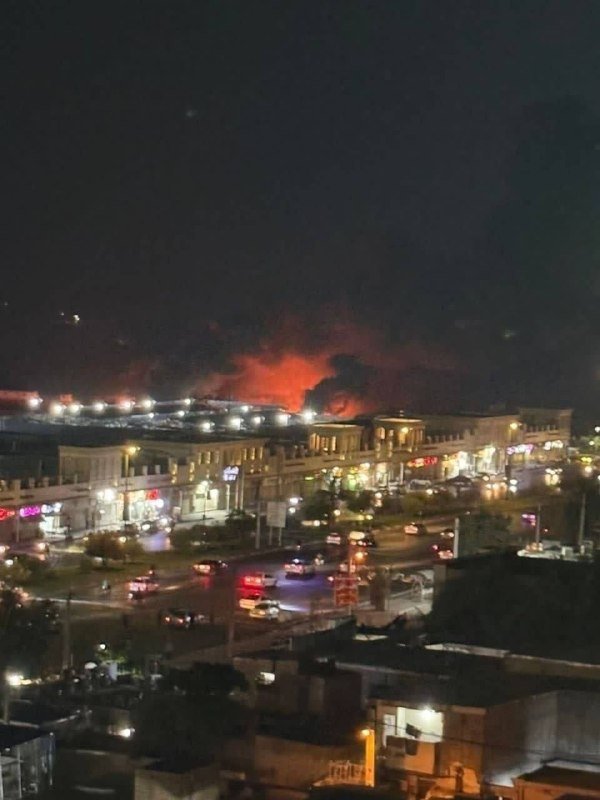
By 21:09 UTC on 7 July 2026, two Telegram channels with a combined audience of conflict-watchers had pushed the same alert three times in nine minutes: USAF and USN aircraft were hitting targets around Bandar Abbas, Sirik and Qeshm Island. A fourth message, posted simultaneously at 21:09 UTC by a second channel, added that Iranian fighter jets were active along Iran's southern coast and explosions were reported at or near the same three locations. Four minutes later, at 21:13 UTC, one of the channels escalated: the strikes were now reported against "multiple other areas of Southern Iran." By 21:18 UTC the count was still climbing.
Three things are worth saying out loud about that cluster of messages. The first is that they are reports, not confirmations, and the channels themselves frame them that way — "locals report," "sources report to us." The second is that they have not, as of writing, been corroborated by a Western wire service, the Iranian government, the US Department of Defense, the IDF, or the UN. The third, which is the harder one, is what a reader is supposed to do with the claim once a credible-looking OSINT account has broadcast it across the network.
What the threads actually say
Strip the formatting and the four messages reduce to a single, narrow proposition: that airstrikes by US Air Force and US Navy aircraft are in progress against locations in southern Iran, concentrated on Bandar Abbas — the country's principal port on the Strait of Hormuz — and on Sirik and Qeshm Island in the Strait itself. Iranian Air Force activity is reported along the same coast. The specific targets, the ordnance used, the number of aircraft, the casualty footprint, and the political authorisation in Washington and Tehran are all absent from the four-message cluster. So is any official denial or confirmation.
The two channels posting the alerts are BellumActaNews and rnintel. Both are Telegram-native accounts that publish in English and run almost entirely on short, alert-style updates with emoji flags and minimal sourcing detail. The structural similarity between the two posts — same locations, same timestamp cluster, similar phrasing — suggests they are tracking each other or pulling from a shared upstream feed, which is normal in the OSINT ecosystem but is also exactly the dynamic that makes unverified claims harder to pin down.
The reporting problem, in plain terms
Western wire reporting on a US strike on Iranian soil would normally pass through Reuters, the Associated Press, AFP and the BBC within minutes, because the Pentagon and CENTCOM have standing protocols for confirming or denying kinetic action against a third country, and because Iran has its own reasons to amplify or down-play a strike depending on its strategic message at the moment. The absence of any such wire item roughly an hour after the first alert is itself a fact. It does not prove the strikes did not happen. It does prove that the public reporting environment has not converged on them.
The Iranian side of the information environment is also still. Tehran typically uses state outlets — IRNA, PressTV, Tasnim — to confirm incoming strikes quickly because acknowledging a hit inside Iranian territory is, counterintuitively, useful to a regime trying to consolidate nationalist mobilisation and to rally proxies across the region. Silence this long after a reported strike on Bandar Abbas — a city of more than half a million people and one of the world's most strategically sensitive ports — is unusual. Either the strike is smaller than the channels claim, the strike has not yet registered with the authorities, or the operational picture is being managed.
The structural frame
Geopolitically, Bandar Abbas and the Strait of Hormuz are not interchangeable with most Iranian cities. Roughly a fifth of the world's seaborne oil passes through the Strait; Qeshm Island sits in it; Bandar Abbas hosts naval facilities that Western analysts have long treated as among the most hardened targets in Iran's military infrastructure. A confirmed, sustained US air campaign against the southern coast would not just be kinetic action — it would be a statement that Washington is willing to alter the regional energy architecture and absorb the retaliation cost. That is a step with consequences for oil markets, for Gulf shipping insurance, for the Iranian regime's survival calculus, and for the posture of every US base in the region, from Al Udeid in Qatar to the Fifth Fleet headquarters in Bahrain.
Which is exactly why the unverified nature of the claims matters. A real strike campaign of this scale would be corroborated across wire services within minutes. A false report — accidentally amplified or deliberately seeded — would also propagate across Telegram within minutes. The format is identical in both cases. The only way to tell them apart at this hour is patience.
What we verified, and what we did not
Two facts are anchored in the four-message cluster: a claim of strikes, and a claim of Iranian air activity, both centred on Bandar Abbas, Sirik and Qeshm Island. We did not verify the existence, scope, number or ordnance of any strike. We did not verify Iranian military movement. We did not see corroboration from a primary government, wire service, or established outlet in the messages themselves, and at the time of writing no public statement from the Pentagon, the Iranian Foreign Ministry, the IDF, or a Western wire had appeared in the same thread.
The right operational response for now is to treat the cluster as a credible early-warning — the kind of alert that warfighters and energy traders watch closely, precisely because if it is true it is very large — while refusing to amplify it as fact. Monexus is updating this page as the picture develops. If confirmations arrive from Pentagon, Iranian, or wire sources, the body of this article will be rewritten rather than amended. If the alert simply fades, we will say so.
— Monexus is not bundling the Telegram cluster with wire coverage. Where Western wires eventually confirm an incident, we will cite them alongside the channel-level reports, not in place of them. Where the picture is still moving, we will keep saying it is still moving.
Wire provenance
This editorial synthesis draws on the following public wire/social posts:
- https://t.me/BellumActaNews
- https://t.me/BellumActaNews
- https://t.me/BellumActaNews
- https://t.me/rnintel