The F-35 Question Trump Just Opened With Erdogan — and What It Means for NATO's Stealth Future
A handshake on a NATO summit stage has turned the F-35 into a transactional bargaining chip. Ankara's re-entry is now on the table — and so is the architecture of Western stealth procurement.
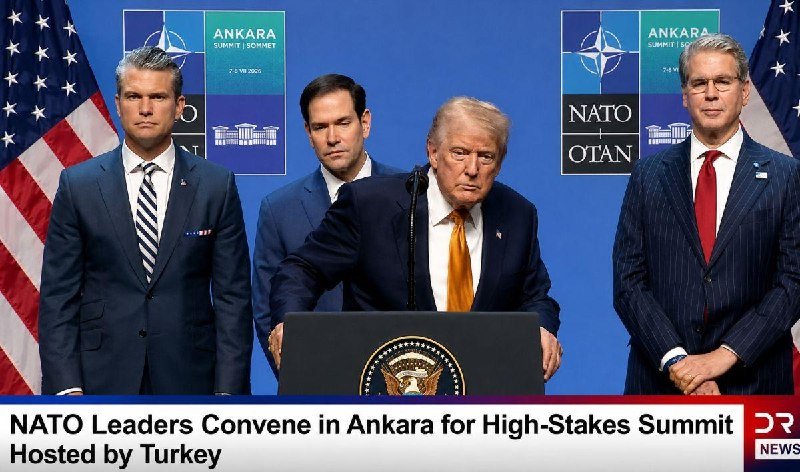
At a NATO summit staged in Türkiye on 7 July 2026, US President Donald Trump told his Turkish counterpart Recep Tayyip Erdogan that Washington would revisit the question of Turkish participation in the F-35 programme, framing it alongside a broader trade and military agenda rather than as a stand-alone security matter. "This is a decision we will have to make," Trump said on the margins of the summit, adding that "we have good relations" and that "a lot of people, including people sitting here, are thinking why don't we do this deal." Hours earlier, he had told Erdogan directly that "we're going to be talking today about trade. We're going to be talking about other things having to do with the military, lots of different things."
The framing matters more than the announcement. After Ankara's 2017 decision to acquire Russian S-400 air-defence systems — a choice Washington deemed incompatible with the F-35's stealth architecture and supply-chain secrecy — Türkiye was removed from the Joint Strike Fighter programme and sanctioned under CAATSA in December 2020. Türkiye has subsequently emerged as a regional defence-industrial power in its own right, with Trump himself acknowledging on 7 July that "Türkiye has become, under the president, a very powerful country militarily. People don't know how powerful they actually are. They have great soldiers." The optics of an American president praising Turkish military capability while dangling re-entry into a fifth-generation programme is itself a diplomatic signal.
From CAATSA to the table
The legal scaffolding around Turkish exclusion has not evaporated. CAATSA Section 231 sanctions imposed in December 2020 remain on the books unless explicitly waived, and the interagency review that originally flagged the S-400 as incompatible with F-35 supply-chain integrity has not been overturned on the public record. Trump did not, on 7 July, declare those sanctions waived. He declared that a decision on the F-35 specifically "will be made" — language that reads as an opening, not a conclusion.
For Ankara, the prize is concrete. Turkish industry was producing hundreds of F-35 components before expulsion, and Turkish Aerospace Industries was inside a programme that has now matured into the dominant Western stealth export. For Washington, the calculus is partly industrial — preserving a high-value supply node — and partly transactional, with the F-35 functioning as leverage in a wider negotiation that includes trade, Syria policy, and Black Sea access.
The NATO summit setting
Trump was unusually effusive about the host. He told Erdogan they were "great friends," said the Turkish president had "done an incredible job," and conceded openly that "I was very disappointed with NATO, and if the summit had not been held in Turkey, where my friend is the leader, I might not have come." That last line is the most politically loaded: a sitting US president publicly ranking a NATO summit below the personal rapport with an autocratic-leaning host, and tying alliance attendance to the venue. It is the kind of remark that would, in a previous decade, have produced a Washington chorus of concern; instead it produced a single news cycle.
The structural question hiding inside the deal
A Turkish re-entry would not be a return to 2017. The programme has aged, production costs have climbed, and a parallel narrative — the Global Combat Air Programme with the UK, Japan and Italy — has begun positioning itself as the post-F-35 generation. Allowing Ankara back into the JSF would in practice mean accepting a partner whose strategic posture includes operating both Western stealth and Russian integrated air defence, a hybrid configuration that several NATO members would view with unease. Counter-arguments are also substantive: Türkiye hosts Incirlik and Kürecik, sustains NATO's southeastern flank, controls the Bosphorus, and has built a defence export base that now rivals several EU members.
Stakes — and what the sources do not yet tell us
The public material available on 7 July is the on-stage rhetoric. No signed arrangement, no CAATSA waiver text, no Pentagon implementation memo has appeared in the reporting window this article draws on. The decision is, in the words of the US president himself, pending. For Türkiye, the upside is industrial reintegration and a symbolic vindication after nine years of pariah status inside the programme. For Lockheed Martin and the F-35 industrial base, a re-admitted Turkish supplier compresses unit cost and reaffirms the programme's transatlantic anchor. For NATO, the question is whether an alliance designed around interoperable standards can absorb a member that operates a rival air-defence architecture on its own soil.
What remains uncertain is what "a decision" actually means in bureaucratic terms, what conditions Washington will attach, and whether Ankara will be required to retire, mothball, or simply stop using the S-400. The summit communiqué that this article does not have access to would clarify that. Until it does, the F-35 question is open in a way it has not been since 2017 — and that, in itself, is the story.
Desk note: Monexus is framing the F-35 question as a transactional rather than doctrinal pivot. The wire cycle so far has reported Trump's remarks as personality-driven theatre; the structural read is that fifth-generation procurement is being folded into bilateral bargaining in a way that will set precedent for future coalition defence deals.
Wire provenance
This editorial synthesis draws on the following public wire/social posts:
- https://t.me/s/osintlive
- https://t.me/s/osintlive
- https://t.me/s/osintlive
- https://t.me/s/osintlive
- https://t.me/s/osintlive
- https://t.me/s/osintlive