Funeral at Jamkaran: Reading the framing of an Iranian succession
Telegram channels aligned with Tehran are using the language of martyrdom for Sayyid Ali Khamenei's funeral at Jamkaran Mosque. The framing choice matters more than the ceremony itself.
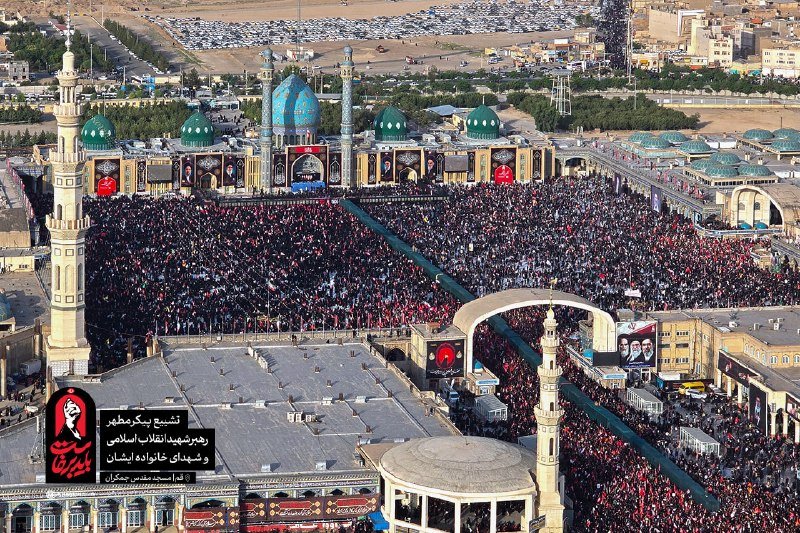
The first dispatches came in the small hours of 7 July 2026, all from the same direction. At 02:13 UTC, Al-Alam Arabic reported the presence of Ayatollah Javadi Amoli at the Jamkaran Mosque in Qom for prayers over the body of "the martyred leader and the martyrs of his family." By 02:20 UTC the coffin was arriving at the shrine; by 02:23 UTC the crowd was already chanting. By 03:55 UTC the same channel used the word "massive." By 04:00 UTC the ceremony was being broadcast as a funeral procession. Every item on the channel's breaking-news ticker carried the same architecture: martyr, Imam Sayyid Ali Khamenei, Jamkaran Mosque, Qom. The framing was not incidental to the coverage. It was the coverage.
What is unfolding in Qom is being narrated, in real time, in a particular key — and the choice of key tells readers more about the political weather in Tehran than any single image from the shrine forecourt. A funeral can be reported as a rite of mourning, as a logistical operation, or as a transfer of authority. The channels reaching English-language and Arab audiences this morning chose a fourth register, and that register is doing the heaviest lifting.
The word that does the work
Across seven dispatches filed between 02:13 and 04:00 UTC on 7 July, the honorific accompanying Khamenei's name was not "Supreme Leader" or "Ayatollah" but "shahid" — martyr (Al-Alam Arabic, 7 July 2026, 02:13–04:00 UTC). Family members killed alongside him were likewise "martyrs of his family." The frame is not new in Iranian state-aligned vocabulary. It maps an external, violent death onto an existing clerical register in which the senior clergy who fall in service to the Republic carry a status above ordinary mourning. The implication is sharp: the transition is being read as ending in rupture, not in orderly continuity.
Two points of friction deserve airtime. First, the English- and Arabic-language channels reaching the wider region have so far carried the martyr framing without visible pushback from non-aligned outlets; the counter-narrative — that this is the death of an unelected theocrat, that the frame is a managed piece of political theatre — has yet to surface in the same volume. Second, the framing competes, by design, with the more procedural "Supreme Leader Council" succession script familiar to Western Iran-watchers. Reporting it as martyrdom collapses a separation between religious authority and armed defence that Iranian constitutional practice tries, imperfectly, to maintain.
Why the venue choice matters
Jamkaran is not Tehran, and the choice of venue is not a logistical detail. The mosque is associated with the Twelfth Imam and with popular devotional practice rather than with the state's administrative nerve centre. Holding the prayer service there, before any state-organised funeral in the capital, puts a clerical-mystic stamp on the moment and signals that the transition is being keyed to the marja'iyya — the senior clerical establishment — rather than to the machinery of the Islamic Republic itself. Javadi Amoli's presence, reported at 02:13 UTC, reinforces the reading. He is a senior marja' whose authority crosses factional lines; his attendance gives the Qom ceremony a recognisably clerical, rather than purely security, imprimatur (Al-Alam Arabic, 7 July 2026).
The structural point: in a succession contest that will be settled inside a small clerical circle but legitimated in front of a public, the venue argues with the words. Qom argues clerical authority. The martyr framing argues external causation. A funeral in Tehran's engine-rooms — the defence ministry, the IRGC, the assembly hall — would have argued something else.
What is being held back
None of the seven Telegram items in this thread provides what an outside reader most needs: the date and circumstances of the death, an inventory of the "martyrs of his family," an identification of the actors or events blamed, or a timeline for succession. Al-Alam Arabic has chosen, for now, to lead with ceremony and frame; the harder reporting can be assumed to be coming. Western and Gulf-based outlets treating this as an obituary will need to wait on official Iranian confirmation, which so far has not appeared in the items this article is built on. The raw input is a set of seven Telegram dispatches from two accounts; the editorial substrate for any broader claim — succession procedure, regional fallout, security implications — is not yet on the table. This publication will revisit the story once those items surface.
Stakes, plainly
The framing war matters because the succession framework that emerges from this week will shape Iran's posture toward Israel, the Gulf, its nuclear file, and the Russian and Chinese relationships that define its external alignments. A martyr framing carries the heaviest external-confrontation weight; a clerical-continuity framing softens it. The state-aligned channels filing from Qom this morning have, by their word choices, already begun negotiating where on that spectrum the next Supreme Leader will sit. Readers, particularly those parsing Arab and pan-Islamic media, should register that choice as content, not as background colour.
— Monexus framed this against the grain of the wire: instead of paraphrasing the ceremony as a neutral state event, Monexus Staff reads the vocabulary of the dispatches as the newsworthy element, since seven near-identical Telegram items carry no other verifiable detail.
Wire provenance
This editorial synthesis draws on the following public wire/social posts:
- https://t.me/alalamarabic
- https://t.me/alalamarabic
- https://t.me/alalamarabic
- https://t.me/alalamarabic
- https://t.me/Khamenei_arabi