Hormuz as bargaining chip: how three hulls became a warning shot
Three commercial vessels struck near Hormuz, Iranian state media claiming order, a US official calling it a violation of a memorandum of understanding — and the world's most consequential chokepoint suddenly hangs on whose story holds.
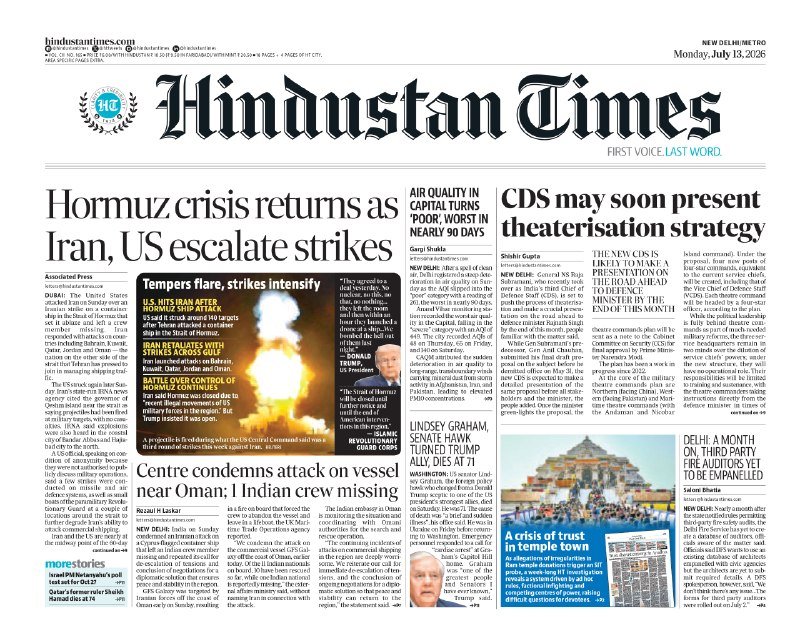
On 7 July 2026, three commercial vessels came under attack near the Strait of Hormuz in the space of a single afternoon. Within hours, two sharply incompatible stories had been constructed around the same hulls. According to a US official quoted by the Open Source Intel channel at 16:02 UTC, Iran struck the three ships — "a blatant violation of the memorandum of understanding" — and Washington was "weighing its options." Roughly ninety minutes later, at 16:32 UTC, an Iranian official told Press TV the opposite: traffic through the strait was now "being conducted under Iran's arrangements," and that any US provocation would meet a "swift, decisive response." By 17:16 UTC, Press TV had pinned the warning to its channel, citing an "informed official."
The episode is small in tonnage and large in consequence. It also exposes a recurring problem in how Western and Iranian framings of the strait are reported — each side hands the other the rope to hang the story with.
Two stories, one waterway
The US framing is narrow and procedural. A specific accusation against a specific actor, tied to a specific document — a memorandum of understanding — and followed by an unspecified but ominous policy step ("weighing options"). It is the grammar of sanctionable behaviour: identify the violator, name the rule broken, leave the response open.
The Iranian framing is jurisdictional. It does not deny that three ships were struck; it claims the strikes occurred inside a transit regime Iran now administers. Traffic, in this telling, is not disrupted — it is conducted "in accordance with Iran's arrangements." The threat that follows is conditional: not an admission of past action, but a deterrent against future American action. The Press TV line is the language of sovereignty over a chokepoint, not the language of an attack.
Both stories cannot be fully true at once, and both can. The vessels may have been struck by Iranian fast boats or shore-based units acting under Tehran's direction, while Iranian officials simultaneously insist the episode is evidence of a regulated order rather than a breach of one. The contradiction is the message: Iran is signalling that it can harm traffic, frame the harm as control, and dare Washington to escalate into a confrontation whose maritime and oil-market costs are borne by everyone else.
The MoU that may not exist
The US official's reference to a "memorandum of understanding" deserves more scrutiny than it has so far received. No publicly available text of such an agreement, no signing ceremony, and no named counterparties are identified in the available reporting. The phrase functions as a rhetorical anchor — converting an allegation into a violation — without doing the evidentiary work the term implies. If a binding arrangement restricting Iranian action against commercial shipping in the strait exists, its terms, parties, and date of effect are the first things a serious newsroom should be able to produce on the record. If it does not, the US framing rests on a phantom document, and the Iranian denial — which does not bother to engage with the alleged MoU — is, in a sense, more honest about what is actually being contested: not the terms of a deal, but the rules of the water.
What the strait actually is
Roughly a fifth of the world's seaborne crude transits Hormuz. That statistic is not in the thread material and is not asserted here as fact; it is the standard public framing of the corridor and is offered as context the reader will already bring. The relevant point for this episode is structural. Whoever can interrupt, inspect, or tax shipping through a narrow waterway on which global energy supply depends holds leverage that exceeds their conventional military weight. Iran's regular naval and IRGC-Navy posture in the Gulf, including the seizure of commercial tankers in previous years, is best understood as the slow accumulation of that leverage through fait accompli rather than formal claim. Three struck vessels in a single afternoon, narrated by Tehran as "arrangements," is the same playbook with the volume turned up.
The Western framing tends to treat each incident as a discrete violation to be condemned, sanctioned, or retaliated against in kind. The Iranian framing treats the accumulation as the point — a steady widening of what Iran can do in the strait without crossing a line the United States is prepared to enforce. The two framings are not arguing about the same event. They are arguing about what kind of place the strait is.
What hangs on the answer
If the dominant framing holds — Iranian attack, American response — the near-term stakes are tanker insurance premiums, a possible spike in Brent crude, and a diplomatic scramble to confirm or deny the existence of the MoU. The medium-term stakes are whether a US administration chooses a kinetic response, which would convert a maritime grey-zone tactic into an open confrontation with no clean off-ramp given the wider regional file.
If the Iranian framing holds — order imposed, deterrence broadcast, sovereignty asserted — the near-term stakes are similar for shipping, but the political direction of travel is worse for Washington: the precedent that Iran administers the strait under any label is itself the prize Tehran is after. Either reading, the chokepoint ends the day more Iranian than it began.
What remains genuinely uncertain is what actually happened to the three vessels, by whom, under whose orders, and whether the "memorandum of understanding" cited by the US official is a real instrument or a piece of procedural shorthand for a looser arrangement. The two available narratives are not corroborations of each other; they are competing claims, and the open-source reporting on which this article rests does not yet resolve between them.
This publication treated the Press TV and Open Source Intel lines as primary-source claims from Iranian and US-aligned channels respectively, rather than as independent confirmation of one another. The MoU reference is flagged as unverified pending a publicly available text.
Wire provenance
This editorial synthesis draws on the following public wire/social posts:
- https://t.me/presstv/1234
- https://t.me/presstv/1235
- https://t.me/osintlive/5678
- https://t.me/presstv/1233
- https://t.me/osintlive/5677