A coffin lands in Najaf, and the regional order tilts another degree
A senior Iranian official's body is being flown to Najaf for burial. The choreography is the message — and it tells you something about the state of the regional order that the Western wire is not yet naming.
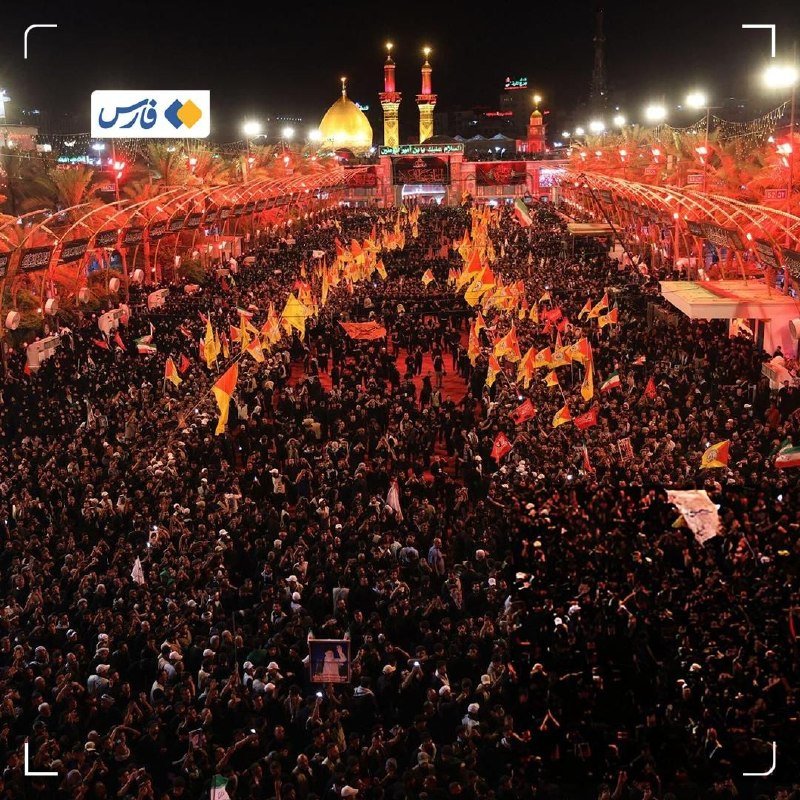
On the afternoon of 7 July 2026, a plane carrying the body of a senior Iranian official and his family touched down at Najaf International Airport. Iranian state outlet Tasnim News released the footage in real time: the runway, the ceremonial reception, the body's movement from aircraft to terminal. By 17:41 UTC, residents of Qom had already held what the same outlet described as a final farewell. The body, Tasnim reported, had departed Iran carrying the title "Imam of the Ummah," a phrase that does not travel lightly. Burial is set for the holy city of Najaf, in Iraq — not in Tehran, not in Qom, not in Mashhad, the three cities that absorb almost every senior Iranian clerical funeral of the modern era. The geography is the story.
Iran's leadership has chosen to bury one of its most consequential figures in a city it does not control, in a country whose government has spent two decades recalibrating away from Tehran's orbit. That choice says more about the regional order the Western wire has been struggling to describe than any of the analyses published this week.
Reading the airport tarmac
The scenes Tasnim has been publishing are doing the diplomatic work in plain sight. Najaf is being treated as a stage. The Iraqi government allowed the transfer, which means at minimum the prime minister's office in Baghdad did not object, and at maximum that Iraq's Shia political class — fractured, Iranian-leaning in some factions, Saudi-and-American-leaning in others — closed ranks long enough to make this work. Najaf airport officials were visibly ready, the planes visible on the apron, the reception formal. There is no plausible reading in which Baghdad was surprised.
That matters. Iraq has spent the last three years threading itself between Tehran and Washington, accepting Iranian-backed militias on its soil while negotiating a security relationship with the United States. Hosting a high-profile Iranian funeral is not a neutral act. It is a public signal of where the Iraqi state's symbolic loyalties still rest, even when its security and energy relationships point elsewhere. The Western press has been describing this as "Iraqi balancing." The Tasnim feed is describing it as Iraqi alignment. Both can be true simultaneously, and the funeral is the place where the contradiction is being made visible.
What the wire is not yet saying
A senior Iranian official being laid to rest in Najaf, with Iranian state media streaming the event live, is the kind of image that the regional press in Beirut, Baghdad and Amman will absorb immediately and that the Western wire will take forty-eight hours to contextualise. The default read in Washington, London and Tel Aviv is to treat such moments as Iranian theatre — a calculated projection aimed at the so-called "resistance" audience. The more uncomfortable read, and the one this publication finds more defensible, is that the projection is succeeding because the underlying audience is real.
Iran's foreign-policy establishment has spent four decades building a network of parties, militias, clerics, media arms and trading houses that can mobilise a crowd in Najaf on a day's notice. The West tends to describe this as a propaganda architecture. The recipients in Najaf, in the Shia quarters of Beirut, in the southern suburbs of Damascus, and in the refugee populations of Sanaa describe it as a community. The funeral is meant to be felt by that community, and the community is large enough that a state broadcaster in Tehran is confident enough to make the visual record of it a matter of national broadcast. That is the structural fact, stripped of the vocabulary the analyst class usually reaches for.
The costs of getting the framing wrong
The Western policy debate about Iran has been, for most of 2026, organised around three propositions: that sanctions are working, that the regional order is reasserting itself, and that Iran's network of allies is fragmenting. Each of those claims is partially true, and each of them is also a comforting story that official sources in Washington, London and Brussels have a professional incentive to amplify.
The Tasnim feed from Najaf suggests a different read. The network of allies is fragmenting at the operational and tactical level — in Gaza, in Syria, in Lebanon, there is open disagreement about strategy and cost. But it is not fragmenting at the symbolic and ideological level. The funeral is the proof. If Iran's regional project were in genuine collapse, Najaf airport would not have been the obvious place for this. The officials who planned the burial knew exactly what they were doing: the choice of Najaf re-anchors the network in the holiest possible geography, in front of the cameras the Iranian state controls, and in a country whose compliance is itself a political fact that needs to be explained.
The stakes, plain
If the dominant Western framing is right, the Najaf burial is a final flourish. The network is winding down, the sanctions are biting, and the next funeral in this region will be in a different kind of place. If the alternative framing is right, the burial is a refounding gesture — a public re-binding of the symbolic and political ties that the tactical setbacks of the last two years have strained but not broken.
The two readings cannot both be true, and the next six to twelve months of reporting from Najaf, Beirut and southern Iraq will determine which one holds. What is already beyond dispute is that the Iranian state has decided to spend significant political and logistical capital on this moment, and that the Iraqi state has decided to allow it. That is a data point. Treat it as one.
What remains uncertain
The sources do not yet specify the identity of the official being buried, the exact Iraqi governmental approvals that were secured, or the diplomatic channels used to coordinate the transfer. Tasnim's reporting is by definition the Iranian state's framing of its own event, and a fuller picture will require Iraqi, Saudi and Western-wire confirmation in the days ahead. Monexus will update the record as that material lands.
Wire provenance
This editorial synthesis draws on the following public wire/social posts:
- https://t.me/tasnimnews_en
- https://t.me/tasnimnews_en
- https://t.me/tasnimnews_en
- https://t.me/tasnimnews_en