Iran buries Khamenei: a ritual of legitimacy, and a question Tehran has not answered
A scripted farewell in Qom and Najaf offers Tehran a chance to project continuity. Whether it can also paper over the unresolved question of succession is the harder test.
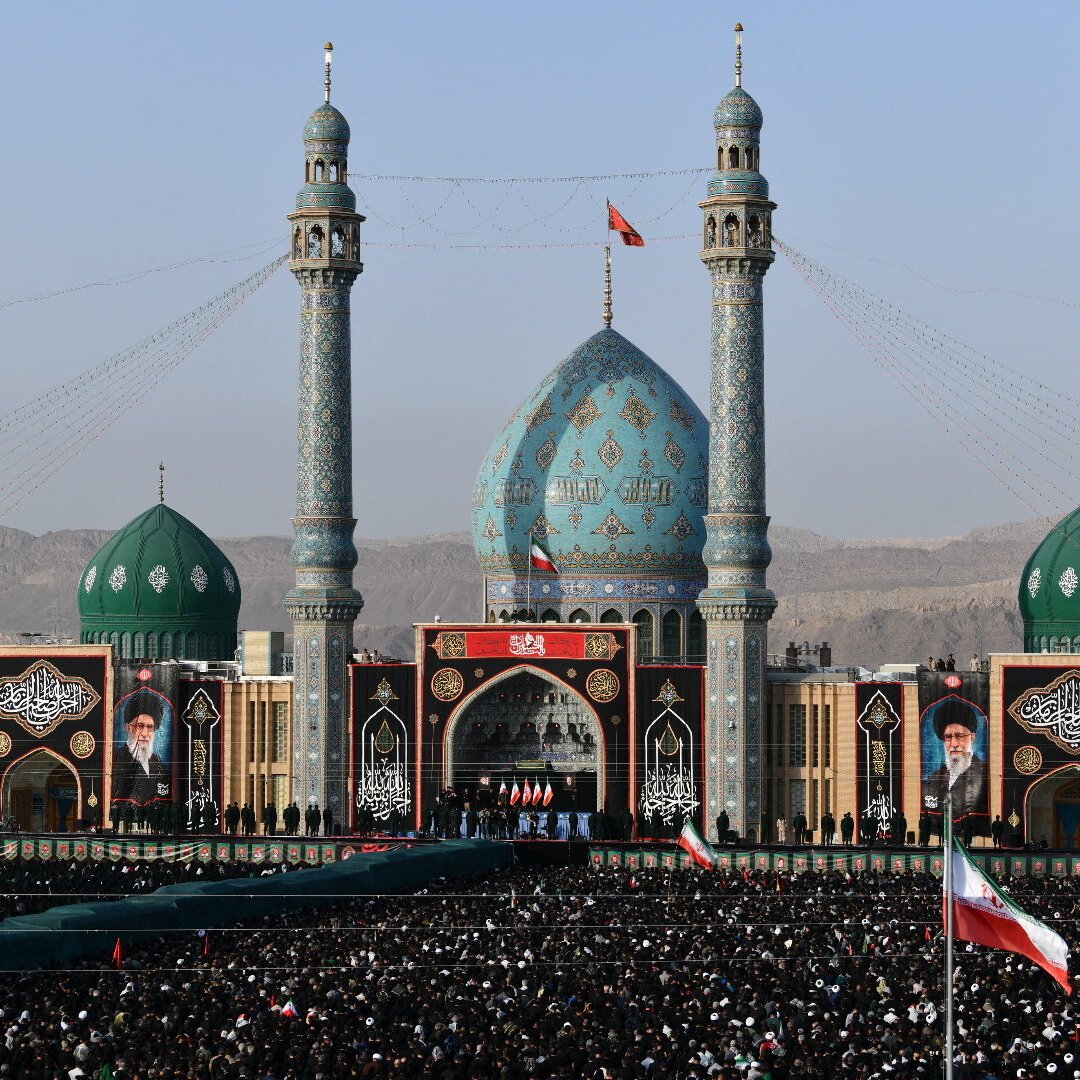
On 7 July 2026, Iranian state television announced the conclusion of what it called a historic and massive funeral ceremony in the holy city of Qom for the country's slain supreme leader and members of his martyred family, with a further procession scheduled to begin at 06:00 local time the following morning in Najaf, Iraq, before continuing onward. The choreography is being executed with the deliberate precision of a regime that has institutionalised grief as a governing tool.
The mass turnout in Qom — broadcast in real time by the Islamic Republic of Iran Broadcasting corporation — is meant to do more than honour a dead leader. It is meant to ratify a transfer. Iran is signalling, in the language it knows best, that the killing of its most senior figure has not produced the political disarray that its adversaries hoped for. Whether that signal holds once the cortège moves on is the harder question Tehran has not answered.
A stage-managed exit
Two facts stand out from the broadcasts. First, the speed: from the announcement of death to a televised mass funeral in Qom, with the next stop already mapped to Najaf, the logistics were set in motion almost immediately. Second, the geography. Najaf — the seat of the Shia clerical establishment in Iraq, and the burial place of the Imam Ali — is a deliberate choice. A supreme leader laid to rest near Ali is a statement of theological lineage as much as political succession.
The ceremony is a piece of political theatre of the kind Tehran has refined over four decades. The audience is plural: Iran's own restive population, which state media insists turned out in historic numbers; the regional axis that takes its cue from the supreme leader's office; and the external powers whose calculation of Iran's trajectory now requires a verdict on who, exactly, is in charge.
The framing the regime wants
Read on its own terms, the coverage from Iranian state outlets makes a straightforward case: the Islamic Republic has absorbed a mortal blow and produced a national ritual in response, fast and apparently orderly. The word used repeatedly in the broadcasts — historic — is doing work. It is meant to translate mass attendance into a plebiscite on continuity.
This is the framing the regime is exporting. It is also the framing its critics inside Iran will treat with deep scepticism. State-aligned coverage of funeral attendance has, in past succession moments, recorded numbers that independent observers questioned. Even when the turnout is genuinely large, the question of what grief performed in a coercive political environment actually ratifies is not the same as the question of what a freely cast vote would ratify.
What the harder question is
Funerals close a chapter. The succession machinery that produces the next supreme leader does not. Under Iran's 1989 constitutional amendment, the Assembly of Experts — a body of 88 clerics elected to eight-year terms — selects the supreme leader. The current state broadcaster coverage does not name a successor, nor does it set a date for the Assembly to convene. That silence is the more important fact in the week ahead.
This is where the dominant Western framing — focused on who shot whom and what Israel or the United States intended — runs ahead of what is actually being decided inside Iran. The regime has not yet been forced to answer, in public, the question of whether the next supreme leader will be drawn from the same conservative clerical establishment that has held the office since 1989, or whether the moment will be used by a rival faction to consolidate a different kind of authority. The state broadcaster's tone — historic, continuous, unbroken — implicitly argues for the first option.
The structural reading
A regional power absorbing the killing of its senior leader and producing a televised ritual of national unity within days is, on its face, a demonstration of institutional depth. The same ritual, viewed more coolly, is also a demonstration of what the regime has to spend political capital on at this exact moment: pageantry rather than explanation. The Iranian state's most useful answer to the question of who is in charge is, for now, the camera in Qom.
That is the geometry the next 72 hours will either confirm or break. If the cortège reaches Najaf and onward without disruption, and if the Assembly of Experts then produces a named successor without visible internal contest, the regime will have earned a window of consolidation. If it does not, the funeral — for all its scale — will be remembered as the moment Tehran spent its reserves of legitimacy on choreography and arrived at the harder question with fewer of them than it started with.
The footage is real. The numbers Iran is claiming are Iranian. The conclusion is not yet in.
This publication treats the funeral as a regime-organised act of political communication. The state outlets broadcasting it are primary sources for what the Iranian government is saying; they are not, on their own, evidence for what Iranians are choosing.
Wire provenance
This editorial synthesis draws on the following public wire/social posts:
- https://t.me/alalamarabic
- https://t.me/alalamarabic
- https://t.me/alalamarabic
- https://en.wikipedia.org/wiki/Assembly_of_Experts
- https://en.wikipedia.org/wiki/Supreme_Leader_of_Iran