Iran's funeral diplomacy: why a dead president draws crowds from Najaf to Karbala
Tasnim's Najaf-to-Karbala coverage of the late president of Iran's cortège is not a grief story. It is a regional signalling exercise, and the Iraqi crowds are the message.
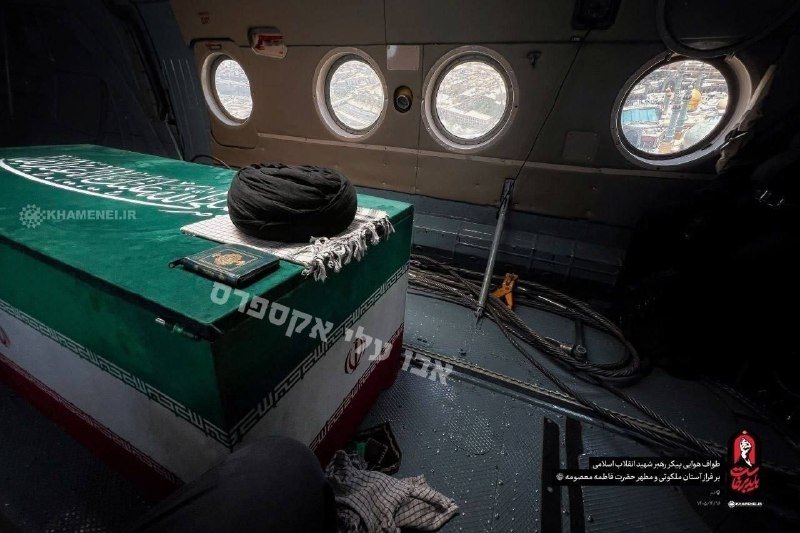
On 7 July 2026, Iran's state-affiliated Tasnim News Agency ran a coordinated four-item thread on the cortège of a fallen Iranian president moving from Najaf to Karbala. The frames were uniform — "Welcome," "spontaneous participation," "the Martyr Imam of Iran," images in the hands of Iraqi mourners. The crowd is the message, and the message is not for Iraqi Shia alone. It is for Tehran's wider neighbourhood, for the governments that have spent the last three years edging away from the Islamic Republic, and for an audience in Washington that reads such scenes in a different register than they are intended.
This is not, on its surface, a hard-news story. A former head of state has died. His body is being escorted through two of Shia Islam's holiest cities by people who came out to see it. But the choreography — Iranian state media as the principal chronicler, the Hashd al-Shaabi-aligned and Iraqi street framing, the deliberate pairing with the Arbaeen pilgrimage season — is the kind of optics operation that the region has learned to read as policy. The Iraqi street, the Iranian camera, and the timing are all inputs to the same signal.
What Tasnim actually showed
The four wire items published between 15:04 and 16:24 UTC on 7 July 2026 describe a single procession: a figure identified in Tasnim's framing as the "Martyr Imam of Iran" leaves Najaf by road, accompanied by family, and is received along the Najaf–Karbala corridor by Iraqi crowds. Tasnim's captions emphasise three things — the word spontaneous, the religious vocabulary of martyrdom and welcome, and the visible diversity of Iraqi participants ("with all its differences and diversity of voices"). The fourth item is a photo essay. The combined effect is a curated portrait of a unified Iraqi Shia public, photographed for an audience that includes Tehran, the Iraqi state, and the foreign-policy readers of state media across the region.
None of the items carry a date of death or a name. Tasnim's framing refers only to "Mr. Shahid" — the honorific shahid (martyr) repeated in the hashtag #Badarqa_Aghai_Shahid_Iran. The thread does not specify the cause or timing of the death, nor the identity of the late official, nor the sequence of events that preceded the cortège. That absence is itself the message: the choreography is the news, the personality is the vehicle.
The Iraqi read, the Iranian read
In Iraq, the optics sit inside a domestic argument that the political class has been having for two years. Baghdad has spent most of 2025 and the first half of 2026 recalibrating its relationship with Tehran — partly under US pressure to wind down the residual footprint of Hashd al-Shaabi-aligned militias, partly because the Iraqi state is hedging against the moment when the Iranian axis has to absorb a major shock. A cortège drawing visible Iraqi crowds through Najaf and Karbala, on camera, at scale, is the kind of footage that complicates that recalibration. It says, in effect, that whatever the Iraqi cabinet negotiates in private, the Iraqi street is not the cabinet's to manage.
In Tehran, the same footage is read differently. Iran has lost the regional-mobilisation capacity it could call on in 2019 or even 2022. The funeral of Qasem Soleimani in 2020 drew Iraqi crowds of a different magnitude and a different political weight. Tasnim's decision to lead with "spontaneous" and "diversity of voices" is calibrated against a known ceiling: the organisers want the picture to look like a movement, not a managed convoy. The framing of an Iranian president as a shahid — a martyr in the technical religious sense, not a victim — is a deliberate doctrinal upgrade. Presidents of the Islamic Republic are not normally elevated into the martyr register. Doing so for this figure is a doctrinal choice that survives this presidency.
What the framing is competing with
The Western-wire version of this event, when it appears, will run as a regional-mourners-piece, with security caveats and a small sidebar on the late president's record. The frames will be measured: a head of state dies, pilgrims gather, the neighbours do their courtesies. The frame this publication is interested in is whether that reading and the Tasnim reading can both be true at once — whether a cortège can be a funeral and a recruitment poster simultaneously, and whether the audiences the footage was made for are receiving it that way.
The structural read is straightforward, and it does not need a theorist's name attached. The Islamic Republic's regional influence is no longer best measured by the rockets in its proxy arsenal or the lines on a map of the Shia crescent. It is increasingly measured by the size and discipline of the crowds it can put on the streets of sovereign Arab capitals. A funeral that reads as a million-person march is, in the current Middle East, a piece of strategic infrastructure. Iran is visibly invested in keeping that infrastructure warm.
What we do not know
The Tasnim thread is the only source on the cortège available to this article. It does not name the late president, does not date the death, does not give a casualty or attendance figure, and does not describe the Iraqi government's role in facilitating transit. Independent confirmation of the scale, the composition, and the political affiliations of the crowds along the Najaf–Karbala corridor is not available in the thread. The Iraqi state has not, in the items before us, weighed in publicly. The framing in this piece — that the procession is being used as a regional signalling exercise — is the reading the optics invite; it is not a reading the available sourcing can prove, and readers should treat it as the most plausible read rather than the only one.
The Monexus framing differs from the wire version it anticipates in one respect: the wire will cover this as a story about a death and a funeral. Monexus is covering it as a story about a death, a funeral, and a regional audience being shown something on purpose.
Wire provenance
This editorial synthesis draws on the following public wire/social posts:
- https://t.me/tasnimnews_en/
- https://t.me/tasnimnews_en/
- https://t.me/tasnimnews_en/
- https://t.me/tasnimnews_en/