Iran buries Khamenei in Qom as the question of succession moves from ritual to politics
A weeklong funeral for Ayatollah Ali Khamenei reaches its finale in Qom. The unfinished business is who replaces him.
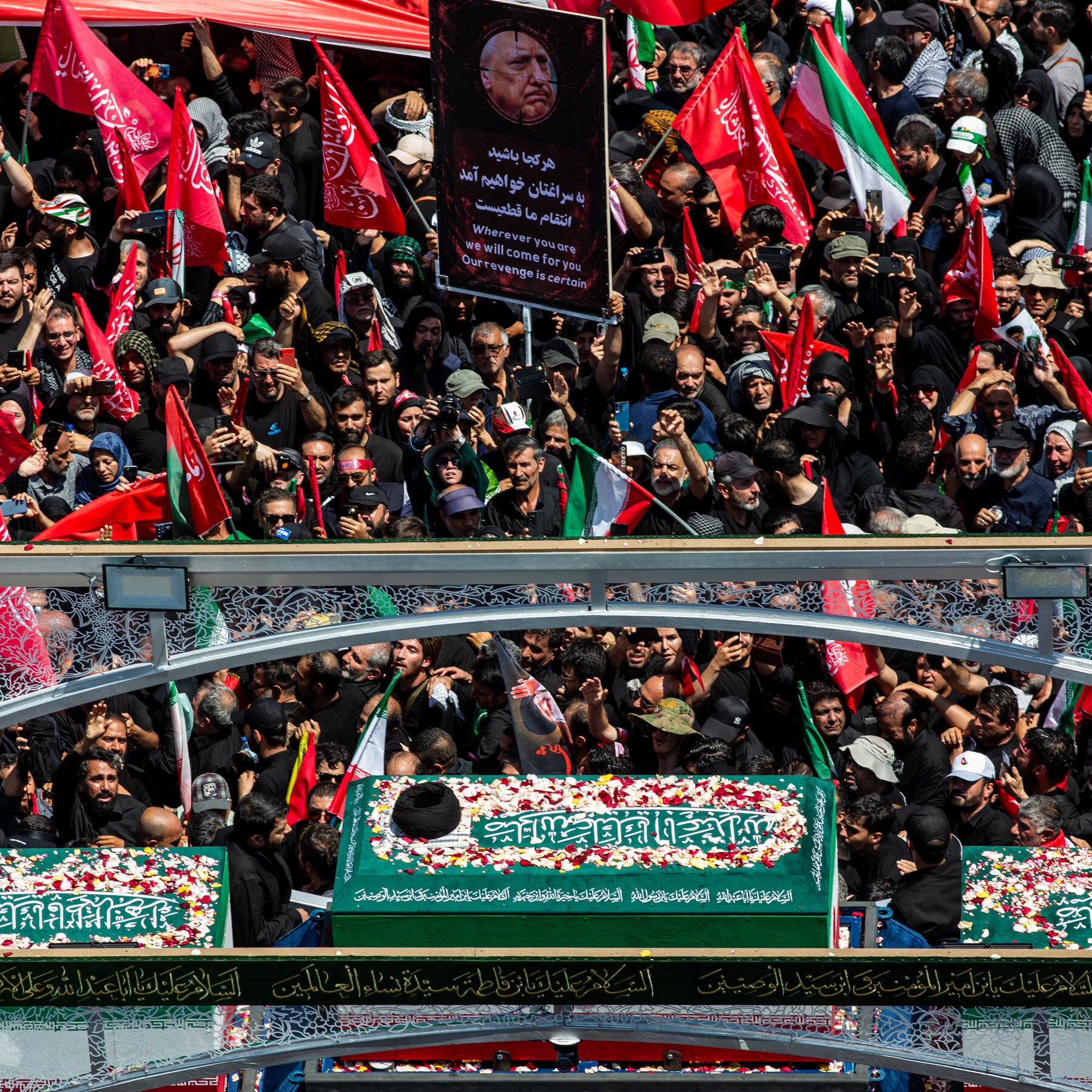
The funeral procession for Ayatollah Seyyed Ali Khamenei drew to a close in the holy city of Qom on 7 July 2026, state media reported, closing one act of a weeklong mourning ritual and opening another — the political contest to fill the supreme leadership of the Islamic Republic.
Iran's official IRNA news agency said the procession ended in Qom and that the body of Iran's "martyred Leader" and his family members would continue rites the following day. The framing — "martyred leader," "historic funeral" — was repeated almost verbatim by Tasnim, the outlet linked to the Islamic Revolutionary Guard Corps. The wording signals that the state intends to enshrine Khamenei's death in the vocabulary of martyrdom that the Republic has used for decades to bind the body politic to its institutions.
The substantive question is not who writes the next eulogy. It is who signs the next fatwa, who commands the IRGC, and who decides whether Iran keeps its posture of armed restraint, calibrated escalation, or something in between. The funeral marks the moment the succession question moves from speculation to scheduling.
What we know, what is still opaque
Khamenei was killed, per Iranian official framing, in an act the state has not detailed beyond classifying him as a "martyr." Major Western wire services have not, in the items available to this desk, identified the date, method, or perpetrator of the killing; outlets referenced here describe the funeral, not the attack. That gap matters. A leadership change in Iran read against an unnamed act of war is a different story from one read against a managed natural death. Until that is settled, every other variable — succession timing, public mood, the role of the Assembly of Experts — sits on unsettled ground.
The funeral itself was held at a site in Qom that state-aligned outlets and the New York Times describe as sacred to many Shia Muslims. The New York Times, reporting on 7 July 2026, called the ceremony "the latest step in a weeklong funeral organized by Iran's government," language that places the orchestration squarely with the state rather than with the marja'iyya — the community of senior clerics who would, in a normal succession, deliberate on a successor.
The succession machinery, and what it does not guarantee
Iran's leadership-transition rules are written; they are also political. The Assembly of Experts is the body formally charged with selecting a new Supreme Leader; its members are elected, vetted, and overwhelmingly drawn from the clerical establishment that has held office since 1989. The Council of Guardians, the Expediency Council, and the Supreme National Security Council each have a role, formal or informal, in moments of crisis.
None of those bodies have spoken publicly in the materials reviewed by this desk. What is visible is choreography: a procession that moved through Qom, Karbala and Mashhad, coordinated across IRNA and Tasnim, and explicitly framed as a martyrdom. That choreography is itself a message — to internal factions, to the regional axis in Baghdad, Beirut and Sanaa, and to the foreign ministries that read Iranian succession as a security variable.
A common outside assumption is that institutional continuity is automatic. The history suggests it is not automatic; it is negotiated. The 1989 transition from Ayatollah Khomeini to Khamenei was, by the accounts most clerics now accept, a contested affair involving late compromises, religious credentials issued under pressure, and a deliberate broadening of the office's published authority. The materials available here do not establish that history in detail, but the precedent is worth flagging: in Iran, succession reads as ritual because the state controls the stage, not because the contest is absent.
The regional reading
A succession in Tehran is read in Riyadh, in Tel Aviv, in Ankara, in Doha and in Washington long before the new incumbent is named. The questions each capital asks are distinct: who has the standing to restrain the IRGC's external operations; who can sign off on nuclear posture; who can absorb the loss of the figure whose name alone closed meetings for three decades; whether the Islamic Republic sharpens its confrontational register in the months when it feels it must prove continuity, or whether it softens it to manage pressure.
Iranian state-aligned media are not, on the evidence here, signalling softening. Tasnim's language — "the magnificent and historic funeral ceremony of the martyred leader of the revolution" — is the language of consolidation, not transition. IRNA's separate, day-ahead framing of Karbala rites suggested the procession would continue across the Shia Iraqi shrine city, a continuity gesture aimed as much at a regional Shia public as at Iranian domestic audiences.
What remains uncertain
Three things stay open. First, the cause and circumstances of Khamenei's death, which the items reviewed here do not establish. Second, the timeline to a named successor: Iranian law permits an interim council; Iranian practice permits delay. Third, the regional response — whether Gulf states read the funeral as an opportunity for quiet diplomacy or as a moment to harden positions on Hezbollah, the Houthis, and the nuclear file.
There is also a fourth, more delicate, uncertainty. The Republic has, for the duration of this desk's recollection, governed partly by the charisma of office and partly by the bargaining of factions inside it. A funeral in Qom speaks to the first. The bargaining is what runs from the day after the procession ends.
How Monexus framed this: we led with the Iranian state framing because that is where the procession is being orchestrated, then deferred to the New York Times for an outside description of the choreography, and held open on the questions of death and succession that the sourcing does not yet settle.
Wire provenance
This editorial synthesis draws on the following public wire/social posts:
- https://t.me/Irna_en/1
- https://t.me/Irna_en/2
- https://t.me/tasnimnews_en/1