Iran's president lands in Najaf for funeral of Khamenei, in a ceremony calibrated to regional power
Masoud Pezeshkian crossed into Najaf on 7 July 2026 to attend the burial of Ali Khamenei, in a ceremony that doubles as a display of the Shia-led order Tehran has spent four decades building.
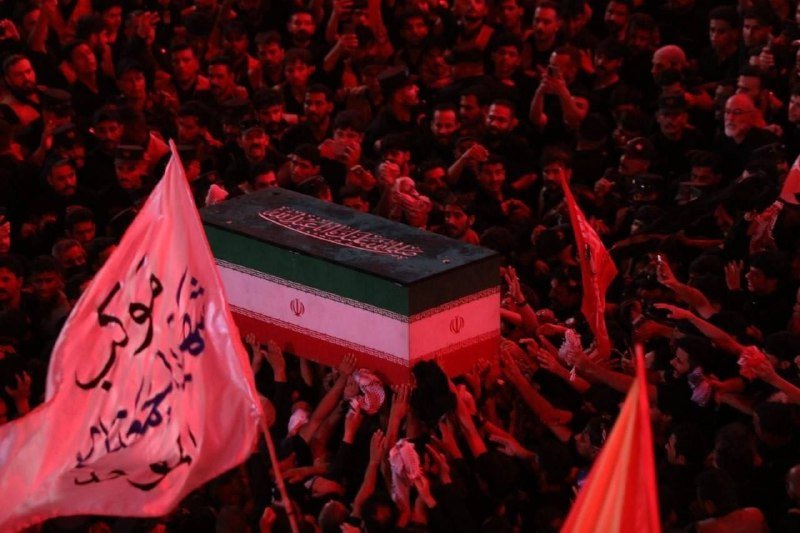
Iranian President Masoud Pezeshkian touched down at Najaf International Airport at roughly 13:05 UTC on 7 July 2026, to an official welcome from Iraqi Prime Minister Mohammed Shia' al-Sudani and a delegation of senior Iraqi officials, according to Iran's Tasnim News. His arrival set off the foreign-head-of-state phase of a funeral sequence that Iranian, Iraqi and pan-Arab outlets had been tracking hour by hour since the previous day. Tasnim, Fars News International and Al Alam Arabic all converged on the same scene within a two-hour window: an Iraqi prime minister greeting an Iranian president at the holiest city in Shia Islam, to bury the man who shaped the Islamic Republic's regional project for nearly four decades.
The gathering in Najaf is, on its face, a religious ceremony. It is also a stage-managed display of the political order that the deceased spent his career constructing — a network of Shia-led governments, allied militias, and clerical patronage that runs from the Persian Gulf to the Mediterranean. The guest list in Najaf will tell observers as much about the Islamic Republic's successor posture as any speech from Tehran.
What is happening in Najaf
Tasnim News reported at 12:54 UTC on 7 July 2026 that Pezeshkian had departed Tehran for Najaf, with a formal welcome planned on arrival "by the Prime Minister of Iraq and a group of officials of this country." The same outlet confirmed the landing roughly seventy minutes later, noting that the president would be received by Iraqi Prime Minister al-Sudani alongside "high and local Iraqi officials." Fars News International, at 14:03 UTC, framed the trip in overtly political-religious terms, characterising al-Sudani's travel to Najaf as participation in the "burial ceremony of the martyred leader of the Revolution." Al Alam Arabic, the Iranian state Arabic-language broadcaster, used near-identical language at 13:25 UTC, describing al-Sudani's arrival as that of a foreign dignitary attending the funeral of "the martyr leader of the Islamic Revolution, Sayyed Khamenei."
The convergence of phrasing across three Iranian-aligned outlets — Tasnim (conservative), Fars (hardline), Al Alam (pan-Arab, Saudi-targeted) — is itself a signal. Iranian state messaging on a leadership transition is centrally coordinated, and the use of the epithet "martyr" rather than the more neutral "Supreme Leader" or "commander" points to a deliberate framing: Khamenei is to be remembered as a combatant fallen in a cause, not merely as a head of state.
The regional choreography
Iraq is the only Arab state with sufficient sectarian, political and security alignment with Iran to host a funeral of this stature. The choice of Najaf — seat of the Hawza, the Shia clerical establishment that predates and rivals Qom — is a concession to Iraqi religious authority that Tehran does not make lightly. Iraqi Prime Minister al-Sudani's personal presence is the most direct signal Baghdad has sent of continuity in the Iran-Iraq relationship under his government, which has been built on a careful equilibrium between Iraqi Shia political constituencies, US troop presence, and Iranian-aligned militias nominally absorbed into the Iraqi state security forces.
The ceremony is also a stress test for a region that has lost several senior figures in quick succession. The pace of leadership turnover in the Iranian-led Shia axis — Hamas, Hezbollah, the Syrian Baathist state, and now the Supreme Leader's office — has compressed the usual mourning-and-succession cycle. Iran's clerical system is engineered for continuity rather than personal charisma, and the public choreography in Najaf is designed to project exactly that: an institution absorbing a transition, not a movement in crisis.
The counter-read
Western wire reporting on Iranian leadership funerals tends to flatten two competing interpretations into a single default frame — that of a brittle theocracy papering over internal fractures. The Najaf ceremony complicates that reading in ways the Iraqi and Iranian sources make visible. Pezeshkian's presence, rather than that of a clerical hardliner, signals that the elected wing of the Iranian state intends to own the public face of the succession. Al-Sudani's reception of him in person, rather than via a lower-ranking envoy, signals that Baghdad reads the new configuration in Tehran as worth a head-of-government investment. The two facts together point to an institutional, rather than factional, handover — the kind of read Iranian state media is plainly trying to install.
A more sceptical interpretation is also available. The "martyr" framing, deployed simultaneously across Tasnim, Fars and Al Alam, may be less a confident projection of continuity than a managed attempt to control a narrative that, inside Iran, is genuinely contested. The sources available to Monexus do not specify who succeeded Khamenei, who delivered the eulogies in Najaf, or which other heads of state travelled alongside Pezeshkian. The Telegram thread reports only the Iranian and Iraqi principals by name. On that thin evidentiary base, the safer reading is institutional rather than predictive: Najaf is being used as the venue at which Tehran tells its allies — and its rivals — that the post-Khamenei order intends to be legible and orderly.
Stakes and what to watch next
The Najaf funeral is the first foreign-policy stage on which the post-Khamenei Islamic Republic will be judged. Three questions follow from it. First, whether the guest list in Najaf includes senior figures from Hezbollah, the Houthis, and the Iraqi Shia militias formally integrated into the Popular Mobilisation Forces — the operational backbone of the regional project. Their presence, or absence, will be the most concrete signal of how Tehran intends to manage its forward defence perimeter. Second, whether Pezeshkian delivers remarks in Najaf that go beyond condolence and into a substantive restatement of Iran's regional doctrine. And third, whether al-Sudani's government uses the occasion to extract any bilateral concession — energy, sanctions-relief cooperation, or border-security arrangements — that would mark the funeral as a working summit as well as a rite.
The thread context does not specify casualty figures, attendee counts beyond the two principals named, or the precise schedule of the burial. Monexus will update as wire confirmation arrives on the wider guest list and the successor architecture in Tehran. For now, Najaf is performing the only function it needs to perform today: making the Islamic Republic's regional order look, to those who depend on it, like a structure that has survived the loss of its longest-serving architect.
Desk note: Monexus has framed this story from the Iranian and Iraqi state-aligned Telegram feeds first, on the principle that the funeral's primary meaning is being set inside that information ecosystem. Where Western wire outlets later publish on the guest list and the succession, we will supplement — but the dominant frame here, as in Najaf itself, is being authored in Tehran and Baghdad.
Wire provenance
This editorial synthesis draws on the following public wire/social posts:
- https://t.me/tasnimnews_en
- https://t.me/tasnimnews_en
- https://t.me/FarsNewsInt
- https://t.me/alalamarabic