Funeral crowds at Jamkaran: a stress test the Islamic Republic does not need
Tens of thousands poured into the Jamkaran Mosque through the early hours of 7 July to bury a slain leader of the revolution. The choreography is familiar — the political implications are not.
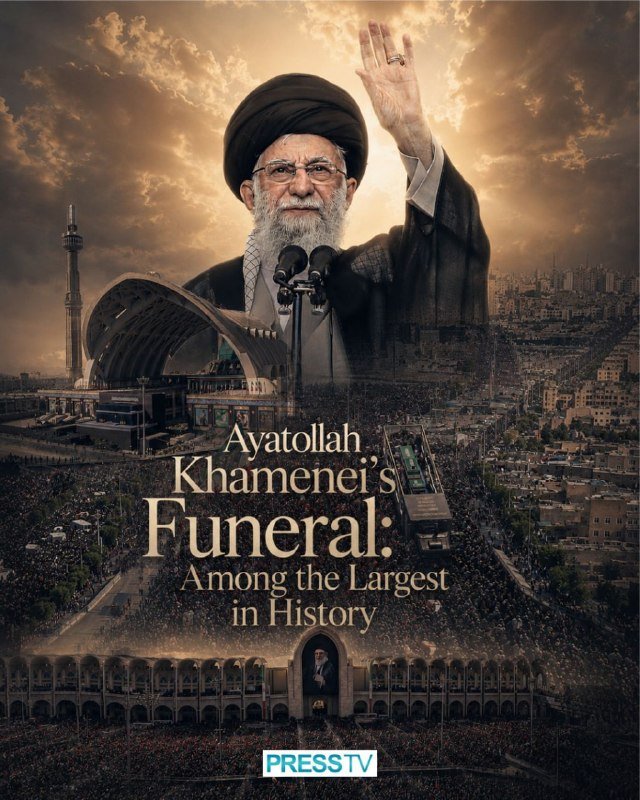
By 03:13 UTC on 7 July 2026, the footage from the road between the Shrine of the Lady of Karamat and the Jamkaran Mosque in Qom had stopped resembling a procession and started resembling a population count. Iranian state outlets al-Alam and Mehr News ran the same visual from slightly different angles — a single dense column of black-clad mourners, still growing at the moment of broadcast, filing toward a shrine built around a well said to await the Hidden Imam. The man they came to bury was described only by title: the "martyred leader of the revolution," killed alongside members of his family, whose bodies were carried into the mosque at around 02:39 UTC for funeral prayers.
The optics are familiar: the choreographed choreography of mass grief that the Islamic Republic has refined since 1989. What is unfamiliar is the timing. The country that built its legitimacy on the persona of an unkillable supreme leader is performing collective mourning in a year that has already exposed how thin the line is between managed symbolism and managed succession. Read the footage less as religion than as a stress test: can the Republic still draw a city to its feet on demand, and can it do so without letting that crowd become a constituency with its own preferences?
The street as a stage
The crowd at Jamkaran is not a fact about faith; it is a fact about infrastructure. Organised processions of this scale do not materialise — they are assembled, by security services, by clerical networks, by baseej mobilisation, and by the patronage chains that bind Iran's bonyads and provincial governors to the centre. The volume reported by al-Alam at 03:13 UTC — a "huge number" of mourners still arriving — and the aerial coverage at 03:09 UTC together signal something that the regime wants seen: that the killing has not produced fear, only resolve. The framing matters more than the count.
This is the same logic that has governed every major funeral from Behesht-e Zahra onward: the body in the street is a policy instrument, and the size of the crowd is the policy. To outside readers, the weeping at Jamkaran reads as evidence of legitimacy. To readers inside the system, it reads as evidence of mobilisation capacity, which is a different and more contingent thing.
What the regime is signalling
Three readings sit on the table. The first, and the one the broadcasters want you to take, is that the Republic absorbs the loss and carries on — that the killing of a senior figure and members of his family is a wound, not a fracture. The second reading, favoured by analysts who watch clerical succession closely, is that the funeral is itself the beginning of a factional contest: who carries the bier, who delivers the eulogy, which faction controls the shrine, which guard the road. The third reading, the cold one, is that the regime wants a visible, public, controllable display of unity precisely because the ungovernable alternative — quiet grief, absent crowds, no procession at all — would tell the rest of the establishment everything it does not want to know.
None of those readings is decisive on the evidence now public. The thread material does not name the dead official beyond his function, does not specify the cause of death, and does not state who attended. The visual record confirms the crowd; it does not confirm what the crowd believes.
The structural frame, in plain prose
Iran's political system runs on two parallel tracks. One is formal — the supreme leader, the appointed clerics, the elected Majles with its vetted candidates. The other is informal — networks of patronage, the bonyads, the IRGC's commercial empire, the clerical families of Mashhad and Qom whose loyalties are older than the Republic. The two tracks normally align, which is what makes the system stable. When they diverge, the divergence shows up first in rituals: whose funeral is public, whose is private; who is allowed to touch the body; who is asked to speak and who is asked to be silent.
That is why the choice of Jamkaran — a shrine to the Hidden Imam, a site of millenarian expectation — is not incidental. The Republic has spent decades managing the boundary between political Shi'ism and popular apocalypticism. A funeral there, for a man described in revolutionary rather than religious terms, is a public reminder of which story the state tells about itself.
What remains uncertain, and what is at stake
The sources this piece rests on are visual and atmospheric: footage and short captions from Iranian state-affiliated channels. They confirm the event and its scale. They do not confirm the victim's full identity, the circumstances of the killing, whether the strike — if it was a strike — was external or internal, or the attendance list at the prayers that began around 02:39 UTC. A reader who wants the political weight of this funeral needs all of those things; the footage alone tells us only that the Republic can still fill a courtyard in Qom on short notice.
What is at stake over the next seventy-two hours is narrower than the rhetoric suggests. If the funeral produces a unified succession move — a named figure, a clear factional alignment, an announcement rather than a procession — the system has demonstrated, once again, that it can metabolise a killing. If it produces only grief without governance, the gathering at Jamkaran will be remembered as the last large voluntary display of the old order, and the next one will have to be coerced.
How this publication framed it: Monexus has relied on Iranian state-affiliated visual sources for the basic facts and has refused to treat the crowd footage as evidence of either legitimacy or weakness. The piece distinguishes what the sources confirm from what they do not, and treats the funeral as an open political question rather than a closed ritual.
Wire provenance
This editorial synthesis draws on the following public wire/social posts:
- https://t.me/s/alalamfa
- https://t.me/s/alalamfa
- https://t.me/s/mehrnews
- https://t.me/s/alalamfa
- https://t.me/s/alalamfa