Khamenei's body in Najaf: what the state-media coverage actually tells us
State-media feeds describe the arrival of Ayatollah Khamenei's body in Najaf. Read literally, they raise more questions than they answer — and the questions matter more than the footage.
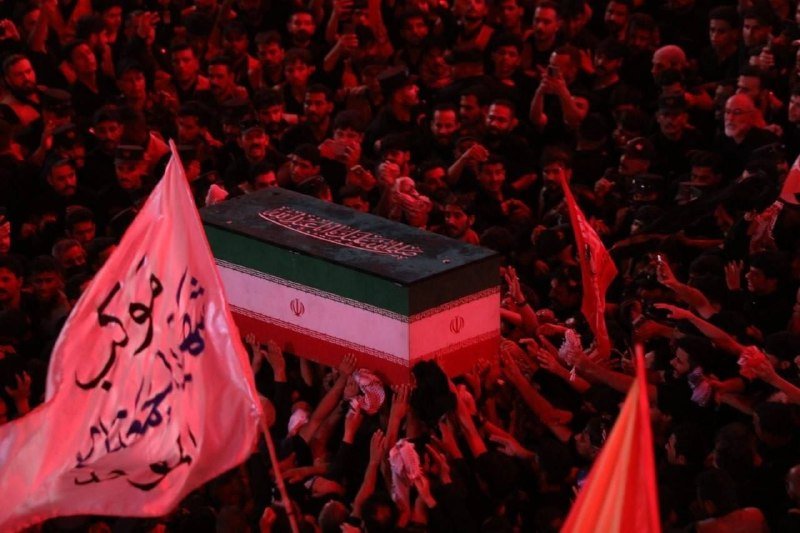
At roughly 18:12 UTC on 7 July 2026, an aircraft said to be carrying the remains of Ayatollah Ali Khamenei departed Tehran for Najaf. Within forty minutes, Iranian state media were broadcasting what they called the plane's arrival at Najaf International Airport, accompanied by footage of Iraqi and Iranian officials on the tarmac. By 18:55 UTC, the same feeds were describing the transfer of a body — described repeatedly in regime-language as the "pure body of the martyred Leader of the Islamic Revolution" — from the aircraft to a receiving party on the Iraqi side.
The story is not what happened at the airport. The story is what the language used to describe it leaves out — and what that omission is designed to do to a domestic Iranian audience already primed for a particular reading of events.
What the feeds actually report
Both PressTV and the Khamenei_en Telegram account — the two sources represented in the available thread — describe the same sequence: a departure from Tehran, a landing at Najaf, a reception by Iraqi officials, and the unloading of remains described as those of the Supreme Leader alongside "the martyrs of his family." Timestamps progress in tight order: 18:12 UTC departure, 18:19 and 18:29 UTC landing reports, 18:43 and 18:51 UTC framing of the airport reception, 18:55 UTC the moment the body is brought down from the aircraft.
The phrasing across both channels is virtually identical, down to the repeated use of "pure body," "martyred Leader," and the explicit date stamp "16/04/2005" attached to one Telegram message — an apparent reference, far from obvious on first read, to the original date of Khamenei's accession to the Supreme Leadership in Iran. This is not breaking news in the conventional sense. It is a curated restaging of a handoff between the Islamic Republic's two most symbolically charged nodes: Tehran and the shrine city of Najaf.
The framing the word "martyr" is doing
The single most consequential word in these dispatches is not Najaf, not Iraq, not Iran. It is "martyr." In mainstream Western coverage of a head-of-state death, the register is neutral: passing, death, funeral. In the language of the Islamic Republic's press, the vocabulary is confessional and political at once — the Leader died not as a patient or an old man, but as a shahid. The frame this constructs is unmistakable: a death understood as sacrifice rather than mortality, a transfer to Najaf — site of Imam Ali's shrine and one of Shia Islam's holiest cities — understood as elevation rather than burial.
That framing is doing concrete political work. Any successor will inherit the office carrying a vocabulary that forecloses criticism of the previous holder; any internal faction will struggle to position itself outside the martyr-narrative during the transition window. The Najaf transfer is not incidental to that narrative. It is its current centre of gravity.
Reading the silence
What the feeds do not say is, by long-standing convention of such reporting, where the actual news is. They do not specify the cause of death, the date of death, the medical circumstances, or the membership of the accompanying "martyrs of his family." They do not name the Iraqi officials shown greeting the aircraft. They do not specify whether Najaf is the final destination or a transit point — Najaf is the home of the shrine, but burial there has historical and sectarian weight in Iranian political theology, and the choice of Najaf against, for instance, Mashhad or Qom carries explicit signal.
In coverage of this kind, the silence is the script. State media in tightly managed systems reveal what selectively, and the choice of what to reveal is the editorial line. The Western reader looking for a wire-style lede — who, what, when, where, how — will not find one here. What they will find is a steady accumulation of reverence-coded language around an event whose basic factual scaffolding is being held back.
Stakes the framing does not acknowledge
A Najaf destination imposes an Iraqi-and-Shia-cosmopolitan frame on what has historically been a tightly Iranian-Republican ritual. That matters for succession politics inside Iran, where rival clerical factions will be reading every detail. It matters for Iran's relations with Iraq's Shia political establishment, whose symbolic recognition at Najaf is being conferred in real time on camera. And it matters for the wider regional readership of these feeds, in Lebanon, Bahrain, and the Gulf Shia communities, for whom Najaf is a spiritual capital whose recognition by Tehran confers its own kind of authority.
The honest reading of the thread is that the major political question — what comes next in Tehran — is being prepared in front of viewers who are not being told it is being prepared. The frame being installed is one of continuity, sacrifice, and translocal Shia legitimacy. It is a frame designed to outlast the moment, not to explain it. That is worth naming, plainly, before the footage calcifies into received history.
Monexus framed this piece against Iranian state-primary feeds; major Western wires and Iraqi official sources had not, at the time of writing, been observed in the available input verifying any of the underlying claims. The thread is therefore treated as a propaganda-and-protocol record, not a corroborated news event.
Wire provenance
This editorial synthesis draws on the following public wire/social posts:
- https://t.me/Khamenei_en/1
- https://t.me/Khamenei_en/2
- https://t.me/Khamenei_en/3
- https://t.me/presstv/1
- https://t.me/Khamenei_en/4