The farewell that wasn't quite a state funeral
Crowds filled the streets of Qom on 7 July 2026 for a farewell procession framed by Iranian state channels as a historic, leader-led mourning. The ritual reveals more about who controls the script than about who leads Iran.
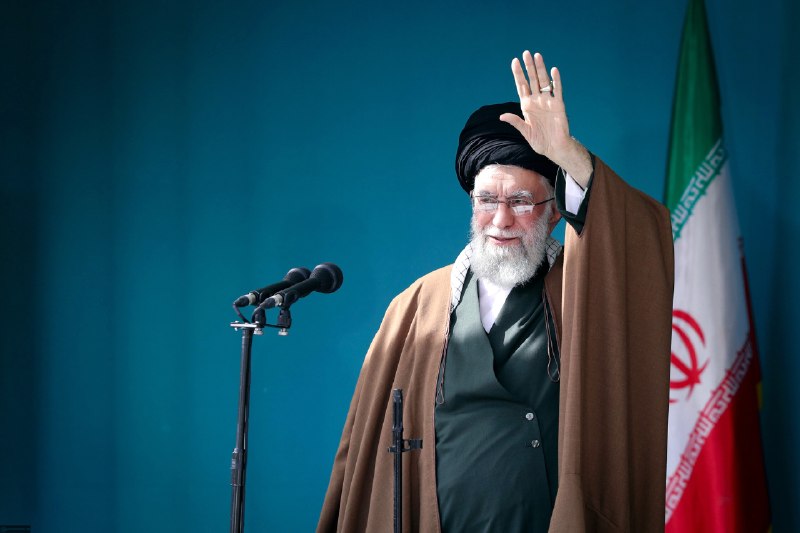
On 7 July 2026, the official Telegram channel of the Khamenei office broadcast live footage of a "pure" procession arriving at the Jamkaran Mosque in Qom — the holy shrine city south of Tehran — for a farewell prayer and funeral rite. The channel's early-morning posts described the body of the "Leader of the Truth-Seekers of the World" and "the martyrs of his family" as being received by an "unending tide" of mourners who had flooded the streets around the mosque. By 04:29 UTC, the same channel was inviting ordinary admirers to record video testimonies under the hashtag #welearnedfromhim, and directing them to a state-built website, wemistrise.ir, to register their names as part of a "historic farewell" the regime says "millions" are attending.
What is unfolding in Qom is less a private moment of grief than a stage-managed exercise in political succession. The language used — "martyr," "Leader of the Truth-Seekers," "soldiers" — borrows the iconography of Shia martyrdom to fuse a single man's biography with the institutional identity of the Islamic Republic. The point of the broadcast is not to inform Iranians of a death; the point is to demonstrate, both to domestic audiences and to foreign observers parsing the signals from Tehran, that the structure around the office of the Supreme Leader remains intact and that grief itself has been collectivised into a form of political consent.
The choreography of the procession
The Telegram posts, timestamped 02:30 UTC and 04:07 UTC on 7 July, frame the day's events as a sequence: arrival of the coffins, the funeral prayer at Jamkaran, and a wider procession that the channel describes in terms usually reserved for military mobilisations. Mourners are referred to as "Martyr Khamenei's soldiers," a phrase that recasts a religious congregation as a paramilitary formation. The framing is deliberate. Shia Islam's reservoir of imagery around Karbala and the Hidden Imam is being used to endow a contemporary political figure with the sanctity normally reserved for figures of sacred history.
The digital choreography is just as deliberate. The same channel that broadcasts the procession also runs a participatory campaign — "record a video, start with 'I learned from him'" — and a state website where users are encouraged to "enter your name" into what is presented as a historic register. The mechanics are reminiscent of the consent-gathering rituals that have accompanied other tightly-scripted moments of succession or affirmation in the Republic's history. The output is not grief as such; it is grief as data, harvested into a brand.
What the language tells us
Three phrases in the channel's short posts do most of the analytical work. "Martyr" sanctifies. "Leader of the Truth-Seekers of the World" universalises, claiming a transnational constituency for a domestic institution. "Soldiers" militarises, blurring the line between citizen, sympathiser, and combatant. Read together, they suggest a system that has decided the only safe register for this transition is maximalist. Half-measures — the dignified restraint that Western state funerals tend to adopt — would, in the eyes of those running the broadcast, leave room for rivals to contest the inheritance.
It is worth noting what is absent. There is, in the official English-language posts, no mention of any institutional process for selecting a successor, no reference to the Assembly of Experts, and no acknowledgment of the rival power centres — the IRGC, the presidency, the office of the judiciary — that any transfer of authority in Tehran will have to navigate. The absence is itself information. The image being projected is one of continuity so seamless that procedure is invisible.
A structural read
Iran's political system has long fused religious authority with state power in a way that makes the death of any senior figure a constitutional as much as a theological event. Theatrical mourning, broadcast on state-aligned channels, performs the function that formal interregnums perform in other systems: it signals to allies, opponents, and the wider world that the institution — not the individual — is the durable actor. The choice of Qom, a city whose identity is built around clerical authority, reinforces the message: this is not a Tehran story, it is a clerical-establishment story.
For outside observers, the operational question is not who the next Supreme Leader will be, but how cleanly the institution can absorb the transition. Theatrical unity in Qom suggests the system believes it can. The structural risk is that the more completely the broadcast forecloses any visible dissent, the harder it becomes for genuine factional disputes to surface without being read as betrayal.
Stakes and uncertainty
What remains genuinely uncertain is the gap between the broadcast and the street. Iranian state media, including English-language channels run from Tehran, have an established habit of selecting footage that flatters the official narrative; the language of "millions" in the channel's own posts is a claim, not a count. Independent verification of turnout, of any incidents at the margins, or of voices inside Iran reading the procession differently, is not available from the materials this publication has reviewed. The sources do not specify which institutions have issued formal condolences, which foreign dignitaries have been invited, or what role, if any, the Assembly of Experts has publicly assumed.
That gap is itself the most important fact for an outside reader. The state is performing a settled succession. Whether the performance reflects reality will become clearer in the days that follow, when the cameras leave Qom and the work of governing — and of contesting — resumes.
This publication has relied on the official Khamenei Telegram channel for the day's footage and on contemporaneous Iranian state media posts for the framing language. Independent confirmation of turnout figures and succession procedure remains outstanding.
Wire provenance
This editorial synthesis draws on the following public wire/social posts:
- https://t.me/Khamenei_en
- https://t.me/Khamenei_en
- https://t.me/Khamenei_en
- https://t.me/Khamenei_en