A funeral, a hashtag, and the framing fight over Khamenei's last day
Iran's official channels are staging the burial of Ayatollah Khamenei as a pilgrimage-in-motion. The harder question is what the choreography is meant to do for an audience far beyond the mosque courtyard.
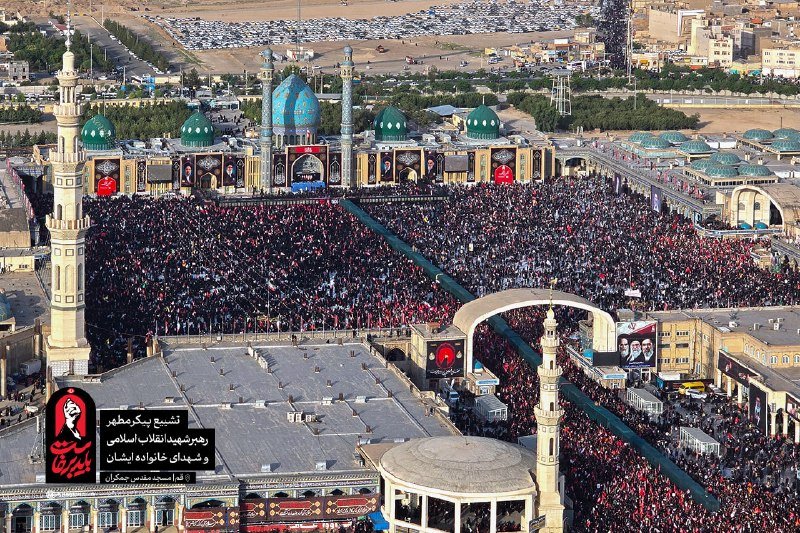
At 02:32 UTC on 7 July 2026, the official English-language account of Iran's Supreme Leader posted its first dispatch from inside the Jamkaran Mosque compound in Qom. Within twenty minutes, the same channel had rolled out a continuous reel: the funeral prayer led by Grand Ayatollah Javadi Amoli, the procession on the shoulders of mourners, the aerial footage credited to KHAMENEI.IR, the tear-streaked close-ups of the faithful. By 04:43 UTC a parallel Persian-language feed was still pushing new arrivals. Between those two timestamps sits a fully produced political ritual — and a real question about who, beyond the mosque walls, it is being made for.
The state-aligned coverage frames the moment in a single register: martyrdom, continuity, ascent. Every Telegram post from the @Khamenei_en channel on 7 July carries the hashtags #WeMustRise and #MartyrKhamenei. The word "martyr" is not incidental. In Iranian revolutionary vocabulary it does work that "dead leader" cannot — it places the deceased inside a theological narrative of sacrifice, and it instructs the audience that mourning is a form of political action. The decision to bury at Jamkaran, the shrine whose fifteen-century association with the Hidden Imam gives it a quasi-messianic weight, intensifies the same message. The choreography is being made to mean something.
The scene as the channel wants it read
What the official feed shows is straightforward: a large crowd, an orderly procession, senior clergy leading the prayer, and an unbroken stream of documentation. The framing is devotional before it is political — the camera lingers on mourners' faces and on the recitation of Surah Al-Fatiha, not on insignia or banners. That choice matters. In a domestic Iranian context, the images function as evidence of legitimacy: a Leader whose body draws the faithful, a clergy united behind the successor arrangement, a population consenting in plain sight. The official narrative is that this consent is spontaneous. The production values — aerial drone work, multilingual distribution, real-time captioning in English — suggest it is anything but.
What the feed is not showing
The same newsrooms that have covered Khamenei's death across the wider Middle East — Al Jazeera English, Reuters, the BBC, Iran International, the Israeli and Gulf press — have spent the past week running on a different set of questions: who succeeds, how the Assembly of Experts resolves it, what happens to the network of allied commands in Iraq, Lebanon, Syria and Yemen, and whether the nuclear file is now reopened in a more permissive or more restrictive direction. None of that work appears in the @Khamenei_en stream. There are no policy clips, no statements from foreign capitals, no briefings from the Atomic Energy Organization of Iran. The official channel is, in effect, running a parallel newsroom: it has chosen martyrdom as its headline and declined to compete on the succession question at all.
A structural reading in plain language
When a state-aligned media operation saturates a moment with devotional imagery and refuses to engage the question of what comes next, the audience it is speaking to is split in two. For Iranians inside the country, the saturation is a stabilising signal — grief performed collectively is grief channelled. For external audiences — diaspora communities, regional adversaries, Western foreign-policy desks — the same saturation performs a different function: it advertises an institution that is, in the regime's own telling, unbroken. The medium is the message in its bluntest form. The decision to publish in English, to label the Leader a "martyr" in that English, and to caption aerial footage for foreign consumption is a deliberate signal to the world that the Islamic Republic considers itself a continuing project, not a closing one.
There is a structural pattern worth naming without theorising. Across the past decade, Iran's external media strategy has consistently used moments of internal vulnerability — sanctions rounds, nuclear deadlock, the Mahsa Amini aftermath, direct strikes — to push imagery of cohesion outward. The funeral coverage sits inside that pattern. The novelty on 7 July is the scale and the speed: an English-language feed of this intensity, dispatched in real time from inside Qom, would not have been technically possible in 2016. The infrastructure for projecting a martyrdom narrative in minutes is itself part of the message.
Stakes and what remains contested
If the choreography works as intended, the immediate effect is to compress the window in which potential rivals inside the system can organise an alternative succession narrative. The harder medium-term test sits elsewhere. The same regional press that is consuming these images is also asking whether a post-Khamenei Iran opens or closes the space for negotiations with Washington, whether the IRGC's regional posture hardens or softens, and whether the nuclear file is now a bargaining chip or an untouchable. None of those questions can be settled by hashtag density. They will be settled, or not, by decisions taken inside rooms the @Khamenei_en camera is pointedly not filming.
What remains genuinely uncertain is whether the framing survives contact with what comes next. A martyrdom narrative is durable when the institution it narrates delivers outcomes; it is fragile when it does not. The coming weeks will show whether the new leadership treats the Jamkaran imagery as a foundation to build on or as a slogan to retire quietly. For now, the only thing that can be said with confidence is that the official channel is choosing, very deliberately, what not to show.
This publication framed the funeral through the channel that produced it, not through the Western-wire lens that dominates the broader succession coverage. The Iranian state feed is treated here as a primary source — its choices of framing are themselves the news.
Wire provenance
This editorial synthesis draws on the following public wire/social posts:
- https://t.me/Khamenei_en/1207
- https://t.me/Khamenei_en/1209
- https://t.me/Khamenei_en/1213
- https://t.me/Khamenei_en/1217
- https://t.me/Khamenei_en/1219
- https://t.me/fr_Khamenei/1488