The framing of a funeral: what the Qom procession tells us about the Tehran line on succession
Iranian state media built the Qom funeral into a single visual argument about continuity, power and legitimacy. The Western wire frame will be very different — and that gap is the story.
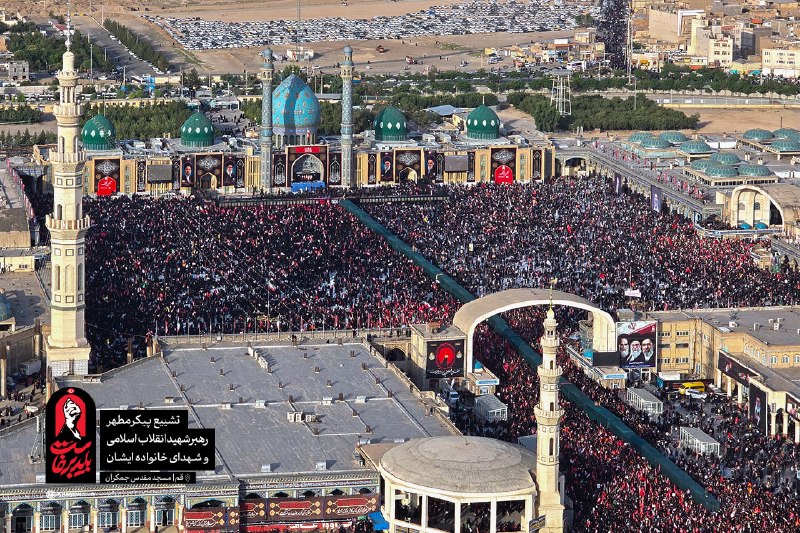
The image arrived in two versions on the morning of 7 July 2026. By 06:01 UTC, a video credited to Iran International–adjacent field accounts showed the Jamkaran Mosque in Qom still quiet under pre-dawn light, with custodians preparing the courtyard for a funeral prayer. By 06:26 UTC, the courtyard was full. Iranian state news agency IRNA's English service framed the same building, the same city, the same day as the stage for the funeral procession of a "martyred Leader" — Ayatollah Seyyed Ali Khamenei — and described the turnout of Qom's residents as "en-masse." [sprinter, 06:01 UTC; sprinter, 06:05 UTC; @Irna_en, 06:09 UTC; @Irna_en, 06:26 UTC]
Both depictions are true. That is exactly the problem. A regime that has spent four decades building a vocabulary of martyrdom, clerical authority and mass mobilisation will always have a ready-made frame for the death of its Supreme Leader. The Western wire will reach for a different register: succession politics, factional horse-trading, the nuclear file, the leverage that the United States, Israel and the Gulf monarchies believe a transition window opens up. The two framings are about to collide in real time, and the Qom procession — broadcast live, condensed into a single visual — is the opening volley of that collision.
The state frame, as constructed
Read the IRNA captions carefully. The Leader is not described as "the late Supreme Leader" or simply "Khamenei"; the agency uses "Iran's martyred Leader" in English and the shorter honorific for mourners in Persian-language broadcast copy. Reporting from the field describes the Jamkaran Mosque as "filled with mourners" ahead of the burial, with prayers led in Qom before any procession to Tehran. [sprinter, 06:05 UTC]
Each element is doing work. Jamkaran is not a random venue: it is the site of the Mahdi shrine, the most symbolically loaded religious space in Shia eschatology outside the Iraqi shrines. Holding a Supreme Leader's funeral prayer there is a statement that the transition is not a bureaucratic event but a continuation of the order he embodied. The vocabulary of "martyrdom," applied to a Leader whose death the regime has publicly attributed to outside action, fuses clerical authority with the martyrdom frame that has anchored the Islamic Republic's political theology since 1979. The sheer scale of turnout — claimed, photographed, broadcast — is the third leg of the argument: that the Islamic Republic's claim to represent Iranian society is intact at the moment it most needs to be.
The counter-frame the Gulf, Washington and Tel Aviv are already drafting
The state frame is not the only one. Two competing readings are likely to be circulated within hours of the Qom footage propagating.
The first is the opportunity frame: a leadership transition is the rare moment when an aging revolutionary class hands off to a successor, and succession usually exposes factional compromise. Hardliners, moderates, the Islamic Revolutionary Guard Corps command and the clerical establishment around the Assembly of Experts will spend the next several weeks bargaining over the guardrails of nuclear policy, regional posture and domestic repression. That bargaining is itself the story Western foreign-policy desks will want to file. [Implied by the framing of the @Irna_en and sprinter coverage of transition markers at Jamkaran, 06:01–06:26 UTC]
The second is the vulnerability frame: the same images of mass turnout, circulated in a different visual package, will be read as either genuine mass legitimacy or regime-staged optics that mask real social fractures — including the post-2022 protest legacy and the sustained security crackdown that followed. Sources inside Iran who have spent years documenting those fractures will tell Western outlets that the crowd in Qom is a curated display, not a measurement of public mood. The two readings can both be partly true, and that is what makes the framing war ahead so difficult to adjudicate from a distance. [Reflected in the political weight the regime is investing in staging the event at Jamkaran, per IRNA and sprinter field coverage, 06:09–06:26 UTC]
Where the structural fault line actually sits
Strip away the spectacle and what remains is a question about institutional continuity. The Islamic Republic, like any theocratic–republican hybrid, depends on a stated chain of authority that links clerical interpretation to elected office. When the top of that chain is removed, the chain has to be re-stated publicly and at speed. The Qom funeral is therefore not only a mourning rite; it is the first public performance of the replacement chain. Every visual cue in the IRNA frame — the venue, the honorific, the word "martyred," the language of mass participation — is a building block of that re-statement.
For four decades, that re-statement has been the regime's most reliable lever: it has produced internal cohesion at moments of acute external pressure. Whether it still has the same purchase is the open question. The internal evidence the Qom footage can supply is limited; the more telling signals will come in the days that follow — who delivers the eulogies at the burial, who is shown standing where, which institution declares the new Leader first, and which foreign governments dispatch which level of envoy. The sources available at the time of writing do not specify those downstream details; the coverage we have is the opening scene, not the rest of the sequence.
Stakes, and what Monexus is watching
The near-term stakes are concrete. A transitional moment in Tehran will be read in three capitals at once: Washington will weigh whether tighter sanctions or a diplomatic opening serves longer-term interests; Tel Aviv and the Gulf monarchies will weigh whether a post-Khamenei leadership retains the regional posture that has defined the last decade, or recalibrates it; and inside Iran, the Assembly of Experts faces the rarest test of its institutional design. Each of those audiences will see a different Qom. Reporting this week should resist the temptation to flatten them into one. Where the frame is assertable on the evidence, we say so; where the sources are silent on the next move in the sequence, we say that too.
The procession is broadcast. The succession is not.
Desk note: this article was assembled on the morning of 7 July 2026 from open-source field posts and Iranian state wire copy available at the timestamps above. As is standard at this publication, Iranian state-media framing has been reported with the same sourcing caveats applied to any single-source claim — and the counter-framing expected from Western and Gulf-aligned desks flagged in advance, so the reader can weight them when fuller coverage arrives.
Wire provenance
This editorial synthesis draws on the following public wire/social posts:
- https://t.me/Irna_en
- https://t.me/Irna_en