The death of Khamenei and the choreography of succession
Iranian state media is broadcasting a coordinated, multi-city farewell for the late Supreme Leader — and the staging itself is the story, because it tells outside powers what the coming succession will and will not look like.
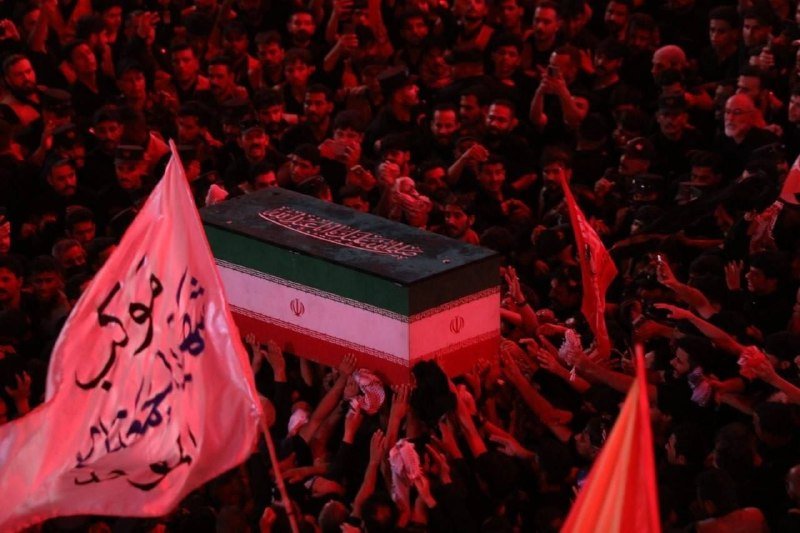
The body of Ayatollah Seyyed Ali Khamenei is being moved in stages through the cities that built his authority, and the cameras are following every metre of the route. State media on 7 July 2026 broadcast a funeral prayer in Tehran led by Ayatollah Javadi Amoli, with the official IRNA feed capturing the senior clergy overcome with emotion as the crowds wept. Press TV ran simultaneous footage of vast processions in Qom, the theological capital, and dispatched a separate unit to Karbala in Iraq, where officials in the shrine city spent the day preparing for an Iraqi funeral sequence. Senior Iraqi cleric Ammar al-Hakim, a long-standing figure in the post-Sistani Shia political landscape, framed the Iraqi leg as a demonstration of "solidarity between two nations" — language that places the mourning inside a transnational religious constituency rather than inside the borders of Iran alone. The choreography is unusually elaborate. It is also the only public information anyone has about the shape of the succession.
This publication reads the multi-city, multi-country funeral not as colour footage but as a text. Funerals of Supreme Leaders in the Islamic Republic are not wakes; they are signalling exercises. The choice of which clerics lead prayers, which cities host processions, which foreign leaders are invited, and which foot-soldiers are given airtime sets the boundaries of the post-Khamenei order before any new name is announced. The fact that the Iranian state is confident enough to route the cortège through Qom — the clerical establishment's home turf — and onward to Karbala is itself a statement of continuity, of the regional architecture that the late Leader spent four decades building.
A stage-managed claim of continuity
Continuity is the message the regime most needs to project. Khamenei's death creates, for the first time since 1989, a vacancy in the office of Supreme Leader, and the constitution's procedure for filling it — selection by the Assembly of Experts, with vetting by the Guardian Council — has never been tested with a sitting Leader already in the grave. Iranian state media's instinct, visible in the 7 July coverage, is to compress that uncertainty into a liturgy of grief that suppresses the mechanical questions. Press TV's Booker Ngesa segment, in which the late Leader is described as "a voice for the voiceless across the world," is the affective accompaniment to that compression. It is the kind of language that flatters the Global South audiences Iran has spent two decades courting, and it doubles as a message to the Revolutionary Guard, the clerical establishment, and the regional allied movements: the framing of the late Leader's legacy is settled, and dissent from it will be received as dissent from the system.
The Qom footage, with the IRNA feed showing dense crowds, is the second pillar of that claim. Qom is the institutional home of the marja'iyya, the senior Shia religious authority that legitimates Supreme Leaders in the first place. Filling Qom's streets is the visual equivalent of securing a fatwa. The two pillars — clerical legitimacy and transnational reach — are exactly the two assets a successor would need an unchallenged handover of, and the state is broadcasting both in real time.
The Iraqi leg and the regional order
The decision to extend the funeral into Iraq is the part of the choreography that travels furthest beyond Tehran's borders. Karbala, home to the shrine of Imam Hussein, is one of the holiest sites in Shia Islam and sits inside a state that has spent the last two decades being drawn, war by war, into a tighter embrace with the Iranian-led regional order. Ammar al-Hakim's framing of the Iraqi funeral as a showing of "solidarity between two nations" is, in that context, a diplomatic as well as a religious statement. It is the Iraqi religious-political class, not the Iraqi state apparatus, putting itself on camera as a mourner. That is significant because the Hakim family's movements have signalled Iraqi Shia political positioning for the better part of a generation.
The regional order Khamenei leaves behind is not a symmetrical alliance but a network of state and non-state actors who share an ideological vocabulary and, in some cases, a command structure. The funeral's Iraqi leg is a public reminder that the network exists, that its nodes in Karbala and Najaf are willing to be seen performing solidarity, and that any successor will inherit that network — or inherit the fight to keep it. For outside powers, the read-through is direct: the succession will not be a Tehran-only event, and the regional posture the late Leader spent decades constructing is being held out as non-negotiable.
What the staging is hiding
The choreography also tells the public what is not yet ready to be said. No successor's name appears in the 7 July coverage, no Assembly of Experts vote has been broadcast, and the senior clerics who lead the prayers are precisely those whose authority is needed to ratify whatever the Guard and the office of the Supreme Leader have already agreed. The choice to foreground grief rather than procedure is itself the second-order signal: a contested succession would not look like this. Coverage that defers to a single emotional register — the late Leader as martyr, as voice of the voiceless, as figure of transnational solidarity — is coverage that has been routed through a single editorial chain. For outside readers trying to read the post-Khamenei landscape, that uniformity is information.
There is also a counter-narrative that the Western wire services have not yet been able to test, because access to Iran for foreign press remains restricted. The Iranian street is large, and the crowds shown in Qom and Tehran are real, but the relationship between a choreographed funeral crowd and a public mood that the regime can rely on once the cortège has moved on is not something the state media can demonstrate. The honest reading of the 7 July coverage is that the regime's message is being delivered with discipline, not that the message has been tested against the public it claims to address.
The stakes for the next ten weeks
A Supreme Leader's funeral in Iran has historically been a one-to-two-week process before a successor is named. The 7 July footage suggests the regime wants the mourning period, rather than the deliberation, to set the tone. That choice compresses the political space in which rival factions — clerical, Guard, technocratic, reformist — might otherwise bargain. It also signals to the regional allies: do not anticipate a strategic pause. The Iraqi leg, the Qom leg, the coordinated clerical language, and the Global-South framing of the late Leader's legacy are designed to make any post-succession adjustment read as continuity, not as renegotiation.
The risk of that compression is that any disruption — a contested factional objection, a security incident, an international strike against a regional proxy — will look, by contrast, like a rupture from a system that has just publicly promised there would be none. The next ten weeks will show whether the choreography is a description of how power actually moves in post-Khamenei Iran, or a description of how the regime wishes it did.
This article framed the funeral procession as the primary documentary evidence because state-media choreography is the only public source currently available; Western-wire access to Iran remains restricted, and the regime has chosen grief over procedure as the lead register. The structural reading is editorial, not academic — Monexus's position is that the staging itself is the news, until the succession names a counter-evidence.
Wire provenance
This editorial synthesis draws on the following public wire/social posts:
- https://t.me/Irna_en
- https://t.me/presstv
- https://t.me/presstv
- https://t.me/presstv
- https://t.me/presstv