Macron in Damascus: Why France Is Talking to al-Sharaa Now
An explosion near the Four Seasons Hotel failed to derail the first French presidential visit to Damascus in over a decade. The bigger story is what Paris thinks it can extract from a government it once disowned.
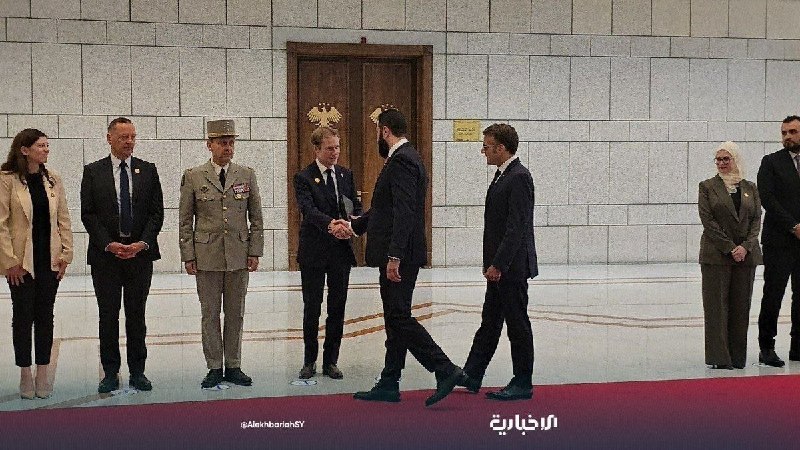
Two explosions ripped through central Damascus at roughly 07:00 UTC on 7 July 2026, near the Four Seasons Hotel where French President Emmanuel Macron is staying during the first French presidential visit to the Syrian capital in more than a decade. Reuters reported the blasts originated from explosive devices, according to initial accounts relayed by the Open Source Intel channel. The Élysée said Macron did not hear the detonations while in transit to meet Syrian President Ahmad al-Sharaa at the People's Palace. Both leaders were confirmed safe by 08:08 UTC, with the meeting proceeding as scheduled.
The security scare is the headline. The diplomatic shift behind it deserves more scrutiny. France is now treating a government led by a former al-Qaeda affiliate as a counterpart worth a presidential visit, and doing so without an obvious security concession in return. That is the story.
The context Paris is working with
Al-Sharaa's administration emerged from the HTS-led offensive that toppled Bashar al-Assad in late 2024. Western governments spent the following eighteen months debating whether to normalise relations at all, given HTS's origins and the unresolved question of how much authority the new authorities actually exercise over former combatant networks. France was among the slower European states to engage. Macron's decision to fly in personally, rather than send a foreign minister, is the clearest signal yet that Paris has decided the engagement question in the affirmative.
The Élysée's public framing emphasises counter-terrorism cooperation, the fate of detained Europeans in Syrian custody, and the management of returning fighters. French officials have been careful to note that the visit does not constitute formal recognition of the new Syrian state, which still operates under transitional arrangements. That legal hedging matters less than the political signal: a head of state on the ground, photographed alongside his counterpart, with the press pool present.
Why the explosions don't change the calculus
Damascus has been a soft target for years, and the security architecture around a visiting head of state would have been calibrated accordingly. The detonations near the hotel — whether attack, warning, or staged theatre — were always going to be read as a message. The message depends on the sender. If it was an ISIS-aligned cell, it confirms the case for Western counter-terrorism cooperation with Damascus and vindicates Macron's trip. If it was a faction inside Syria uncomfortable with the Paris-Damascus opening, it tells us the opening is already producing friction. If it was a third party entirely, it is a reminder that the Syrian state's writ is partial.
The Élysée's decision to confirm Macron's safety and proceed with the meeting — rather than evacuate, curtail, or denounce — signals which reading Paris prefers. The trip continues.
What France actually wants
The strategic question is what Paris thinks it can extract. Three plausible asks dominate:
First, intelligence cooperation on jihadist networks operating from Syrian territory, particularly the cells that have historically threatened French soil. France has been attacked on its own territory by attackers with Syrian battlefield experience; the counter-terrorism file is the most politically defensible justification for the visit.
Second, leverage on the question of European citizens held in Syrian detention facilities, including the foreign fighter cohort and their associated families. Macron has a domestic political incentive to bring detainees home or at minimum to know exactly where they are.
Third, positioning inside the wider European scramble for influence in a post-Assad Syria. The United States has moved cautiously; Gulf states have moved quickly; Turkey has long-standing entanglements with Syrian armed groups; Russia is working through residual relationships. France's claim to be the EU's lead interlocutor in Damascus rests on this visit landing successfully.
The structural read
The pattern is familiar: a Western capital engages a government it once disowned once that government demonstrates enough internal consolidation to be a useful interlocutor and enough fragility to remain dependent on external legitimisation. The trade is recognition, aid access, and political cover in exchange for counter-terrorism cooperation, migration management, and quiet cooperation on the residue of the old order — including, for France, the question of what to do with the Syrian chemical weapons file and the missing-detainee file that has hung over bilateral relations since the early 2010s.
The longer-term question is whether al-Sharaa's administration can deliver on whatever it promises in this kind of negotiation. Governments that inherit a state hollowed out by fourteen years of war tend to struggle with implementation. The detonations near the hotel this morning, whatever their authorship, are an early reminder that the gap between Damascus's formal authority and its operational reach remains wide.
Stakes
If the opening holds, France gains a privileged channel into Syrian security files and a seat at whatever political settlement eventually consolidates the country. The EU collectively gains a testing ground for how to engage post-jihadist administrations without either legitimising them wholesale or leaving them to drift back into the orbit of external patrons less interested in European preferences.
If it does not hold, the visit becomes a security embarrassment and a precedent for engaging governments on the basis of paper commitments that cannot be enforced. The French public, which has absorbed the cost of previous Syrian policy failures, will be unforgiving if the trip produces nothing tangible.
The honest assessment is that the sources available at this hour do not yet tell us which way this goes. Reuters has confirmed the explosions; the Élysée has confirmed the meeting; the Syrian presidency has confirmed al-Sharaa's participation. What the meeting actually produced — communiqués, agreements, prisoner lists, intelligence protocols — will take days to surface, if it surfaces at all. Today's photographs tell us France has decided to talk. They do not yet tell us what Paris expects to hear back.
Desk note: Monexus frames the visit as a deliberate French strategic choice rather than a crisis-response gesture, given that the Élysée proceeded with the meeting after the detonations and that al-Sharaa's transitional government remains an active diplomatic interlocutor across Europe.
Wire provenance
This editorial synthesis draws on the following public wire/social posts:
- https://t.me/s/osintlive
- https://t.me/s/ClashReport
- https://t.me/s/BellumActaNews
- https://t.me/s/ClashReport
- https://t.me/s/ClashReport