Macron in Damascus: A visit interrupted, and what it tells us about Syria's new opening
Three people died in two explosions near President Macron's Damascus hotel on 7 July 2026. The French leader had already left for the presidential palace. The attack is a reminder of how fragile Syria's post-Assad opening remains.
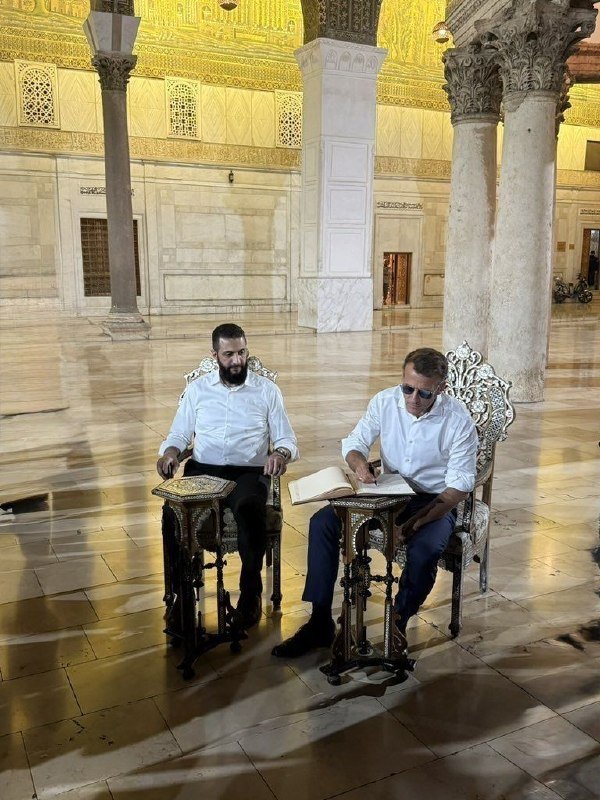
Three people were killed in Damascus on 7 July 2026 when two bombs — one of them apparently a car-borne device — detonated in trash receptacles near the hotel where French President Emmanuel Macron was staying, according to the Saudi-owned outlet Al Hadath, whose reporting was carried by the Open Source Intel Telegram channel at 08:24 UTC. Macron was not in the building at the time. The Élysée Palace said the president did not hear the blasts and had already departed for a meeting with his Syrian counterpart, Ahmad al-Sharaa, at the presidential palace. Al Hadath added that Macron had left the hotel roughly fifteen minutes before the explosion. Footage circulated by OSINT researchers on X shows a damaged vehicle and debris in a street identified as being near the hotel.
The attack is the most jarring single moment of a visit that, on paper, was designed to ratify something historic: the first meeting in Damascus between a French president and a Syrian head of state since the country began its slow, contested re-entry into the regional diplomatic mainstream. It is also a reminder that the diplomatic opening around Syria under al-Sharaa's transitional government remains a target-rich environment for those who want it closed.
A visit, then a blast
The choreography of 7 July was meant to do work of its own. A presidential visit to a capital that, only a few years ago, was a pariah destination for most Western governments is a signal — to investors, to refugees weighing return, to regional chanceries, and to the factions inside Syria who have spent the past year testing whether the new order is real. That Macron was in Damascus at all is the headline. That he was not harmed is the second headline. The third — that three Syrians died in an attack apparently timed to his presence — is the one that will define the political fallout.
Al Hadath, a Saudi-owned Arabic news channel, was the original on-the-ground source for both the casualty figure and the timing of Macron's departure. The Élysée's confirmation arrived through the same wire of reporting carried by Open Source Intel at 08:24 UTC. Independent verification of the casualty count from Western wire services was not in the immediate reporting window; the figure of three killed should be treated as preliminary until corroborated.
Who has an interest in spoiling the opening
The Damascus meeting sits inside a longer pattern of normalisation moves around al-Sharaa's transitional government. France, like several European Union member states, has spent the past months reopening lines of communication and signalling conditional engagement — tied, in Paris's case, to migration cooperation and to what French officials describe as an "inclusive" transition. That conditionality is itself the point of friction. Inside Syria, the political space is contested by former opposition factions now folded into the security architecture, by communities that remain sceptical of the new order, and by remnants of the old regime whose networks have not all dissolved.
A bomb near a visiting head of state does not require a state sponsor to be politically legible. It is legible enough as a message: the diplomatic opening is contested, and the cost of attending it will be paid in Syrian lives, not in the lives of the dignitaries who fly in for the photo. That is the read that European chancelleries will take from the morning's footage. It is also the read that Damascus will want to discourage.
What the opening actually requires
The deeper question is whether the new Syrian authorities can deliver the basic condition that any European re-engagement presupposes: a credible security environment in the capital itself. The attack happened in central Damascus, in daylight, near a hotel used for a presidential visit. The device description — one of the explosions reportedly a car bomb — points to either an improvised operation with significant pre-surveillance or a failure of perimeter security on a day when every detail should have been locked down. Neither reading is flattering.
For France, the political calculation will now run in two directions. On one side, the attack is a reason to deepen intelligence and security cooperation with Damascus, to demand visible counter-terrorism performance from the transitional authorities, and to harden the conditions attached to any further normalisation. On the other, it is a reason to ask whether the pace of re-engagement has outrun the security ground truth, and whether European leaders should be in Damascus at all until that ground truth improves.
Stakes, and what remains unknown
If the trajectory continues — more visits, more bilateral meetings, more conditional re-engagement — Syria under al-Sharaa becomes a working diplomatic partner rather than a frozen conflict file, with concrete consequences for refugee returns, EU reconstruction funding, and the regional counter-terrorism architecture. If the trajectory stalls, the transitional government's most important external constituency will read the pause as a verdict, and the factions that prefer the country to remain ungovernable will conclude that violence still pays.
Several things remain genuinely unsettled in the morning's reporting. The casualty count originates with a single Arabic-language outlet. The attribution question is wide open: no group has claimed responsibility in the material available, and it would be irresponsible to speculate beyond the facts in hand. The exact nature of the second device is described as one of the blasts appearing to be a car explosion in on-the-ground footage, which is consistent with but not identical to the trash-can framing of the initial reports. And the political context of al-Sharaa's meeting with Macron — its substance, its deliverables, its place in the longer French Syria file — has not yet been reported in any detail. Those gaps will fill in over the coming days. What is already clear is that Syria's new opening has just had its first real test, and the test happened in the street outside the hotel, not inside the meeting room.
Wire provenance
This editorial synthesis draws on the following public wire/social posts:
- https://t.me/s/osintlive
- https://t.me/s/osintlive
- https://twitter.com/Osint613/status/2074402759823052837/video/1