The Mourners of Qom and the Politics of a Televised Funeral
Massive crowds filled the road between Jamkaran Mosque and the shrine of Lady Masoumah on 7 July 2026 to bury Ayatollah Khamenei. The pageantry is the politics.
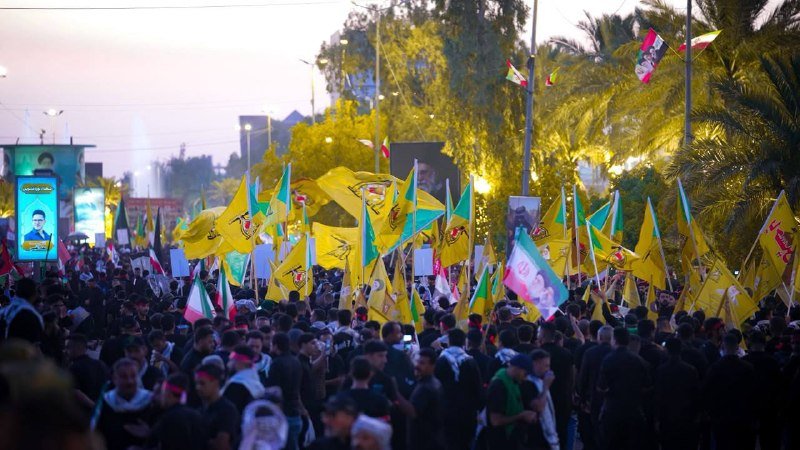
In the pre-dawn dark of 7 July 2026, the road between Jamkaran Mosque and the shrine of Lady Masoumah in Qom became a moving wall of black cloth and raised hands. State media broadcast aerial footage of a funeral procession so dense that, as one Telegram feed put it, "wherever you stood in Qom, you could find yourself joined to the rows of mourners." The body of Ayatollah Ali Khamenei, Iran's Supreme Leader since 1989, was carried on the shoulders of the crowd alongside family members described in official channels as martyred with him. By 03:00 UTC the procession was already underway; by 04:31 UTC PressTV was reporting that the streets of Qom were filled; by 05:17 UTC the official Khamenei_en channel was releasing aerial footage of the funeral prayer at Jamkaran itself. The pageantry is not background. In the Islamic Republic, the choreography of mourning is the choreography of succession.
What is unfolding in Qom is the most consequential political theatre in the Middle East since the January 2020 killing of Quds Force commander Qasem Soleimani, and it is being staged in real time on Telegram, state television, and the official Khamenei.ir network simultaneously. The crowds are real. They are also being framed, cropped, narrated and rebroadcast with the explicit purpose of demonstrating institutional continuity at the moment an institution is most exposed.
The funeral as constitutional moment
Iran does not hold a competitive presidential transition when its Supreme Leader dies. Under the 1989 constitutional framework, the Assembly of Experts — an 88-member body of senior clerics — is responsible for selecting a successor, and it has historically acted with speed and cohesion after the death of a sitting Leader. The visible orderliness of the Qom procession therefore serves a domestic audience as proof that the transition is not in doubt: the system is mourning, but the system is also working. PressTV's running caption — "#MartyrKhamenei," repeated across at least four updates between 04:31 and 05:17 UTC — is doing the same work that party coverage of a leadership congress does in a one-party state. It names, it mourns, it signals.
The framing matters because the framing is the policy. If the Assembly's deliberations were to be read as contested, regional markets and security planners would price that in within hours. The visual argument being made from Qom is that they should not.
The "martyr" frame and what it does
The repetition of the word "martyr" across official channels — applied not only to Khamenei himself but to family members killed alongside him — is itself an editorial choice with consequences. It situates the Leader's death inside a long Iranian narrative of legitimate resistance and external persecution. That narrative is the same one the Islamic Republic has used to justify its regional posture for decades, from the Soleimani file to the proxy architecture in Lebanon, Iraq, Yemen and Syria. Funerals framed as martyrdom are not just religious rites; they are policy continuity documents, signed in front of the cameras.
For outside observers, including Western wire services that will eventually lead the English-language coverage, this means treating the funeral footage as evidence of two distinct things at once: the genuine, demonstrable scale of public grief in Qom, and a state-managed signal about the trajectory of the transition. Both are true. Reporting that flattens the second into the first misreads the moment.
Who is not in the frame
The same official feeds that document every dense frame of the Jamkaran road do not, in the materials available to this publication, name the successor or surface any visible internal debate from the Assembly of Experts. That silence is informative. Iran's regional adversaries — Israel, Saudi Arabia, the United States — will be watching for the first public signal of factional positioning. So will the domestic constituencies that the Islamic Republic has spent four decades managing through a mixture of coercion, patronage and ideological mobilisation: the bazaar, the seminaries of Qom itself, the Sepah officer corps, the families of the dead in Syria and Lebanon.
The decision to flood the zone with aerial footage and tightly captioned bulletins before any successor is announced is a deliberate choice to occupy the visual field first and argue the politics second.
The stakes, narrowly drawn
If the transition resolves cleanly and quickly, the funeral footage will be retrospectively read as the system working as designed, and oil markets, the Iranian rial, and the regional balance of risk will settle into a familiar groove. If the visible unity in Qom is a cover for a slower, more contested succession, the same footage will look, in hindsight, like the last moment the Republic appeared whole. Both readings are consistent with the footage being real. The Qom crowds are not telling us which one we are in — only that the question is now open.
This article focuses on the framing and choreography of the Qom funeral as documented in official Iranian state channels on 7 July 2026. Coverage of the Assembly of Experts process, regional reactions and successor dynamics will be treated in separate pieces as primary-source material becomes available.
Wire provenance
This editorial synthesis draws on the following public wire/social posts:
- https://t.me/Khamenei_en
- https://t.me/presstv
- https://t.me/presstv
- https://t.me/Khamenei_en