Najaf funeral procession lays bare the regional choreography around a slain Iraqi cleric
The transfer of a martyred cleric's body through Najaf on 7 July, broadcast by Iranian state outlets, underscores how sacred geography is being staged for a regional audience.
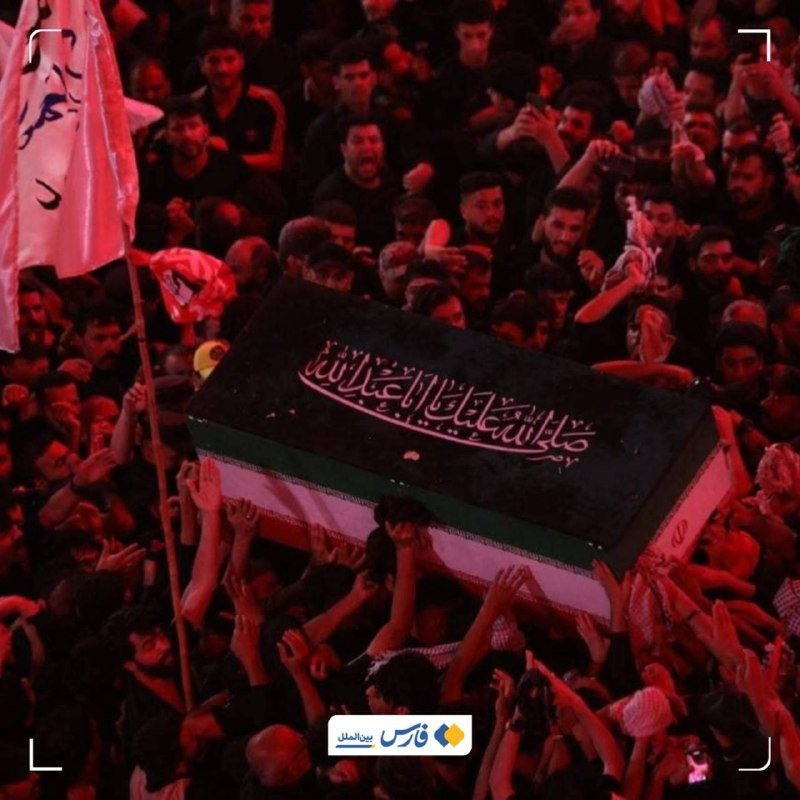
The body arrived at Najaf airport on the afternoon of 7 July 2026, transferred under guard, greeted by an Iraqi parade unit, and then carried in procession toward the shrine of Imam Ali, where pilgrims clutching printed images of the dead cleric lined the courtyard. Iranian state outlets Tasnim and Fars broadcast each stage with a coordinated visual grammar: the cargo plane on the tarmac, the honour guard, the slow movement of the coffin toward the shrine, the crowds pressed against the marble. By 18:22 UTC the aircraft had touched down; by 19:33 UTC Iraqi officials had formally paid their respects.
What the footage documents is not merely a funeral. It is a piece of regional choreography, staged in one of Shi'a Islam's holiest cities and amplified through channels headquartered in Tehran. The cleric referred to in the Tasnim framing as Imam Shahid — and tagged in the broadcaster's social-media push with the campaign hashtag #Badarqa_Aghai_Shahid_Iran#must_rise — is being elevated, in real time, from a casualty into a symbol. The location is the message: Najaf, not Karbala or Kadhimiya, despite the body reportedly having transited through Iraqi airspace from Iran. The visual grammar is the message too. Iraqi honour guards and civilian pilgrims appear alongside Iranian state-media cameras, in a tableau that asserts a cross-border religious and political community at a moment of acute strain.
Reading the procession
The choice of Najaf is not incidental. The city is the seat of the Hawza, the grand seminary whose senior marja'iyya sets the doctrinal tone for millions of Shi'a across Iraq, Iran, Lebanon, the Gulf, and South Asia. A funeral there confers legitimacy that a ceremony in Tehran alone cannot. Iranian state media understood the assignment: Tasnim framed the transfer as a "lasting frame" of the cleric's lovers at the airport, then moved to the shrine of Amirul Momineen (AS) — the formal Arabic designation of Imam Ali — where pilgrims held the martyr's portrait during what Tasnim described as the lead-up to a funeral beginning at 18:00 local time. Fars, the other Iranian state outlet in the broadcast chain, foregrounded Iraqi official participation rather than Iranian clerical presence, allowing the Iraqi state to carry the visible face of the rite while Iranian cameras carried it to a transnational audience.
The choreography therefore does two things at once. For an Iraqi domestic audience, it positions the Iraqi security forces and civilian faithful as primary mourners, anchoring a figure of Iranian provenance in Iraqi sacred space. For the transnational Shi'a audience that Iranian outlets reach in Arabic, Farsi, Urdu, and English, it constructs the cleric as a martyr whose killing carries regional meaning, with the #must_rise hashtag supplying the activist wrapper.
Counter-readings
Two readings of the same footage should be aired. The first, from Iranian state-aligned channels, is that an Iraqi cleric of standing was killed, that Iraqi authorities honoured the body, and that the faithful turned out in numbers large enough to fill the courtyard of the shrine. On this telling, the visual evidence is straightforward.
The second reading is structural. Iraqi Shi'a politics has long been a contested arena between Tehran-aligned formations — most prominently the Badr Organisation, historically led by figures close to the Islamic Revolutionary Guard Corps — and figures aligned with the Najaf Hawza's more quietist marja'iyya, most prominently Ayatollah Ali al-Sistani's office. A cleric whose body is repatriated under Iranian media sponsorship, saluted by an "Iraqi parade unit," and channelled through a hashtag designed to circulate on Persian-language social media sits closer to the first pole than the second. The framing of "Imam Shahid" — a title that fuses the Iranian revolutionary vocabulary of martyrdom with an Arabic religious register — is itself a tell.
Neither reading fully cancels the other. Iraqi officials did turn out. The pilgrims did gather. But the camera, the channel, the choreography, and the hashtag are not neutral infrastructure. They are an argument about who gets to mourn whom, and in whose name.
What remains opaque
The source material does not name the cleric, the date or circumstances of his killing, the Iraqi ministry that dispatched the parade unit, or the identity of the pilgrims depicted in the courtyard. Tasnim's hashtags reference "Badarqa Aghai Shahid Iran" — fragments consistent with a figure associated with the Badr Organisation's orbit, but not a definitive identification. Iranian state outlets often use such language for multiple slain figures; the cleric in this procession should not be conflated with other "Imam Shahid" referents in the Iranian press corpus without independent corroboration.
What can be said with confidence is narrower: on 7 July 2026, an unidentified cleric's body was flown into Najaf, greeted by an Iraqi honour guard and civilian mourners, and the resulting procession was broadcast in near-real-time by two Iranian state outlets with hashtags designed for cross-border circulation. The footage is the evidence. The interpretation is contested.
Stakes
The point of looking carefully at a funeral procession is that it is a low-cost, high-visibility form of regional messaging. Martyrdom frames travel cheaply: a hashtag, a portrait, a coffin carried across a courtyard. They cost almost nothing compared with the diplomatic weight they carry. For Tehran, the procession reasserts a transboundary religious constituency at a moment when Iraqi politics has drifted, in many of its measurable indicators, toward Baghdad–Baghdad and Baghdad–Riyadh reconciliation rather than Baghdad–Tehran alignment. For Iraqi actors, participation confers religious legitimacy and security-sector visibility. For regional analysts, the procession is a reminder that the visible choreography of Shi'a sacred space remains contested terrain, and that Iranian state media remains a competent operator within it.
Desk note: Monexus framed this piece around the visible choreography — airport, honour guard, shrine, hashtag — rather than around the cleric's biography, because the source items did not provide a corroborated identification. The contested interpretive lanes (Iranian state framing vs structural reading of Iraqi Shi'a politics) are both aired before the article reaches its structural conclusion.
Wire provenance
This editorial synthesis draws on the following public wire/social posts:
- https://t.me/farsna
- https://t.me/tasnimnews_en
- https://t.me/tasnimnews_en
- https://t.me/tasnimnews_en