Najaf and the choreography of succession: what Iran's funeral machinery tells us about the transition ahead
Iran's state-aligned media has spent 24 hours broadcasting a continent-wide mourning circuit. The choreography is familiar. The political questions behind it are not.
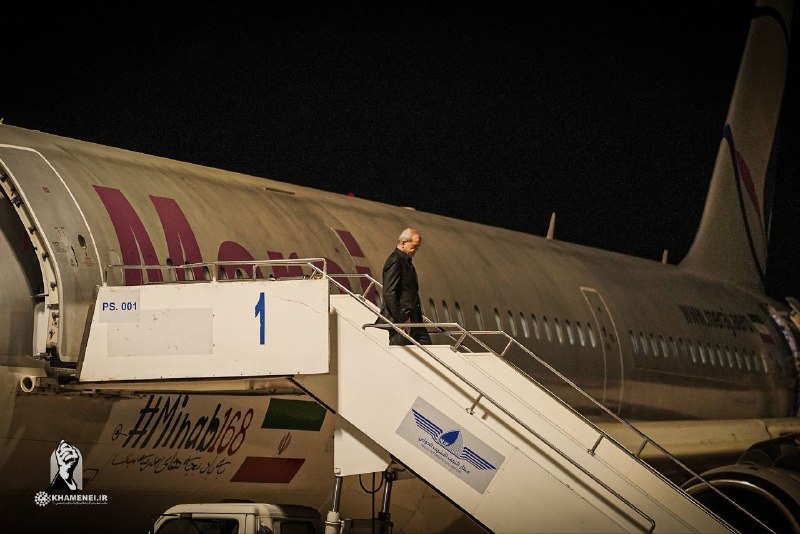
On 7 July 2026, the body of Ayatollah Seyyed Ali Khamenei, Iran's Supreme Leader, landed at Najaf International Airport. Hours earlier, Iranian President Masoud Pezeshkian had arrived in the holy city to attend a funeral ceremony that Iranian state media is framing as a continental moment. PressTV's own reporting describes the choreography in near-evangelical terms: the leader's remains arriving in Najaf, memorial gatherings in Dar es Salaam, a digital flood of commentary from journalists and political analysts treating the death as a hinge event. According to PressTV, "people of Iran have spoken," and the world is meant to hear them through the volume of the broadcast mourning circuit.
Funerals are how the Islamic Republic manufactures legitimacy. They are also how it tests its successor arrangements in public. The Khamenei-era machinery — the coordinated coverage, the foreign dignitaries, the satellite memorial in a Tanzanian city — is being deployed at full intensity. The political questions it is meant to obscure are more interesting than the spectacle.
A state-aligned script, performed at scale
PressTV's coverage on 7 July followed a recognisable template. First, the leader's remains are moved to a Shi'a holy site — Najaf, not Mecca or Karbala, places the regime cannot fully command — to bind the succession narrative to a transnational religious authority. Second, Iranian state outlets publish a curated "global reaction" feed: foreign analysts, opposition sympathisers, diaspora voices, all registering respect. The Tanzanian memorial is the kind of soft image the script demands: Shi'a communities from Mombasa to Zanzibar mobilised inside a frame of dignified mourning, broadcast back to a domestic audience as proof of the Republic's reach. None of this is spontaneous. The reporting that surfaces it is itself part of the production.
The editorial choice to lead these threads with the word "martyred" is not incidental. "Martyrdom" in the Islamic Republic's lexicon is a political designation; it places the leader inside a revolutionary continuity that began with the Iran-Iraq war dead. Reading the PressTV feed at face value tells you what the regime wants the public to feel. Reading it as a sourcing artefact tells you which way the legitimacy wind is blowing.
What the succession is actually about
The Supreme Leader's office in Iran is not a hereditary post. It is filled by the Assembly of Experts, a body of clerics whose deliberations are opaque and whose selections have, in the modern era, never produced a contested outcome in public. The transition ahead is therefore less about personality than about the balance inside three institutions: the clerical establishment around Qom and Mashhad, the Islamic Revolutionary Guard Corps, and the elected-but-subordinate executive. Pezeshkian's presence in Najaf is itself a signal — the president, who won on a moderate-technocrat ticket, performing proximity to the late leader's body is the visible part of an internal bargaining that has presumably been underway for some time.
Two plausible reads of the transition compete in Western and Gulf-based analysis. The first is that the IRGC consolidates: the next Supreme Leader is a clerical figure who owes his position to the security establishment rather than to the Qom seminary network, and Iran's regional posture — Hezbollah, the Houthis, the Iraqi militias — stays essentially intact. The second is that the clerics reassert: a Marashi or a similar Qom-aligned figure restores doctrinal authority over the security state, which then has to justify its budget and its foreign footprint inside a religious vocabulary that constrains rather than enables it. The PressTV coverage is consistent with either. It is not designed to disambiguate.
The Najaf staging ground
Why Najaf, and not Tehran or Mashhad, for the foreign-facing leg of the funeral? The choice is a diplomatic one dressed as a devotional one. Najaf is in Iraq, in a country where Tehran-aligned militias hold political weight but where Iran's room for manoeuvre has narrowed as Baghdad has rebalanced toward the Gulf. Hosting the Supreme Leader's funeral cortege in Najaf allows the Islamic Republic to broadcast an image of unimpeded religious authority across the Arab world while testing, gently, whether Iraqi airspace, Iraqi roads, and Iraqi security forces will perform the choreography Iran requires. Pezeshkian's arrival sequence — described in PressTV's reporting as a deliberate, pre-ceremonial positioning — is the visible part of that test.
There is also a structural read. Iran's legitimacy claim has always rested on a claim to lead the ummah beyond its borders. The Najaf stop is a reminder that the Republic frames itself as a Shi'a power with a universal vocation, not as a nation-state managing a domestic succession. Coverage of the funeral in outlets from Lebanon to Bahrain to Tanzania is, in that sense, not coverage of an Iranian event; it is coverage of an event the Iranian state wants its neighbours to see themselves as belonging to.
What the framing leaves out
The PressTV feed is comprehensive on grief and thin on substance. It does not name the clerics considered front-runners in the succession conversation; it does not describe the institutional mechanics that will choose the next Supreme Leader; it does not address the economic pressures inside Iran that an extended mourning period imposes on a population already managing currency depreciation and sanctions overhang. Western wires have run analysis on these questions — Reuters, the BBC, the Financial Times have all carried succession reporting over the past year — but the official Iranian script is structured to keep the camera on the mourning, not on the bargaining.
What remains genuinely uncertain is the pace. Iranian transitions have historically been slow, deliberate, and announced in ways that suggest the decision was already taken long before the public was told. The choreography now being broadcast from Najaf, Dar es Salaam, and Tehran is therefore best read as a phase of the production rather than as the climax. The climax — the announcement from the Assembly of Experts — will arrive on its own clock, in its own register, and will be covered by PressTV in the same vocabulary it is using now. The reader's job is to notice what that vocabulary leaves out, and to weight the institutional reporting accordingly.
The wire has spent 24 hours describing a martyrdom. Monexus is more interested in the assembly that will pick the next Supreme Leader, and in the security-state balance that assembly will reflect.
Wire provenance
This editorial synthesis draws on the following public wire/social posts:
- https://t.me/presstv
- https://t.me/presstv
- https://t.me/presstv
- https://t.me/presstv