Najaf's reception for Khamenei: a pageant, a power signal, and a problem for Washington's regional arithmetic
Iraq rolls out a state reception in Najaf for the late Iranian Supreme Leader, and the optics — Iraqi mourners, Pezeshkian, the Iraqi PM — say more about the region the two governments want to build than the man being mourned.
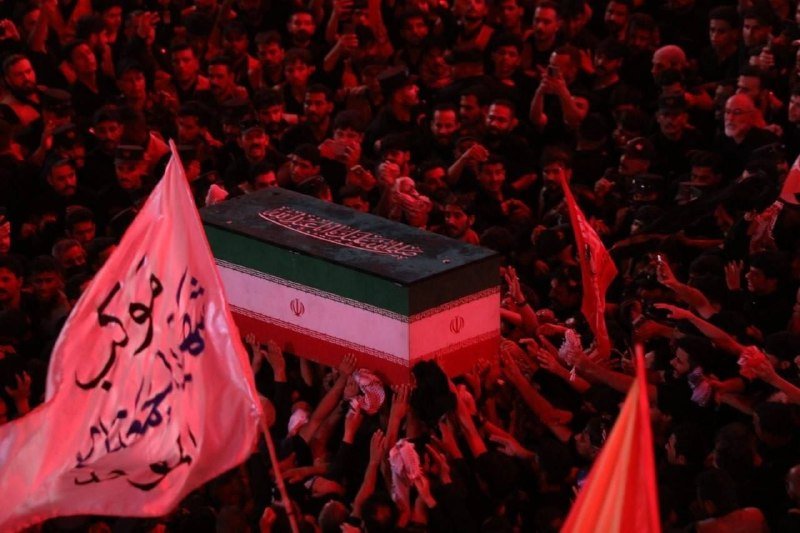
The coffin's first stop was not Tehran. On 7 July 2026, the body of Ayatollah Seyyed Ali Khamenei, the late Leader of the Islamic Revolution, was received at Najaf al-Ashraf International Airport in an official Iraqi ceremony attended by Iranian President Masoud Pezeshkian and Iraqi Prime Minister Ali al-Zaidi, with the Iraqi hosts performing a mourning chant in Arabic as the cortege moved onto Iraqi soil. Footage released by Khamenei.ir and circulated by Press TV showed mourners pressing close to the platform on which the coffin rested; the Iraqi prime minister offered condolences to the late leader's eldest son. Whatever one makes of the pageantry, the choreography is the news: Najaf, not Qom, got the first embrace.
The choice of Najaf as the inaugural foreign stop is a deliberate signal from Baghdad and Tehran about the regional order they are willing to project — one in which Iraqi sovereignty, the Shia clerical establishment of the Hawza, and the Islamic Republic's transnational religious authority sit on the same axis. The reception is also a quiet rebuke to the assumption, common in Western commentary, that Iran's regional reach depends on militias and ballistic missiles. Here is a softer currency: shared shrine, shared grief, shared choreography, broadcast.
What the optics say, in plain language
Three things are visible in the 7 July footage. First, a head-of-state welcome in Najaf, with the Iraqi PM physically present at the airport — a protocol reserved for visiting leaders, not for the foreign dead. Second, a religious register: the Arabic mourning chant performed by Iraqi hosts, and the choice of Najaf, the burial place of Imam Ali and the senior seminary city for Shia scholarship, as the inaugural foreign venue. Third, an Iranian presidential presence, with Pezeshkian standing in for a state that is still organising succession. The cumulative effect is a public statement that the relationship between Baghdad and Tehran is not a transactional alignment of convenience; it is a confessional and political compact, openly staged.
The Western press will read this through the lens of Iranian influence in Iraq — armed factions, political vetoes, pipeline politics. That reading is not wrong, but it is incomplete. Najaf is not a proxy of Tehran; the Hawza has its own institutional weight, its own marja'iyya, and a long history of doctrinal disagreement with the Islamic Republic. By routing the mourning through Najaf first, both governments are also signalling that the religious infrastructure of southern Iraq is a co-author of the moment, not a backdrop.
The counter-narrative Washington will hear
In Washington, the dominant read will be simpler and more brittle: Iraq is in Iran's orbit, and the Najaf ceremony is the latest exhibit. The implication is that Baghdad cannot host a senior Iranian figure without the event being a delivery vehicle for the Islamic Republic. The strongest version of that argument leans on documented Iranian political and security influence inside Iraq — the Shia paramilitary landscape, the long history of cross-border transit, the unresolved file of Iranian-backed factions inside the Popular Mobilisation Forces.
The structural counter is that Najaf has hosted Iranian clerics, Iranian presidents, and Iranian dead for decades, including during periods of acute US-Iranian tension, and that the Iraqi state's decision to give Khamenei a state-style reception is a sovereign act of a government that has spent two decades trying to position itself as something other than a theatre for someone else's war. Iraq's own clerical establishment, its tourism economy around the shrine cities, and its domestic political balance all have a stake in Najaf being read as an Iraqi city first, not an Iranian one. Both readings are factually defensible; the honest version is that they coexist, and that Najaf's role in the ceremony is best understood as a place where they overlap on purpose.
The structural frame: a regional order being staged, not negotiated
What is unfolding is less a negotiation than a staging. The Islamic Republic, mid-succession and mid-sanctions, wants a public image of unbroken regional standing. Iraq's government, balancing a US troop presence, a Saudi-Iranian detente brokered in Beijing in 2023, and a domestic Shia public, wants to be seen as a sovereign host rather than a proxy. Najaf serves both: it is unambiguously Iraqi territory, and it is unambiguously central to the religious identity that the Islamic Republic claims to lead. Choosing it as the first foreign stop folds two audiences into one frame.
The harder question — whether this compact can survive the actual contest over Khamenei's successor — is not answered by a coffin. The Islamic Republic's regional architecture has rested, for three decades, on a single religious-political office and a network of allied or aligned movements. The Najaf ceremony showcases the network at full strength. It does not test it. The test comes later, in the form of the next leader's authority inside Iran, the next Iraqi government's willingness to keep hosting, and the next Saudi-Turkish-American attempt to peel Shia-majority politics away from Tehran without detonating the Iraqi state.
What remains uncertain
The sources document the ceremony in granular detail: the airport arrival, the chant, the mourners around the platform, the condolence call, the bilateral presence of Pezeshkian and al-Zaidi. They do not specify the duration of the Iraqi ceremony, the size of the official Iranian delegation beyond the presidency, the security arrangements in Najaf, or whether the body will be transported onward to Iran or to a burial site inside Iraq. They do not name the late leader's successor, and they do not tell us which Iraqi political factions were represented at the airport. A reader drawing conclusions about the long-term regional consequences of this moment is, fairly, extrapolating beyond the record.
What the record does support is narrower and more durable: on 7 July 2026, Iraq treated the late Iranian Supreme Leader as a state guest, in a religious capital of the Shia world, with the Iranian president at his side, and the footage released by both governments. That is a fact about the order the two states want to be seen presiding over. The order itself will be tested by everything that comes after the funeral cortège.
— Monexus framed this as a story about a regional compact being publicly staged, not as a story about Iranian influence alone. The wire lead will emphasise the Iranian dimension; the Iraqi dimension, and Najaf's institutional weight as a seminary city, carry equal weight in the analysis above.
Wire provenance
This editorial synthesis draws on the following public wire/social posts:
- https://t.me/presstv/164204
- https://t.me/presstv/164203
- https://t.me/presstv/164202
- https://t.me/Khamenei_en/185412
- https://t.me/Khamenei_en/185411