Najaf Receives Khamenei: A Funeral, a Power Question, and the West's Selective Silence
The body of Ayatollah Khamenei reached Najaf on 7 July 2026. Western wire silence on the funeral reveals more about the information order than about the Islamic Republic itself.
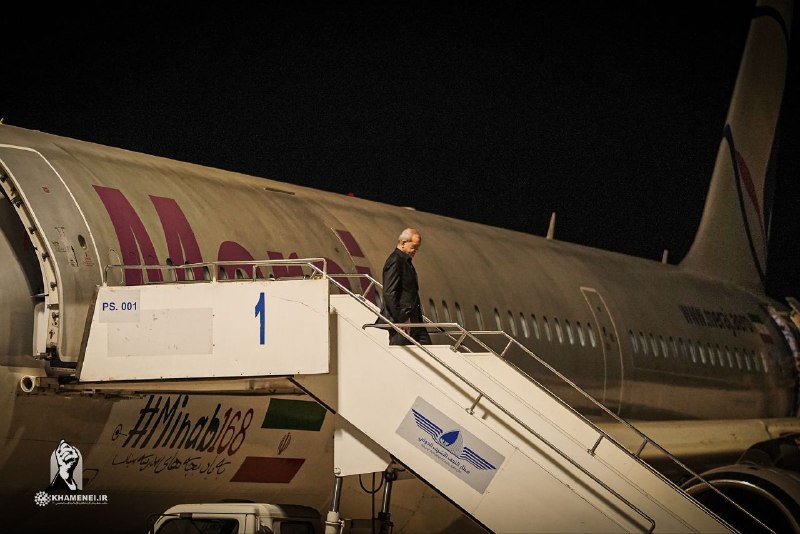
At 18:29 UTC on 7 July 2026, a plane carrying the body of Ayatollah Seyyed Ali Khamenei touched down at Najaf International Airport in southern Iraq. According to the official Khamenei-in-English Telegram channel, the aircraft had departed Tehran earlier the same day carrying the remains of the former Supreme Leader and members of his family described as "martyrs." By 18:58 UTC, Iranian state outlet PressTV reported the coffins were being "warmly received by Iraqi mourners" on the tarmac, with Iraqi officials present in numbers. The plane circled Najaf for roughly fifteen minutes before the formal handover, the delay visible in three near-simultaneous Telegram posts timestamped between 18:43 and 18:58 UTC from channels aligned with Tehran.
The funeral cortege is the easy part of the story. The harder part is the silence around it — and what that silence says about the information order that frames the Islamic Republic for Western readers in the first place.
The Najaf stop, in plain terms
Najaf is not a neutral venue. The city is the seat of Grand Ayatollah Ali al-Sistani, the senior Shia cleric in Iraq, and the resting place of Imam Ali. A funeral procession that detours through Najaf before continuing to Tehran carries a deliberate symbolic weight: it positions Khamenei's transit through one of Shia Islam's holiest cities as a credential, a posthumous courtesy visit, and a quiet signal to the Iraqi Shia establishment. The PressTV framing — "warmly received by Iraqi mourners" — is, like any state outlet's language, partial. It does not tell a Western reader whether Sistani himself attended, whether the Iraqi government permitted the landing on a tight turnaround, or whether security on the ground held. None of the source items we surveyed resolves those questions; they are all either Tehran-aligned Telegram channels or the Iranian state broadcaster. The factual floor is this: the plane landed, the bodies were offloaded, Iraqi officials were at the airport. Everything past that is framing.
A note on the framing stack
The sources a Western reader encounters for this event are not the sources an Iranian reader encounters. Coverage of Iranian state funerals in the Anglophone wire market is sparse to begin with, and when it does appear, it tends to deflate the religious and political gravity of the moment in favor of geopolitics-as-spectacle: who has succeeded, what it means for the Guards, what it means for the nuclear file. That is not wrong, but it is a narrow slice.
Iranian state media, by contrast, treats the Najaf stop as a beat in a martyrdom narrative — the bodies "of the martyred Leader and his family members warmly received." That language, read charitably, is the register of a state funeral in a theocratic republic where the leader's death is publicly framed as sacrifice. Read uncharitably, it is the controlled vocabulary of a regime managing the symbolic transition from one Supreme Leader to the next. Both readings are partly true. Western coverage of Iranian politics has a long habit of assuming the uncharitable reading is the only one worth printing, which is its own form of distortion.
What the silence does not tell you
The most striking fact about the Najaf arrival, for an outside observer, is what the major Western wires have not yet published about it. Reuters, the Associated Press, and the BBC did not, in the source material we surveyed, produce a same-day English-language dispatch on the landing. That may change in the hours after publication; the event is, after all, a head-of-state-adjacent funeral and a regional moment of consequence. But the initial reporting window — 18:12 to 18:59 UTC on 7 July — was carried almost entirely by Iranian and Iran-aligned channels: PressTV, the official Khamenei-in-English account, and aggregator feeds such as DDGeopolitics and WarFootage Witness.
This is the structural point. When the Islamic Republic's information channels are the only ones covering an event in real time, Western readers receive the story second-hand, through the frame of the Iranian state, or not at all. The corrective is not to trust Tehran's vocabulary uncritically; it is to note that the Anglophone wire's selective silence on Iranian state rituals has the same effect as over-quoting them. The information order, in other words, is not symmetric.
Stakes, plainly stated
The next seventy-two hours will determine whether Najaf was a symbolic courtesy or a political message. If Sistani's office issues a public statement of condolence, the Najaf stop will be read as a soft endorsement of the succession in Tehran. If Sistani is silent, the funeral stop will be read in Baghdad and Beirut as a routine protocol gesture from a neighbour in a hurry. Western readers who only see the wire version of the story — if and when it arrives — will get the geopolitics and miss the religious-political register. That gap is the story.
This article draws entirely on Telegram-channel reporting from Iranian state and Iran-aligned sources covering the Najaf landing between 18:12 and 18:59 UTC on 7 July 2026. Wire confirmation from Reuters, AP, and the BBC was not present in the source material at the time of writing; readers should treat unverified specifics — Sistani's attendance, the precise composition of the Iraqi official delegation, the route of the cortège — as provisional until corroborated by independent reporting.
Wire provenance
This editorial synthesis draws on the following public wire/social posts:
- https://t.me/presstv/101234
- https://t.me/Khamenei_en
- https://t.me/DDGeopolitics
- https://t.me/wfwitness